




If They Can Make It Here: NYC Adds Hybrids
The New York City Department of Sanitation collects more than 12,000 tons of residential and institutional refuse and recyclables each da
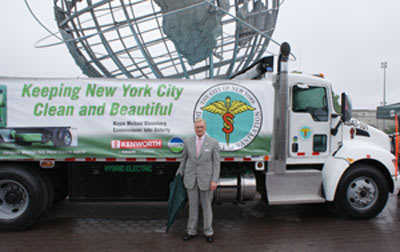
The New York City Department of Sanitation collects more than 12,000 tons of residential and institutional refuse and recyclables each day
. This involves 7,899 uniformed sanitation workers, 2,041 civilian workers and about 5,700 vehicles, including collection trucks, street sweepers and front-end loaders. "Clean is the name of the game," says Rocco DiRico, deputy commissioner of support services for the department.
As a city that is constantly under public scrutiny and burns a lot of diesel fuel, New York strives to be a model of environmental pursuits - especially within its Department of Sanitation, where clean is part of the job description. "That's what we do," DiRico says.
So when the department had the opportunity to evaluate hybrid refuse trucks in its fleet and become the first municipality to use hybrid technology in a rear loader configuration, they jumped at the chance.
Buying hybrids
The city recently added four hybrid trucks, thanks to the help of the Hybrid Truck Users Forum's Refuse Truck Working Group, a program of Calstart. The Hybrid Truck Users Forum's goal is to speed the commercialization of medium- and heavy-duty hybrid and high-efficiency technologies.
Because hybrid truck technology is still in its infancy and has limited production levels, it is expensive - although there are various tax breaks and grants from federal and local sources. If hybrids catch on with the private sector, it will help drive the price down. DiRico says it's the chicken or the egg scenario. "No one wants to be the first," he says. "We thought we'd take the lead and get things going."
The department invested in a hybrid electric Mack TerraPro Low Entry model refuse truck, a Class 8 model with parallel architecture. The city also tapped two Crane Carrier refuse trucks, one installed with Bosch Rexroth's hydrostatic regenerative braking parallel hydraulic hybrid system, and another hybrid electric with series architecture. A fourth vehicle, the Kenworth T370, a 33,000-pound medium-duty truck with Eaton's hybrid system and a parallel architecture, will be used as a rack truck, delivering supplies and parts. The city has purchased four additional Crane Carrier refuse trucks that will arrive by the end of the year, including two hybrid electric and two hybrid hydraulic vehicles.
(A parallel hybrid has multiple propulsion systems that can be operated independently or together. In a series hybrid, both sources of energy go through a single propulsion device.)
With the exception of the Kenworth, all are preproduction prototypes. "These are the latest and greatest," DiRico says.
Testing, testing
Over the next year, the department will be testing each truck, looking at emissions and fuel economy. Also part of the evaluation are how well they operate on the streets collecting refuse, how the drivers like them, and how well they perform in the five boroughs and hold up as the seasons change. The refuse trucks will also be used to plow snow in the winter.
It will be particularly interesting to see how the technology copes with the stop-and-go aspect of refuse collection. In Queens, for example, the trucks will likely be stopping every 50 feet or so, DiRico says. In Manhattan, the cycle is similar to that of a bus, with stops every block. "If one can do it all, that's great. If all three can do it all, it's even better."
The Hybrid Truck Users Forum is working with the department to help with the data collection.
DiRico, who had the chance to test drive a truck, was pleasantly surprised by its braking capabilities. As a result of the regenerative process, he did not have to use the brake pedal as often because the vehicle decelerates on its own, causing less brake wear and reduced brake noise. According to DiRico, these advantages were mentioned by the truck makers but were not front and center. "That was the silent successes of what I saw," he says.
Other efforts
This is not the department's first attempt to make its fleet more environmentally friendly. A few years ago, New York switched to a 5-percent biodiesel blend. It is currently retrofitting all existing diesels with advanced diesel exhaust aftertreatment technology, such as diesel particulate filters. With ethanol fueling stations in every borough, the department also houses 200 to 300 light-duty ethanol-powered vehicles.
The department has also been testing Class 8 compressed natural gas trucks. In the Northeast, however, the CNG vehicles have had issues in terms of weather and range. The problems prompted the department to try hybrids. "Diesel has been good to us performance-wise," DiRico says. "The technology seems to be the best path to reduce fuel consumption."
"We do have other technologies on the horizon," DiRico says, including a CNG-powered hybrid hydraulic collection truck that's in the pipeline.
By this time next year, the department will add three more hybrid vehicles and hopes to have enough information as to what path to pursue. "If these trucks can work here, they can work anywhere," DiRico says.
From the July 2009 issue of Heavy Duty Trucking.
More Fuel Smarts

How Volvo Updated Its D13 for EPA 2027 [Watch]
Volvo’s updated D13 promises lower emissions without sacrificing performance or fuel economy. Take a closer look at what changed inside the engine in this HDT Spotlight video.
Read More →
Diesel Price Spike Shortens Payback for Natural Gas Trucks, Report Says
Energy Vision estimates fleets could recover the higher purchase price of an RNG-fueled Class 8 tractor in 1.3 to 2.8 years under current fuel-price scenarios.
Read More →
Calstart Becomes Catalyst Mobility, Reflecting Broader Focus
Calstart is now Catalyst Mobility, reflecting the nonprofit’s growing national role in clean transportation, including zero-emission trucks, infrastructure and incentive programs.
Read More →

Record Diesel Prices Squeeze Trucking Fleets
Average U.S. diesel prices have climbed to nearly $6 a gallon, surpassing the 2022 record as tight refinery capacity and Middle East disruptions keep fuel costs elevated.
Read More →
How Fuel Delivery Shapes Engine Performance
Fuel delivery depends on more than what happens at the injector. For fleet, maintenance and technical professionals, looking at the full path from pump to injector can provide useful context for understanding engine performance.
Read More →
East Coast Port Launches $45M Electric Truck Push
The Port Authority of New York and New Jersey announced millions in incentives for zero-emission drayage trucks, yard tractors, and new charging hubs near the port.
Read More →
California Bill Could Shed Light on Electric Truck Prices
Why do battery-electric Class 8 trucks remain so expensive? A California bill headed to Gov. Gavin Newsom would give fleets and state agencies more visibility into what manufacturers charge.
Read More →
Detroit Opens Orders for EPA 2027 Engines
Detroit isn’t starting from scratch to meet EPA 2027 diesel emissions standards. Its Gen 6 DD13 and DD15 engines keep much of today’s platform while updating the fuel and aftertreatment systems.
Read More →
Zero-Emission Truck Corridor Planned for West Coast
California, Oregon, Washington, British Columbia and Baja California are coordinating plans for truck charging and hydrogen fueling from Canada to Mexico.
Read More →
A Closer Look at Kenworth’s Electric T880E Vocational Truck [Video]
Learn more about Kenworth's T880E battery-electric vocational truck at the Paccar Technical Center, including its range, applications, upfitting considerations, and PTO options, in this HDT Spotlight video.
Read More →