




Hybrid Yard Jockey Delivers
The terminal tractor - yard jockey, hostler, whatever you call it - has to be one of the most used, abused and under-regarded vehicles in any fleet
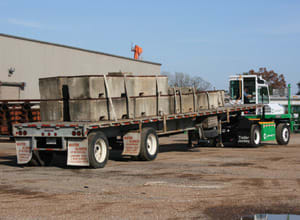
This trailer is loaded to gross 110,000 pounds to replicate the heaviest containers at the docks as they come off the ships. PHETT drives like a conventional yard jockey, but quieter.
The terminal tractor - yard jockey, hostler, whatever you call it - has to be one of the most used, abused and under-regarded vehicles in any fleet.
Yet a green-painted tractor from Capacity of Texas now entering production has one of the most sophisticated hybrid power setups you'll find in any vehicle.
Think about the duty cycle of the yard jockey, and a hybrid powertrain makes enormous sense. It is all low-speed, stop-and-start. There's opportunity to use regenerative braking. Electric traction is perfect because the motor's peak torque is at stall so it can get very heavy containers under way very effectively. And electric power is cheap: An overnight charge of the Capacity PHETT that will run it for up to half a day costs 63 cents.
The Pluggable Hybrid Electric Terminal Tractor is just coming to market after a staggeringly short development period from concept to vehicle in just 10 months. This is in large part due to Capacity chief engineer Colin Roberts, whose General Motors experience has made him the man to ramrod a major project through Capacity's highly nimble engineering, research and development process.
And make no mistake, there was plenty of engineering and research that went into the PHETT. As far as development, they built the first prototype, put it to work in the toughest imaginable environment in the Port of Houston in the pouring rain, and it did everything asked of it without any fuss or failure. As Roberts says, it was a bit of an anticlimax. That alpha truck has more than 600 hours on it, and it's still going strong.
Moreover, the PHETT does it all so quietly.
Anyone who has been around a yard jockey knows they are gear bound. Most of the working day, the B Series Cummins that is the conventional diesel power in a Capacity truck is running against the governor. The hydraulics that lift and lower the fifth wheel are run at full speed to cut cycle times, the throttle is slammed to the floor to get the container or trailer spotted where it is needed as fast as possible. And the Allison automatic transmission that's the norm lets the engine rev freely all the time. The drivers are being paid to move material, and that's what they do, just as fast as they can.
The PHETT delivers the same level of performance - or better - with just the whirr of an electric motor. That is until the batteries become depleted, and that's when the diesel gen-set kicks in - but still only quietly.
Configuration
The Capacity PHETT is a series hybrid. The diesel engine - currently a 40-horsepower Kubota in a Cummins Onan gen-set - doesn't drive the vehicle. The drive is by a Baldor/Reliance AC traction motor, and the power is stored in 52 lead-acid batteries, 26 to a side and in parallel giving a system voltage of 330 volts and, drawing 500 amps and equivalent of 225 horsepower. Lead acid was chosen because of the cost. Lithium ion batteries and a fuel cell would do the job just as well, and if there is a market demand for such a configuration, Roberts will be right there with a hybrid to exploit it. For now, lead-acid is just fine.
The motor drives through a conventional short driveshaft to the Sisu hub-reduction drive axle that is cleverly mounted in the frame so the load imposed on the fifth wheel is carried directly by the drive axle. And these yard jockeys are built for some serious loading; this one is rated to move a 120,000-pound trailer.
The 21kW generator set charges the batteries as the charge on the battery depletes and the voltage drops throughout the day. The gen-set is rated just a little less than the peak demand of the chassis, but given that the driver makes stops for breaks, it is sufficient to carry the jockey at its rated performance through the day.
Additional power for auxiliaries is provided by a second motor mounted on a platform above the gen-set that provides the power for the lifting hydraulics and power steering, for the air conditioning and the air compressor for the full FMVSS121 air-brake system that Capacity insists on spec'ing - whether the yard tractor goes on highway or not.
All this packages neatly in the space vacated by the 200-horsepower Cummins B Series, so nothing much changes in the rest of the chassis or cab. There are a couple of different gauges on the dash, but the rest is unchanged.
The economics
The alpha prototype has over 600 hours on it and the generator set only 300, showing that the PHETT is in battery replenishment mode only half the time the tractor is working. Given that it is a 40-horsepower vs. a 200-horsepower diesel, there are huge savings in fuel, but Phillip Ford, who is president of the Capacity, says they are being conservative in claiming fuel savings of 40-60 percent.
There are also significant maintenance savings. The engine only runs half the time, it is a much smaller displacement and an oil change is one gallon instead of four. And with no Allison transmission, there's none of the service associated with that component. The electric motor is well protected by the slip-jointed driveshaft and is anticipated to have at least a 30-year life. Batteries will need replacing at five to seven years depending on duty cycles, but generally, the hybrid demands a lot less service than a diesel yard jockey.
But it is a lot more expensive. It's hard to put a number on it yet because only a few have been built, but there are plenty of operations where green is king and the initial cost is rarely part of the decision process. Undoubtedly, over the years these pieces of equipment operate, the hybrid will deliver real dollar savings. The point at which it does is very difficult to estimate and very dependent on the type of service the jockey sees.
In the driving seat
Any yard jockey is a snap to drive. Automatic transmission means it's just a case of selecting which direction you want to go and turning the steering wheel. The electric drive is no different. So when it was my turn at the wheel, I just keyed the PHETT on, moved the selector into drive and headed off to the trailer - an old flatbed loaded with enough Jersey barriers that the landing gear had sunk through the blacktop on the yard - 110,000 pounds altogether.
Wedging the tractor under the nose of the trailer, the PHETT picked it up easily. In the lift and lower mode, the auxiliary motor speeds up from its normal 700 rpm to 1900 just during the pumping mode to reduce lift and lower cycle times. Then with the control lever in "forward," squeezing down on the accelerator got the outfit smartly and quietly under way. The only indication of the weight of the trailer was a rise of the front of the tractor as I poured on the coals.
Stopping with the full air brake system was simple enough, and there are two foot pedals to choose from - an idiosyncrasy of the yard jockey industry.
The last thing you expect in a yard jockey is sophistication. But here it is, and it delivers. Initial cost is higher, but companies such as Walmart - where this jockey is headed - take their social responsibilities very seriously and are prepared to pay the higher initial price. The good news is that the hybrid drivetrain is so good at what it does that over time there is a very realistic payback and then a lifetime of savings.
From the February 2010 issue of Heavy Duty Trucking.
More Equipment

How Volvo Updated Its D13 for EPA 2027 [Watch]
Volvo’s updated D13 promises lower emissions without sacrificing performance or fuel economy. Take a closer look at what changed inside the engine in this HDT Spotlight video.
Read More →
Michelin Tire Improves Efficiency and Durability for Regional Fleets
The Michelin X Multi Energy D2 is a regional haul drive tire engineered to help fleets improve fuel efficiency, durability and traction in demanding stop-and-go operations.
Read More →
ZF Expands Commercial Vehicle Push in North America
ZF is expanding its North American commercial-vehicle presence with new transmission applications, electrification, trailer technology and autonomous-driving systems.
Read More →
Tesla Wants a Self-Driving Semi. Are Cameras Enough?
Could Tesla’s camera-only autonomous driving technology work on an 80,000-pound Semi? In this commentary, HDT's Deborah Lockridge takes a look at Tesla, Cybercab, and how autonomous trucks see the road.
Read More →
Kodiak: Driverless Long-Haul Truck Launch on Track for 2026
Kodiak AI says its driverless long-haul safety case is 93% complete and it remains on track to begin commercial operations by year-end 2026.
Read More →
What DOT’s Automated Vehicle Strategy Means for Trucking
The U.S. Department of Transportation issued a new automated-vehicle strategy that outlines plans for driverless-truck regulations, cross-state freight corridors, and federal safety standards.
Read More →
East Coast Port Launches $45M Electric Truck Push
The Port Authority of New York and New Jersey announced millions in incentives for zero-emission drayage trucks, yard tractors, and new charging hubs near the port.
Read More →
PlusAI Going Public to Fund Autonomous Truck Launch
A SPAC deal could provide PlusAI with up to $300 million as it works toward a 2027 commercial launch of factory-built autonomous trucks.
Read More →
NHTSA Moves to Rewrite Truck Fuel-Economy Rules
The National Highway Traffic Safety Administration says it lacks authority to regulate medium- and heavy-duty truck engines separately from complete vehicles, but the existing standards have not yet been eliminated.
Read More →
Detroit Opens Orders for EPA 2027 Engines
Detroit isn’t starting from scratch to meet EPA 2027 diesel emissions standards. Its Gen 6 DD13 and DD15 engines keep much of today’s platform while updating the fuel and aftertreatment systems.
Read More →