




How to Reduce Splash and Spray From Your Trucks
Aerodynamic improvements can do double duty to reduce splash and spray from trucks.

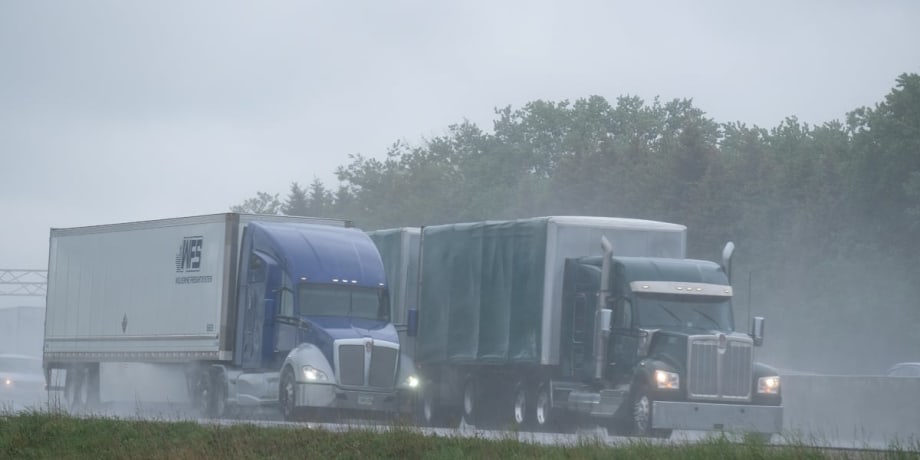
Splash and spray can reduce driver visibility from 1,500 feet on dry road to 300-600 feet in rainy conditions, TMC says.
Photo: Jim Park
Spray from trucks has been irritating motorists since the 1960s.
Congress took up the challenge with the Surface Transportation Assistance Act of 1982, which contained wording requiring improvements to visibility on wet roadways by reducing splash and spray from trucks by “practicable and reliable means.” Despite decades of testing and evaluation of emerging technology, that mandate remains unfulfilled.
That’s not to say there hasn’t been improvements. Enhancements to tractor-trailer aerodynamics have streamlined the airflow around trucks, taming some of the turbulent air that propagates spray around the vehicle. But the root causes of splash and spray remain.
Standing water on highways will be picked up and tossed around by the tires, and every droplet of water flung into space smashes against some solid surface on the truck, exploding into the mist and spray that reduces visibility for nearby motorists.
The American Trucking Associations’ Technology & Maintenance Council published a recommended practices document in 2015 (RP 759) that discusses the causes and impacts of road spray and even maintenance considerations related to corrosion and dirt infiltration. It also identifies road spray hot spots, such as the tractor-trailer gap, mirrors, reefer fuel tanks, fenders, mudflaps, and even the design of the trailer skin. However, the RP doesn’t make specific recommendations for splash and spray suppression short of suggesting fleets look for ways to reduce mist-inducing turbulence.
“Splash and spray, ironically, provides a great visual indicator of the impact of vehicle aerodynamics improvements,” says Daryl Bear, the lead engineer and chief operating officer of Mesilla Valley Transportation’s research division, MVT Solutions. “You can see the spray. All that water is trapped in the swirling air around the truck. Compare the spray patterns on a square-nose non-aero truck to a fully treated truck and the difference is amazing.”
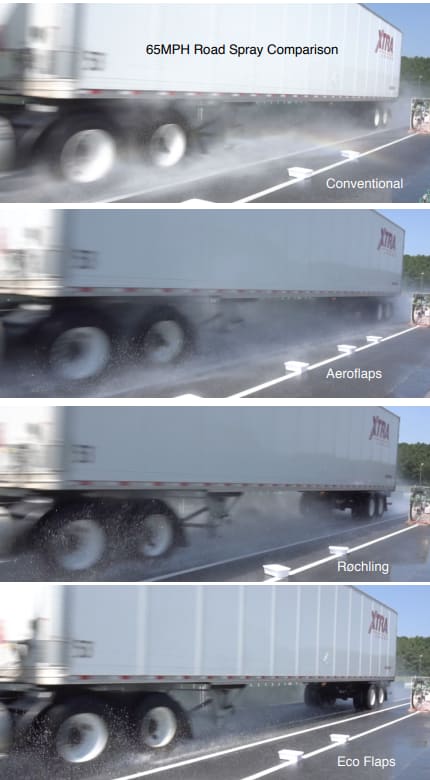
Slotted mudflaps reduce spray from the wheels by allowing water to collect and flow back to the ground rather than smashing the droplets into mist against hard rubber. Shown: Conventional mudflaps (top) versus slotted mudflaps.
Photo: Eco Flaps
Bear has done tests at MVT’s facility in Las Cruces, New Mexico, quantifying the difference. Not surprisingly, trailer side skirts help a lot. Front and rear-end treatments help as well.
“Smoothing out the air flow and reducing turbulence is one thing, but the side treatments keep the spray out from under the truck where all the square surfaces are, like axles, crossmembers and the landing gear,” he says. “And mudflaps appear to matter a great deal, too.”
He found that slotted mudflaps, such as Eco Flaps, allow air to pass through, while trapping water droplets and allowing them to drain back to the pavement — rather than splattering into a finer mist as they would against a hard solid surface.
“We market the Eco Flaps as fuel-saving devices, but they have safety benefits too, through improved visibility both for the truck driver and other motorists,” says Asa Hazelwood, Eco Flaps’ president.
There are other brands available, such as Aeroflap from Fleet Engineers, Michelin’s Energy Guard, and Featherwing SprayBreaker flaps.
Slotted mudflaps are one of many attempts at reducing splash and spray. There are also textured mudflaps that look a bit like AstroTurf. There are broom-like spray suppression skirting from the likes of Fleet Engineers mounted above drive and trailer axles designed to keep water from the wheels from escaping into the slipstream. These and other technologies have some impact on spray, but not all fleets see the value in installing them.
“Trucks need mudflaps,” Hazelwood says. “They will see a [return on investment] on our product from fuel savings. There’s a safety benefit too, but we hardly ever have anyone looking to buy on the safety benefits alone.”
More Equipment

Used-Truck Remarketing Math Is Changing
Used-truck value is no longer just a concern at trade-in. Decisions made throughout a truck’s first life can influence what it’s worth years later.
Read More →
How Volvo Updated Its D13 for EPA 2027 [Watch]
Volvo’s updated D13 promises lower emissions without sacrificing performance or fuel economy. Take a closer look at what changed inside the engine in this HDT Spotlight video.
Read More →
Michelin Tire Improves Efficiency and Durability for Regional Fleets
The Michelin X Multi Energy D2 is a regional haul drive tire engineered to help fleets improve fuel efficiency, durability and traction in demanding stop-and-go operations.
Read More →
ZF Expands Commercial Vehicle Push in North America
ZF is expanding its North American commercial-vehicle presence with new transmission applications, electrification, trailer technology and autonomous-driving systems.
Read More →
Tesla Wants a Self-Driving Semi. Are Cameras Enough?
Could Tesla’s camera-only autonomous driving technology work on an 80,000-pound Semi? In this commentary, HDT's Deborah Lockridge takes a look at Tesla, Cybercab, and how autonomous trucks see the road.
Read More →
Kodiak: Driverless Long-Haul Truck Launch on Track for 2026
Kodiak AI says its driverless long-haul safety case is 93% complete and it remains on track to begin commercial operations by year-end 2026.
Read More →
What DOT’s Automated Vehicle Strategy Means for Trucking
The U.S. Department of Transportation issued a new automated-vehicle strategy that outlines plans for driverless-truck regulations, cross-state freight corridors, and federal safety standards.
Read More →
East Coast Port Launches $45M Electric Truck Push
The Port Authority of New York and New Jersey announced millions in incentives for zero-emission drayage trucks, yard tractors, and new charging hubs near the port.
Read More →
PlusAI Going Public to Fund Autonomous Truck Launch
A SPAC deal could provide PlusAI with up to $300 million as it works toward a 2027 commercial launch of factory-built autonomous trucks.
Read More →
NHTSA Moves to Rewrite Truck Fuel-Economy Rules
The National Highway Traffic Safety Administration says it lacks authority to regulate medium- and heavy-duty truck engines separately from complete vehicles, but the existing standards have not yet been eliminated.
Read More →