




How Technology Can Make You Greener
Trucking operations generally don’t invest in technology with the sole purpose of becoming “greener.” For most fleets, the decision is prompted by a desire to improve operational efficiencies, customer service and the bottom line.


Dennis Dellinger,
president of Cargo Transporters, with some of the company’s drivers. The company makes use of its mobile communications and telematics technologies to improve mpg and reduce paper.
Trucking operations generally don’t invest in technology with the sole purpose of becoming “greener.” For most fleets, the decision is prompted by a desire to improve operational efficiencies, customer service and the bottom line.
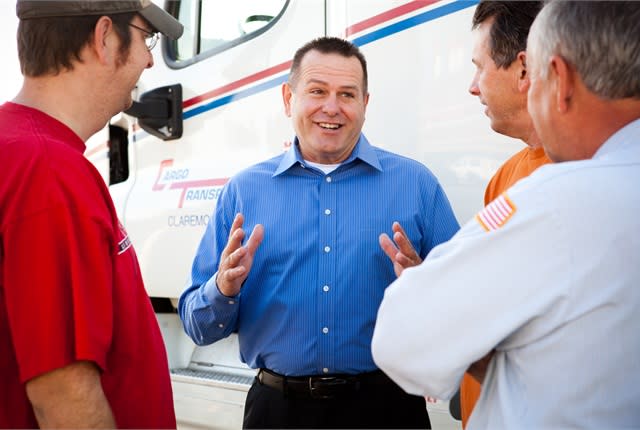
Dennis Dellinger,
president of Cargo Transporters, with some of the company’s drivers. The company makes use of its mobile communications and telematics technologies to improve mpg and reduce paper.
But while they are achieving these gains, many fleets also reduce their carbon footprint along the way – a double bang for the buck, so to speak.
Chip Powell, director of U.S. operations for Blue-Tree Systems, says trucking operations deploy fleet management systems such as those provided by his company to improve productivity and reduce costs. But they also reduce their carbon footprint by reducing idling, improving mpg and cutting down on paper.
Powell says the technologies fleets now deploy give them the ability to see what’s happening with their vehicles, which allows them to better manage them.
Sustainability has become increasingly important to the customers many fleets service.
“Pretty much everything we do has a lot to do with being green,” says Kerry Bringle of Trimac, a Calgary, Alberta-based trucking company with locations throughout North America.
“When you invest in these technologies, you get cost control, and part of that cost control is a reduced carbon footprint, because less energy is being used in some fashion or another,” Bringle says.
Chip Sheely, director of sustainability for Southeastern Freight Lines in Lexington, N.C., says his company integrates “eco-friendly business practices into its daily operation in ways that are also good for business, driving efficiency and cost savings.”
The company’s green efforts go beyond the fleet. “As customers continue to be more aligned with the carbon footprint throughout their supply chain and demand ongoing improvements to the industry’s sustainability efforts, our next challenge will now be to look at the entire package together.”
Sheely says Southeastern is starting to implement a whole package approach through its new facilities.
A new service center in South Houston, for instance, conserves energy through everything from motion detectors that turn lights on and off and the placement of windows for natural light to a 2-acre solar panel field that will generate one-third of the facility’s power. It also conserves water with a 10,000-gallon cistern for irrigation purposes from rainwater.
Cutting miles
Reducing miles and improving efficiency are the key payoffs fleets get from deploying automated dispatch, routing, navigation and mobile communications systems.
Management systems allow fleets to be more efficient with their dispatching, making sure a specific load is assigned to the right truck and the right driver to minimize deadhead miles, says Mark Cubine, vice president marketing at McLeod Software.
Local delivery and LTL operations use routing optimization technologies to put together loads for multi-stop operations that accomplish the job with the fewest miles.
“The systems allow carriers to know how much is on each truck, which drivers are best suited for that particular run and which truck works best for that load or route,” says James Stevenson, vice president sales for TMW Systems.
Trimac’s Bringle says their system helps eliminate empty miles because it gives managers the ability to track mileage, loaded and empty.
The information can then be used to analyze lanes and restructure those that need it to improve efficiencies.
“Back in the old days, the analytical side would occur at the end of the month or the end of the quarter,” Bringle says. “Any change would be a couple of months behind. Now we are looking at these changes weekly. The technology brings us closer to real time.”
Adam Kahn, director of fleet solutions, Omnitracs, says: “It comes down to people, paper, fuel and vehicles.”
The data fleets can get back from their telematics system, combined with better dispatching and routing, gives fleets the information they need to better train their people, reduce paper, cut fuel use by reducing miles and spec vehicles that are right for their particular operations.
Improving mpg
According to John Swanton of the California Air Resources Board, increasing a long-haul truck’s fuel mileage by just 0.6 mpg reduces that truck’s emissions by 10%. (Based on a truck running 125,000 miles with most of those miles at highway speed.) That is an additional benefit the fleet receives on top of reduced fuel costs.
John Pope, chairman of Cargo Transporters, Claremont, N.C., says the best way to start becoming greener is on the fuel side. The company uses its onboard technologies to monitor vehicle and driver performance.
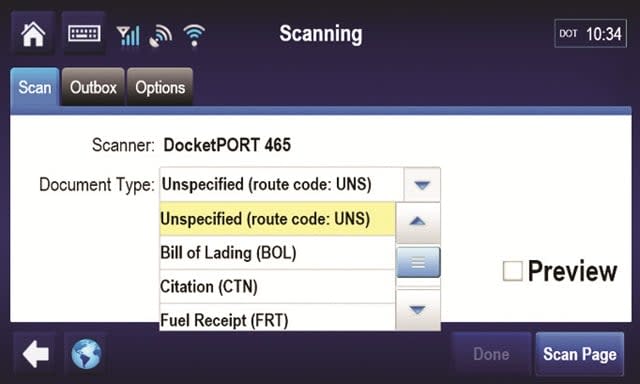
In-cab scanning helps fleets reduce paper use plus cuts down on the energy needed to move that paper around the country.
“The technologies provide us a driver-training opportunity,” he says. Performance data is extracted daily, equipment specifications are reviewed and the company changes equipment frequently.
“The green part of the company is the professional company driver,” Bringle says. “How that company driver handles the equipment is what ultimately makes us green.”
The company uses its onboard system to collect data on individual power units and individual drivers. Fuel mileage is tracked by branch, with specific goals set for each. “What the technology does is it improves our vision,” Bringle says.
“With the technology we understand where the equipment is, how many hours that driver has. You can’t plan a truck you can’t see.”
Sheely aggrees that the driver is the key. Southeastern uses its onboard technologies to coach drivers and has successfully reduced idle time by 45% on its pickup and delivery trucks.
Reducing paper
Cutting paper is another way fleets can implement sustainable practices. It’s not just the trees that are saved; moving paper around takes energy. The bonus for fleets is getting all the documents necessary to generate an invoice back in a more timely fashion.
TMW’s Stevenson notes that automated trucking management systems include document management capabilities. “That takes you to where you can do paperless end-to-end,” he says.
From receiving orders electronically via EDI or fax, to automated dispatch and routing instructions, to bills of lading and the ability to capture signatures electronically, the whole job can be completed without a single piece of paper.
McLeod’s Cubine says management systems allow fleets to be more efficient with their dispatching and it also allows them to reduce paper.
“Eliminating paper through automation has had a big impact on fleets,” Cubine says. “The best-run fleets can use truckstop or in-cab scanning to bill and process settlements quickly while managing images instead of mailing stacks of paper around the country. They can use automated forms recognition technology to eliminate costly indexing services.”
BlueTree’s Powell says, “a whole host of processes go away as long as you get rid of the paper.” That includes drivers using truckstop fax machines or scanning services or document delivery services and clerical staff sorting, indexing and storing paper. Document management systems do it all automatically.
Many fleets take full advantage of going paperless. “Every place we can, we stop the paper flow and inject the scanning process to move the paper into electronic versions,” Bringle says.
Cargo Transporter’s Pope says his company has “eliminated the whole paper stream, including driver vehicle inspection reports.”
The same is true for Southeastern Freight. Braxton Vick, senior vice president corporate planning and development, says using electronic log and DVIR applications with its PeopleNet mobile communications system “saves us some 14,000 pieces of paper a day.”
Reducing fuel use, empty miles and paper will each help a fleet improve its green image. It will also make the fleet more efficient and add to the bottom line.
A win-win for both the fleet and the environment.
More Fleet Management

Nominations Open for HDT Emerging Leaders
Heavy Duty Trucking is looking for accomplished trucking fleet professionals under 40 who are making an impact and helping lead the industry forward.
Read More →
Why Private Fleets Are Taking More Freight
Private fleets are putting their own trucks on demanding customers and high-cost lanes as companies seek greater control over service, costs, and capacity.
Read More →
Color Match Smarter: Tools That Restore & Perform
For fleet managers and collision repair professionals keeping heavy-duty trucks on the road, getting the color right the first time isn't just about appearance — it's about efficiency, turnaround time, and bottom-line results. Discover how today's digital color tools are transforming the repair process from guesswork to precision.
Read More →


FMCSA Pauses Biennial-Update Enforcement Amid Motus Transition
Carriers whose updates were due on or after June 1 have more time, while FMCSA works to stabilize its new registration system and warns of phishing sites impersonating its new carrier registration system, Motus.
Read More →
2026 Blueprint for Countering Smarter Supply Chain Theft
Cargo theft is no longer just the cost of doing business. It's a multi-billion-dollar criminal enterprise exploiting vulnerabilities across your fleet, drivers, and supply chain.
Read More →
How Telematics Improves Visibility, Control, and Performance in Refrigerated Fleets
Explore how telematics help refrigerated fleets improve visibility, uptime, efficiency, compliance, and cargo protection across connected cold chain operations.
Read More →
What the U.S.-Canada Trade War Means for Trucking
Escalating U.S.-Canada tariffs could disrupt cross-border freight, reduce truck volumes, raise costs, and create new uncertainty for carriers on both sides of the border.
Read More →
What Are Trucking’s Top Concerns for 2026?
The American Transportation Research Institute wants to know what's worrying trucking fleet managers, drivers, and other stakeholders in its annual Industry Issues survey.
Read More →
American Trucking Associations Looks for a New Leader
ATA President and CEO Chris Spear abruptly left his job at the association on August 21, at a pivotal time for the trucking industry.
Read More →
Public Wi-Fi Cybersecurity Risks: How Truck Drivers and Fleets Can Protect Their Data
Public Wi-Fi can expose truck drivers and fleets to credential theft, malware, and other cyber threats. Here’s how to reduce the risk on the road.
Read More →