




How Swift Transportation Got Back on Track
SAN DIEGO -- "It doesn't matter if you are big or small, the principles are the same," said Richard Stocking, president and COO of Swift Transportation, in discussing how his company got back on track following the recession

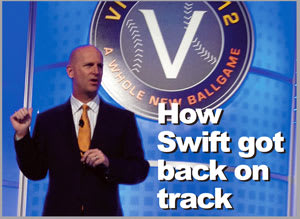
SAN DIEGO -- "It doesn't matter if you are big or small, the principles are the same," said Richard Stocking, president and COO of Swift Transportation, in discussing how his company got back on track following the recession.
Speaking at Qualcomm's Vision 2012 Management Conference this week, Stocking referred to a quote by George Wood Bacon, who had said, "fortunes aren't made in the boom times ... fortunes are made in depression or lean times."
The recent recession forced Swift to reevaluate how it did business.
"We'd Lost Our Way"
"We'd lost our way at Swift," he said, and were "close to disaster," but the company instituted changes that turned things around. Before the downturn, he said, "We were growing for growth's sake. The recession was the best thing that happened. It made us look more closely at our company."
Borrowing on concepts from the Michael George book, "Lean Six Sigma," which combined managerial concepts found in the Six Sigma and Lean Production manufacturing initiatives, Stocking said his company established guiding principles, a mission statement and a vision of what the company wants to be.
"We don't want to be just a trucking company," he said. "We want to be a provider of best-in-class transportation solutions for our customers."
Whole Person Paradigm
He advised the audience to tap into the "whole person paradigm," of body, heart, mind and spirit when leading employees to get the most out of people. "You want to make sure you treat people right," and not look at employees as simply an expense. You need leadership that inspires trust, clarifies purpose, aligns systems and unleashes talent, he said.
You get there by developing a strategic plan that looks at "where are we going," in one year, five years and 20 years down the road.
Such plans require discipline, Stocking said, and his team has learned to distinguish between "wigs and "pigs" - wildly important goals and pretty important goals. "If you focus on only the pretty important goals, you can't be great," he said.
Stop Doing
Part of the strategic planning at Swift was developing what he called stop-doing lists -- anything that isn't furthering your goals, stop doing. But he cautioned against trying to accomplish too many goals; three or four is the max.
Keeping score is important, he noted, because a company can't measure their progress without a scorecard of some kind. The scorecard should be easy to understand, he said, using a scoreboard at a basketball game as an example. "You need to know within 3 seconds if you are winning or losing." And there has to be accountability.
As an example of how the company has evolved, Stocking said that by using elements from Lean Six Sigma, improved processes in their shops helped them avoid buying 300 trucks -- a huge savings due to developing better processes. They were able to grow the fleet by increasing utilization instead of adding equipment.
Goals From Within
Strategic focus groups within the company work on developing future goals.
"You don't want a leader who comes down from the mountain," and delivers directions he said, just as you don't want a leader who can't make a decision. Rather you want a leader who can "get people involved from all levels. It's all about momentum."
A great leader is one who, when he leaves, the company continues on without missing a beat because the vision and processes are already in place. In the end, it's about the power of belief, Stocking said. Your people need to buy into the vision. Then, the right combination of leadership, execution and results equals a winning culture which perpetuates itself, regardless of who sits in the top chair.
More Fleet Management

Geotab Links Fleet Card to Vehicle Data
The new card combines fuel discounts with telematics-based purchase controls. Geotab’s analysis also points to potential savings from choosing lower-priced fuel stops.
Read More →
How MFA Helps Protect Trucking Fleets
Multi-factor authentication adds protection when passwords are stolen. Here’s how it works and where fleets should start.
Read More →
How Better Freight Data Helps Trucking Teams Get Ahead of Disruption
Trucking and logistics teams have plenty of data. The problem is getting the right information in front of the right people soon enough to act. Better-connected data can help teams spot trouble earlier and make smarter decisions before small problems become big ones.
Read More →

Trimble: Taking Artificial Intelligence in Trucking Beyond Faster Tasks
At Insight 2026, Trimble executives argued that fleets may need to redesign workflows to get more from AI as it introduced new products and enhancements. AI’s value will depend on how fleets combine automation with their people's knowledge.
Read More →
Build a bulletproof fleet: Uniting ELDs and dash cams for total compliance
An ELD can prove compliance, but it cannot always prove what happened on the road. Discover how uniting accurate ELD data with AI-powered dash cam video can help your fleet strengthen compliance, defend against liability, protect drivers and reduce operational costs.
Read More →
Nominations Open for HDT Emerging Leaders
Heavy Duty Trucking is looking for accomplished trucking fleet professionals under 40 who are making an impact and helping lead the industry forward.
Read More →
Why Private Fleets Are Taking More Freight
Private fleets are putting their own trucks on demanding customers and high-cost lanes as companies seek greater control over service, costs, and capacity.
Read More →
Color Match Smarter: Tools That Restore & Perform
For fleet managers and collision repair professionals keeping heavy-duty trucks on the road, getting the color right the first time isn't just about appearance — it's about efficiency, turnaround time, and bottom-line results. Discover how today's digital color tools are transforming the repair process from guesswork to precision.
Read More →
FMCSA Pauses Biennial-Update Enforcement Amid Motus Transition
Carriers whose updates were due on or after June 1 have more time, while FMCSA works to stabilize its new registration system and warns of phishing sites impersonating its new carrier registration system, Motus.
Read More →
2026 Blueprint for Countering Smarter Supply Chain Theft
Cargo theft is no longer just the cost of doing business. It's a multi-billion-dollar criminal enterprise exploiting vulnerabilities across your fleet, drivers, and supply chain.
Read More →