




How Business Intelligence Can Drive Your Final Mile Forward
While the final mile may be the last piece in the supply chain, businesses often consider it the most important because of the value placed on customer satisfaction levels.
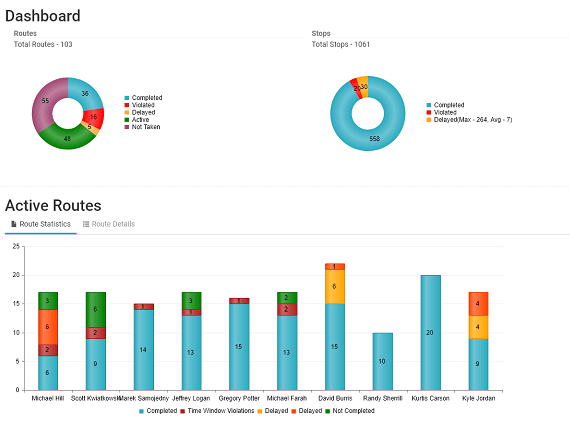
Having up to date and useful data can have a real impact on a fleet's final mile business.
Graphic via TMW Systems
The final mile is a unique and vital part of the supply chain in and of itself. Companies that operate in this sector of logistics strive for top-end service and place a heavy emphasis on customer relationships. Businesses that make local deliveries or pickups often fall into this category. It involves timeliness, speed, accuracy and precision. This last, but critical, portion of the supply chain is changing. And, it’s changing quite dramatically because of market dynamics and technological advances.
No longer are the days of orders being placed and customers waiting a few days for the delivery to be completed, abiding by the timeline of the shipper. Now, customer expectations have taken priority. And, those expectations have increased to the point of same day delivery. While the final mile may be the last piece in the supply chain, businesses often consider it the most important because of the value placed on customer satisfaction levels.
Nowadays, most people associate the final mile with the Amazon, or e-commerce, package that you ordered arriving at your front door the next day. But you also should think about the bread delivery person who stocks the shelves at the same time every Tuesday at your local grocery store, or how a charity goes house-to-house to pick up scheduled donations. All three final mile operations require timeliness, speed, accuracy and precision.
Final mile deliveries – whether to customers or within an organization – can be challenging given requirements, service level agreements, demands and more. Shippers, carriers and customers all have to ensure that the standards of the contract are upheld and criteria met. Not only that, but, all three parties have to follow regulations set forth by OSHA, the Federal Motor Carrier Safety Administration and other government organizations. The more regulations there are that have to be met, the harder it becomes to successfully execute final mile deliveries.
In the past, final mile deliveries were completed using paper and manual data entry or filing. Now, the process is simplified down to the point where it’s just a matter of entering the data into a software solution that is easily accessible using a computer or a mobile device.
As more and more businesses are learning the value of technology-based solutions along with the application of business intelligence (BI), there’s becoming more visibility into best practices within the transportation industry than ever before. Business executives can look at the auto-generated reports that software solutions offer to make decisions based on data that supports the reason for change.
Often, however, there’s a lack of clear understanding about which key performance indicators (KPIs) to look at that address the challenge that the company is facing. And when data is pulled from the various departments from across the business, executives are finding that there’s too much information to digest. So, it often becomes noise and is ignored. Understanding which set of data affects what KPI is a valuable skill to hone when searching for ways to cut operational costs and improve margins within final mile operations.
The best way to overcome that hurdle is to identify clear business objectives and map KPIs to those goals. You have to know what you want to answer before deciding how to answer it. Only then can you decide what KPIs will address your concerns. Also, create simple analytics that will help you track the KPI.
Additionally, let the KPIs evolve as needed. You might realize that there’s a more effective way to reach your business goal only once the new process has been implemented. Last, gain supporters for the cause throughout the company. Change isn’t easy. People get stuck in old habits that are hard to break. Trust in the data and outcomes, as established by high quality, relevant information and with management backing is key.
Part of successfully implementing new BI tools is also making sure that everyone is properly trained in both understanding how to collect the data and understanding how it addresses concerns within your company’s final mile business. Employees are more likely to accept the new information when they fully understand it and see clear outcomes as a result of analysis.
KPIs are at the heart of using BI to improve business outcomes. So, understanding common KPIs in the final mile scenario is extremely important. Top KPIs to consider in final mile may include: improved planning, cost to serve, profitability, and utilization, among others.
As final mile solutions become increasingly important within the trucking and logistics industries, distributors and wholesalers are recognizing BI as a more critical part of the puzzle. And while final mile addresses the final leg in the supply chain, it must be looked at holistically or “end-to-end,” starting with planning and evolving through BI, to deliver on the promise of overall business improvement. BI is a game changer because it can also provide the “intelligence” needed to go beyond basic dispatching, routing, or scheduling to provide the insights that truly affect business process improvements.
If applied correctly, BI can make the final mile more impactful by meeting KPIs that have a lasting effect on meaningful business outcomes that map directly to overall business objectives. That’s why while final mile solutions are critical to companies reliant on pick up and deliveries, BI is the “secret sauce” in business improvement that ties it all together.
Brian Larwig, vice president of Final Mile at TMW Systems, has more than 17 years of experience in transportation technologies focused on efficiencies, automation, decision assist solutions, and leveraging data to strengthen organizations. Larwig has been at Trimble for 10 years, and prior to that worked at UPS on automation and technology forward solution teams. This article was authored under the guidance and editorial standards of HDT’s editors to provide useful information to our readers.
Related: How E-Commerce Trends Are Affecting Final Mile Logistics
More Fleet Management

Color Match Smarter: Tools That Restore & Perform
For fleet managers and collision repair professionals keeping heavy-duty trucks on the road, getting the color right the first time isn't just about appearance — it's about efficiency, turnaround time, and bottom-line results. Discover how today's digital color tools are transforming the repair process from guesswork to precision.
Read More →
FMCSA Pauses Biennial-Update Enforcement Amid Motus Transition
Carriers whose updates were due on or after June 1 have more time, while FMCSA works to stabilize its new registration system and warns of phishing sites impersonating its new carrier registration system, Motus.
Read More →
2026 Blueprint for Countering Smarter Supply Chain Theft
Cargo theft is no longer just the cost of doing business. It's a multi-billion-dollar criminal enterprise exploiting vulnerabilities across your fleet, drivers, and supply chain.
Read More →


How Telematics Improves Visibility, Control, and Performance in Refrigerated Fleets
Explore how telematics help refrigerated fleets improve visibility, uptime, efficiency, compliance, and cargo protection across connected cold chain operations.
Read More →
What the U.S.-Canada Trade War Means for Trucking
Escalating U.S.-Canada tariffs could disrupt cross-border freight, reduce truck volumes, raise costs, and create new uncertainty for carriers on both sides of the border.
Read More →
What Are Trucking’s Top Concerns for 2026?
The American Transportation Research Institute wants to know what's worrying trucking fleet managers, drivers, and other stakeholders in its annual Industry Issues survey.
Read More →
American Trucking Associations Looks for a New Leader
ATA President and CEO Chris Spear abruptly left his job at the association on August 21, at a pivotal time for the trucking industry.
Read More →
Public Wi-Fi Cybersecurity Risks: How Truck Drivers and Fleets Can Protect Their Data
Public Wi-Fi can expose truck drivers and fleets to credential theft, malware, and other cyber threats. Here’s how to reduce the risk on the road.
Read More →
For Nicky Cupp, Fleet Innovation Starts With Frustration
HDT Truck Fleet Innovator Nicky Cupp turns everyday pain points at Fraley & Schilling into opportunities for better technology and smarter processes.
Read More →
Adam Buttgenbach’s Approach to Electric Trucks: Start With Where They Fit
HDT Truck Fleet Innovator Adam Buttgenbach helped PepsiCo build one of North America’s largest EV fleets by focusing on where electric trucks make operational sense.
Read More →