




Driving Link’s Smooth Riding Semi-Active Cab Suspension
Link’s newest and yet-to-be-released cab suspension smooths out the bumps like never before.

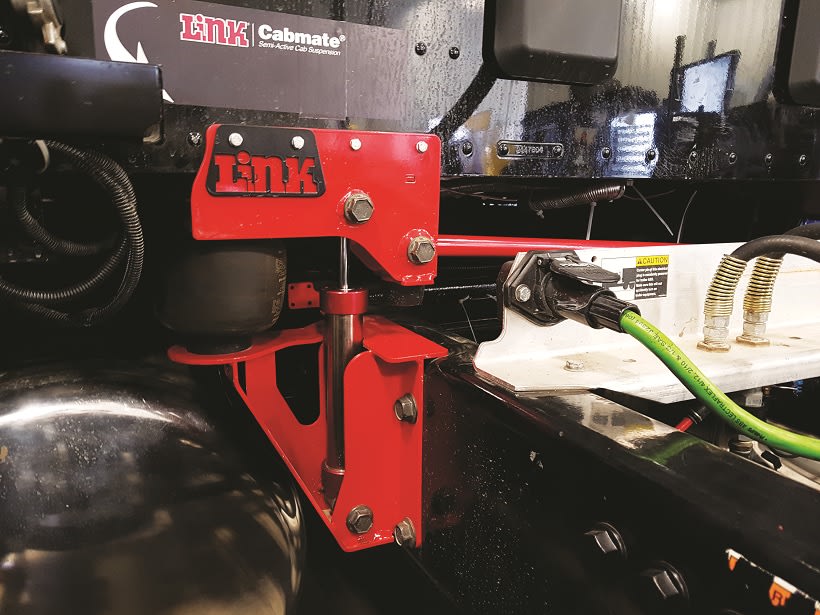
Link’s Cabmate semi-active cab air suspension promises a better ride for drivers and a better sleep for team drivers.
Photos: Jim Park
Link Manufacturing knows a thing or two about cab air suspensions. The company pioneered cab suspensions back in the early 1980s, when Link’s founder, former cab-over-engine driver Bill Nibbelink, decided he’d had enough of the bone-jarring ride in his COE. He invented the first cab suspension to use air bags and shock absorbers, the likes of which is now fitted to nearly every truck cab in North America. All the OEMs have a standard cab suspension, but Link’s Cabmate maintains a 40% OEM marketshare. And it’s about to get even better.
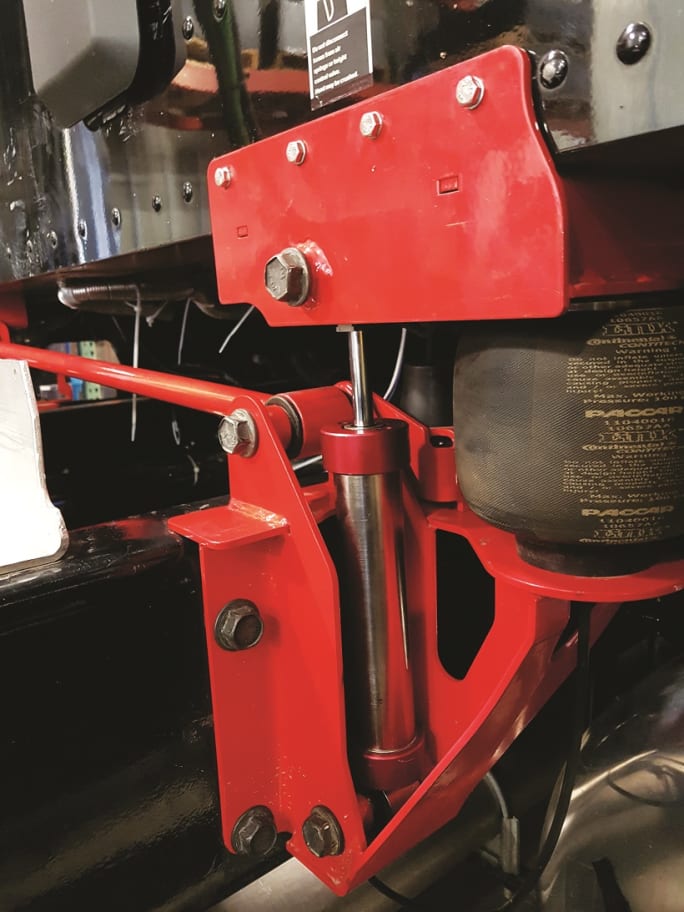
The electronic controller uses inputs from sensors on the cab to adjust the firmness or softness of the ride based on how the suspension reacts to road conditions.
Link is now in the final stages of development on a semi-active cab suspension it plans to release to OEMs in 2019 called Road Optimized Intelligence, or ROI Cabmate.
Semi-active means variable-rate damping in the suspension’s shock absorbers. The damping rate is electronically controlled using input from two accelerometers built into the rear of the cab and two position sensors that monitor the movement in the truck’s main suspension. The suspension’s electronic controller uses information from these sources to set the damping rate in the suspension’s shock absorbers, which it adjusts hundreds of times every second to maximize ride comfort.
Link is currently exploring two methods of managing the dampening in the hydraulic shock absorber: an orifice that rapidly adjusts its size to either allow or limit fluid migration within the body of the shock; or with magnetorheological fluid, which thickens or thins with the application of a specific voltage and thus impedes or permits the movement of the piston within the body of the shock.
The dampening rate in an off-the-shelf shock absorber isn’t variable, so it can only do so much to respond to movement. In this semi-active system the dampening rate is infinitely variable, so it can respond to large or small bumps accurately to keep the ride smoother than was previously possible.
The truck I drove for the test was using the latter method, but either approach works well, explains Tye Davis, Link senior engineer. “We are still evaluating the two methods, but if we get the same performance either way, we will choose the option that minimizes the overall cost of the system.”
During my visit to Link’s manufacturing facility in Sioux Center, Iowa, I toured the testing rigs where all manner of suspension inputs were simulated, from “cliff event” bumps to the washboard-type bumps found in concrete highways. It was easy to see the suspension responding to the various inputs while the system was on or off. Link has charts and graphs that clearly demonstrate the technical effectiveness of such a suspension design, but during the test drive the differences were equally obvious to my back and my backside.
The test course was decidedly less scientific than the test rigs, but it represented real-world conditions. The first portion of the test was a section of concrete highway with uneven slabs that give the washboard feel. It’s located a few minutes from the plant on Route 18 near Hull, Iowa. We made a run over that stretch of road with the factory suspension installed, then returned to the plant to switch that suspension out for the new ROI Cabmate semi-active suspension.
The test truck was a 2016 Peterbilt Model 579 with an 80-inch sleeper, a truck already known to have pretty good ride characteristics.
The result was palpable — and visible, too. We recorded the two runs on video, and you could see there was less movement of the driver’s seat relative to the cab. But more importantly, the movement was modulated so the ride actually felt smoother.
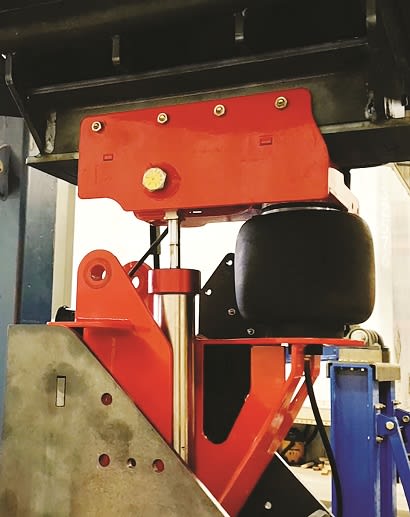
The semi-active suspension with the magnetorheological shock absorber can adjust its dampening factor several hundred times a second.
We also did a before-and-after test over a couple of railroad crossings. Again, the difference could be both felt and seen. On one of the crossings, my seat bottomed out with the standard suspension, but smoothly moved up and down with the semi-active suspension. In this case, the suspension limited the travel of the shock, preventing the movement of the cab from causing the seat suspension to travel fully downward and hit the stops. There certainly was movement in the seat suspension, but it was much smoother than with the standard cab suspension.
The implications for team drivers can hardly be overstated. Lying as they usually do in the rear of the sleeper at the farthest point from the fulcrum (the front cab mounts), the range of motion would be at its worst. The semi-active suspension limits the up and down movement of the cab dramatically and most importantly, smoothly. I can think of a few options that actually help with driver retention, and I wouldn’t hesitate to add this one to the list.
The ROI Cabmate also features electronic height control. The system minimizes air consumption compared to traditional-height control valves, because it does not fill or exhaust air in response to dynamic suspension motion. And as might be expected, Link says the semi-active suspension can reduce wear and tear on the cab structure, too.
More Equipment

How Volvo Updated Its D13 for EPA 2027 [Watch]
Volvo’s updated D13 promises lower emissions without sacrificing performance or fuel economy. Take a closer look at what changed inside the engine in this HDT Spotlight video.
Read More →
Michelin Tire Improves Efficiency and Durability for Regional Fleets
The Michelin X Multi Energy D2 is a regional haul drive tire engineered to help fleets improve fuel efficiency, durability and traction in demanding stop-and-go operations.
Read More →
ZF Expands Commercial Vehicle Push in North America
ZF is expanding its North American commercial-vehicle presence with new transmission applications, electrification, trailer technology and autonomous-driving systems.
Read More →
Tesla Wants a Self-Driving Semi. Are Cameras Enough?
Could Tesla’s camera-only autonomous driving technology work on an 80,000-pound Semi? In this commentary, HDT's Deborah Lockridge takes a look at Tesla, Cybercab, and how autonomous trucks see the road.
Read More →
Kodiak: Driverless Long-Haul Truck Launch on Track for 2026
Kodiak AI says its driverless long-haul safety case is 93% complete and it remains on track to begin commercial operations by year-end 2026.
Read More →
What DOT’s Automated Vehicle Strategy Means for Trucking
The U.S. Department of Transportation issued a new automated-vehicle strategy that outlines plans for driverless-truck regulations, cross-state freight corridors, and federal safety standards.
Read More →
East Coast Port Launches $45M Electric Truck Push
The Port Authority of New York and New Jersey announced millions in incentives for zero-emission drayage trucks, yard tractors, and new charging hubs near the port.
Read More →
PlusAI Going Public to Fund Autonomous Truck Launch
A SPAC deal could provide PlusAI with up to $300 million as it works toward a 2027 commercial launch of factory-built autonomous trucks.
Read More →
NHTSA Moves to Rewrite Truck Fuel-Economy Rules
The National Highway Traffic Safety Administration says it lacks authority to regulate medium- and heavy-duty truck engines separately from complete vehicles, but the existing standards have not yet been eliminated.
Read More →
Detroit Opens Orders for EPA 2027 Engines
Detroit isn’t starting from scratch to meet EPA 2027 diesel emissions standards. Its Gen 6 DD13 and DD15 engines keep much of today’s platform while updating the fuel and aftertreatment systems.
Read More →