




Driving Impressions: Ford's Transit Connect is Bigger Than it Looks
A Transit Connect is roughly 2 feet shorter and weighs about 1,500 pounds less than an E-150 van. The TC's high roof makes it roomier than it might look in a photograp

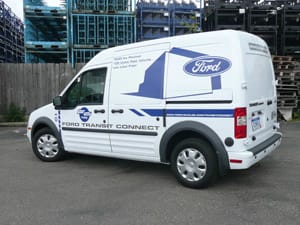
Tall roof and near-6-foot-long cargo bed allow Transit Connect to carry a lot. Upfitters can add shelves, cabinets, racks and other equipment for carrying cargo and tools. It has a sporty feel but is a commercial truck from the ground up, Ford says.
A Transit Connect is roughly 2 feet shorter and weighs about 1,500 pounds less than an E-150 van. The TC's high roof makes it roomier than it might look in a photograph
; its cargo area is 59 inches high by 48 inches wide by 72 inches deep, for a volume of 135.3 cubic feet. Its floor sits less than 2 feet off the pavement for easy loading and unloading, and its rear and side doors allow excellent access. With a fold-down rear seat it can carry up to five people and still a goodly amount of cargo, for a total payload of 1,600 pounds.
The TC is nimble and quick on city streets and can more than keep up with freeway traffic, though I had to put my foot into it to properly merge from on-ramps. This was during a show-and-tell event for news reporters at the Royal Oak (Mich.) Farmers Market near Detroit, one of a series of events Ford was hosting across the country.
Behind the wheel
My assigned TC was set up for a tradesman, with shelves and cabinets along the walls of its roomy rear compartment. Ford has partnered with three upfitters so buyers can specify a wide array of shelving, drawers and boxes. Or buy it bare and arrange your stuff to suit yourself.
The TC's powertrain - a 2-liter Duratec inline-4 and 4-speed automatic transmission - delivers 22 to 25 mpg of gasoline, Ford says. That's maybe 5 to 10 mpg better than the hefty V-8s that propel most full-size vans. Most TCs sold in Europe have a small diesel and a 5-speed manual tranny, but Americans wouldn't want them, Ford believes.
Our press contingent convoyed over streets and expressways, scooting easily through traffic and turning tightly where we had to. This TC was quick, but carried only one other guy and no cargo. However, our hosts had loaded another TC with 1,200 pounds of bagged sand, and my driving buddy and I piled in with a Ford rep - maybe 600 pounds worth of people - and we took turns driving it around the block. Now about 200 pounds over its payload rating, the TC's ride was well settled and its acceleration adequate. On a freeway it would've been sluggish but workable.
Just the facts
A basic TC comes as a panel van with windowless sliding side doors and rear "barn" doors with darkened glass. A buyer can keep or delete the rear glass, and can spec windows in the side doors and rear-quarter panels. The customer can also choose a windowed wagon version with a rear seat that accommodates three people and folds up to expand cargo space.
Up front is a pair of bucket seats flanking a small console that houses the shift selector and rises to form an arm rest. A businesslike instrument panel includes a speedometer, tachometer and the usual engine-temperature and fuel gauges. A handy package shelf above the big windshield holds the wireless keyboard for an on-board PC, one of the Ford Work Solutions options - a whole 'nother subject.
The small van has a sporty feel and drives that way. It reminded me of Chevy's HHR Panel - a direct competitor - and Chrysler's PT Cruiser. But the Transit Connect is larger and, Ford reps insisted, built from the bottom up as a commercial truck. It feels very stout and our near-new examples were rattle-free. Ford says the Transit Connect has been rigorously tested, successfully operated overseas, and will last many years here.
With its 15.4-gallon gasoline tank, a Transit Connect should go about 500 miles between fill-ups, Ford says. For operations that keep trucks closer to home, sometime next year Ford will have a battery-electric version that'll go 100 miles between plug-ins. Meanwhile, if you need a bigger, heavier truck of this sort, then an E-van still makes sense. But if not, and with the Transit Connect's starting price of $21,475, can you afford not to check one out? If it helps, its AM-FM radio will play tunes from Motown and any other label you'd want.
From the September 2009 issue of Heavy Duty Trucking.
More Equipment

How Volvo Updated Its D13 for EPA 2027 [Watch]
Volvo’s updated D13 promises lower emissions without sacrificing performance or fuel economy. Take a closer look at what changed inside the engine in this HDT Spotlight video.
Read More →
Michelin Tire Improves Efficiency and Durability for Regional Fleets
The Michelin X Multi Energy D2 is a regional haul drive tire engineered to help fleets improve fuel efficiency, durability and traction in demanding stop-and-go operations.
Read More →
ZF Expands Commercial Vehicle Push in North America
ZF is expanding its North American commercial-vehicle presence with new transmission applications, electrification, trailer technology and autonomous-driving systems.
Read More →
Tesla Wants a Self-Driving Semi. Are Cameras Enough?
Could Tesla’s camera-only autonomous driving technology work on an 80,000-pound Semi? In this commentary, HDT's Deborah Lockridge takes a look at Tesla, Cybercab, and how autonomous trucks see the road.
Read More →
Kodiak: Driverless Long-Haul Truck Launch on Track for 2026
Kodiak AI says its driverless long-haul safety case is 93% complete and it remains on track to begin commercial operations by year-end 2026.
Read More →
What DOT’s Automated Vehicle Strategy Means for Trucking
The U.S. Department of Transportation issued a new automated-vehicle strategy that outlines plans for driverless-truck regulations, cross-state freight corridors, and federal safety standards.
Read More →
East Coast Port Launches $45M Electric Truck Push
The Port Authority of New York and New Jersey announced millions in incentives for zero-emission drayage trucks, yard tractors, and new charging hubs near the port.
Read More →
PlusAI Going Public to Fund Autonomous Truck Launch
A SPAC deal could provide PlusAI with up to $300 million as it works toward a 2027 commercial launch of factory-built autonomous trucks.
Read More →
NHTSA Moves to Rewrite Truck Fuel-Economy Rules
The National Highway Traffic Safety Administration says it lacks authority to regulate medium- and heavy-duty truck engines separately from complete vehicles, but the existing standards have not yet been eliminated.
Read More →
Detroit Opens Orders for EPA 2027 Engines
Detroit isn’t starting from scratch to meet EPA 2027 diesel emissions standards. Its Gen 6 DD13 and DD15 engines keep much of today’s platform while updating the fuel and aftertreatment systems.
Read More →