




Driving Impressions: Alternative Fuels for Light-Duty Trucks
Here are two ways to avoid buying petroleum from unfriendly countries

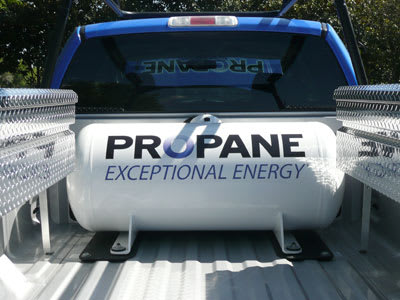
Behind the cab in the bed of this converted F-150 is a 53-gallon fuel cylinder, 41 gallons of which provide 500 miles of range.
Here are two ways to avoid buying petroleum from unfriendly countries.
1. Go down to your Ford dealer and ask for a test drive of the latest F-150 with the 5.4-liter Triton V-8 engine. The driving experience is almost exactly what you'll get with a propane-fired version available from Roush Performance, and the company is proud of that.
2. Find a GEM Car dealer and ask for a spin around the lot in one of its electric utility trucks. You might find it more impressive to drive and more useful than you'd now think.
Roush and GEM were among about a dozen suppliers that offered drives of light- and medium-duty trucks during the Alternative Fuels and Vehicle Institute's recent annual conference in Orlando, Fla. These two manufacturers are among those that believe that propane and electricity are the best way to the future.
But of course there are other paths.
Natural gas is one. It got another boost from T. Boone Pickens, who delivered the conference's keynote address in which he promoted gas as a motor fuel instead of gasoline and diesel. A lot of those familiar fuels come from petroleum sold to us by sometimes unfriendly countries, he said, and domestically produced natural gas will set us free of them. Many organizations are adopting natural gas for their trucks and cars.
(And if grass cutting is among their tasks, they can now buy a big gas-fueled zero-turning-radius lawn mower from Dixie Chopper, a high-end builder in Indiana. I drove it at the conference and I want one!)
Propane - more properly called liquified petroleum gas - is not new as a vehicle fuel, but it's increasingly viable, according to the Propane Education and Research Council.
Meanwhile, electric vehicles are getting more attention, partly because General Motors is closer to market with its highly publicized Chevy Volt. At least two companies now sell commercial electric trucks in the U.S. (See "Future is Green at NTEA" in the April issue of HDT). GEM is owned by Chrysler, so some of its dealers sell GEM electric cars and utility trucks.
Propane is the most widely used of any alternative fuel, powerering 10 million vehicles worldwide, PERC says. But it's still in a world dominated by gasoline and diesel, and that's partly what makes the modern Roush F-150 worthy of remark. Unlike carbureted propane engines of the distant past, this one is fuel-injected and electronically controlled. However, also unlike the old dual-fuel systems, which could switch between propane and gasoline, this one burns only propane, and it'd be expensive to convert the engine back to gasoline. That won't help resale, unless the next owner also wants to use propane.
Auto writers have heaped praise on Ford's restyled-for-2009 F-150, and the propane system makes it a curiosity. But it drives like a standard F-150 except for the initial operating step: You twist the ignition switch as if to crank over the engine, but let it go. The system takes about four seconds to recharge the fuel lines to the injectors, then the starter motor cranks the engine and it immediately fires up. Partly as a safety measure, propane is purged from the lines upon engine shutdown.
Ford's 24-valve Triton V-8 is quiet but powerful, and this engine moved the pickup smartly around the parking lot set aside for the drive. It makes the same power and torque with propane as with gasoline, Roush says. Alas, there was no street or freeway driving, so I can't speak to its suitability at higher speeds. Nor can I say how reliable or durable the system is, but Roush is well known among hotrodders, and the company would've been long gone by now if its equipment weren't good.
Here's what's involved in the conversion, done at Roush's facility in Livonia, Mich., near Detroit: Technicians strip the stock gasoline fuel system from the Ford V-8 and replace it with components made to handle propane. They include stainless steel fuel lines, billet aluminum fuel rails, a multi-valve fuel pump that is part of a new propane fuel tank, a custom electronic control module calibrated for propane, and all necessary wiring and hardware.
Two tanks are available. This truck had a 59-gallon cylinder just behind the cab in the pickup bed; 41 of those gallons are usable, and let the truck run as far as 500 miles before refueling. Or a donut-shaped "toroidal" tank can replace the spare tire, which then would be stowed in the bed or stored in a garage. That tank holds 23 gallons, of which 20 are usable and give a 250-mile range.
The company also converts F-250 pickups and E-250 cargo vans with the 5.4-liter engine. Those are more likely to be commercial trucks, and sales of the F-250 system, just introduced in January, are already outpacing those for the F-150, which came out about a year and a half ago, says the company. Converted trucks are shipped to Roush-affiliated dealers for sale to customers.
A Roush-installed system is priced at $8,795 for the F-150 and $8,995 for the F-250, and comes with a three-year/36,000-mile warranty. Do-it-yourselfers can save $1,000 by buying a kit that comes with instructions. Either way, a federal tax credit can cover up to 50 percent of the purchasing price. Of course that's on top of the price of a new Ford truck.
Propane has less carbon energy and Btus, so it averages 17 percent less tank mileage. In the F-150, gasoline will deliver about 15 mpg on the highway, while propane gets about12 mpg. However, government subsidies cut the price of motor fuel-taxed propane to less than that of gasoline, especially in Texas and some Midwest states. So operating costs are 5 percent to 30 percent less, says Roush, quoting PERC numbers.
On the "green" side, propane combustion produces 20 percent less nitrous oxide, up to 60 percent less carbon monoxide and fewer particulates. About 90 percent of propane sold here is made from natural gas and oil produced in the U.S., Canada and Mexico, so using it reduces imports of oil from overseas. Thus you can feel patriotic even while counting the dollars you save.
That assumes you have a good outlet where you can buy the fuel, which propane people say is no problem. If you have a list of propane dealers, you could conceivably drive this F-150 cross country, and this XLT model was more than comfortable enough. But it makes more sense to keep the truck close to home and refuel at the same place. That's true of most alternative fuels, but the propane industry says there are more places to buy it than the others.
GEM eLXD Really Goes(to work)
GEM means Global Electric Motorcars, and "motor" here means a 7-horsepower electric unit driving the rear axle of this e4, a four-passenger car with a stubby bed. Nine 8-volt maintenance-free gel batteries keep things in motion for up to 50 miles on a charge that might cost a buck, which is equivalent to 150 miles per gallon of gasoline, the company says.
Of course, load as much as 1,100 pounds of cargo in the 48- by 70-inch bed behind the cab and performance will be more leisurely. But either way you'll be leaving absolutely no exhaust fumes behind, and that's its main point. (Yes, you're transferring blame to a distant power generating plant, but that's another matter.) Anyway, nine 8-volt maintenance-free gel batteries keep it going for up to 40 miles on a charge that might cost a buck, the company says.
An eLXD's curb weight is 1,550 pounds and its rated payload (cargo plus people) is 1,450 pounds, for a GVW of 3,000, GEM says. It runs on 13-inch wheels and tires, its wheelbase is 114 inches, and its overall length is 144 inches. Come to think of it, take out 70 inches for the bed length and you get a bumper-to-back of cab dimension of 74 inches. Because all the mechanicals are below and to the rear, we could call it a really low-cab-forward truck.
There's plenty of room for two in the oval-nose cab, which can be had with fiberglass doors for operation in cold weather. The tru
More Fuel Smarts
Cummins Adjusts 2027 Engine Rollout After EPA Proposal
The engine maker will gradually introduce its new Model Year 2027 diesel engines while continuing to offer current models during the transition, citing the EPA's proposed emissions rule changes.
Read More →
EPA Proposal Could Ease 2027 Truck Costs and Buying Uncertainty
The proposal doesn't change the tougher NOx standard, but it would revise key implementation requirements that manufacturers say have driven up costs and complicated fleet purchasing decisions.
Read More →
Cummins, Paccar Ease DEF Derates After EPA Guidance
Updated diesel engine software gives truck operators more time to address emissions-system issues while staying compliant with EPA emissions standards.
Read More →
Maintenance in the Messy Middle Part 3: Biodiesel
Biodiesel can reduce emissions, improve fuel-system lubricity and use existing diesel infrastructure. But NACFE’s Messy Middle maintenance report says fleets must actively manage storage, cold-weather operation, filters and oil drain intervals to avoid problems.
Read More →
Enhance Fleet Performance with High-Efficiency Auxiliary Power Units
Drive sustainable cost savings while increasing driver comfort during short- and long-haul logistics operations.
Read More →
Maintenance in the ‘Messy Middle’ Part 2: Renewable Diesel Fuel
NACFE's latest Messy Middle Powertrain Service & Maintenance report says renewable diesel gives fleets an opportunity to reduce carbon emissions without changing trucks, fueling infrastructure or maintenance practices. But technicians still need to understand several important operational differences.
Read More →
The Diesel Engine Enters NACFE’s ‘Messy Middle’
NACFE’s new Messy Middle Powertrain Service & Maintenance report says keeping modern diesel engines running now depends as much on software, diagnostics and data as traditional mechanical service.
Read More →
DTNA Software Update Gives Truckers More Time Before DEF Derates Take Effect
The changes reflect EPA guidance aimed at reducing downtime caused by emissions-system faults while maintaining compliance requirements.
Read More →
New Agentic Predictive Maintenance Report Demonstrates How Degraded Aftertreatment Systems Waste Fuel
Questar analyzed a large mixed-class fleet and discovered it was wasting as much as $30 in fuel per vehicle, per day, because of mechanically degraded aftertreatment systems.
Read More →
New York City's Microhub Project is Delivering Results
Trucking, last-mile delivery companies, and environmental advocates like what they are seeing so far with New York's microhub program.
Read More →