




Driving the Peterbilt-Cummins Fuel-Sipping SuperTruck
The SuperTruck lives up to its name as a groundbreaking technology demonstration project that is also fun to drive.

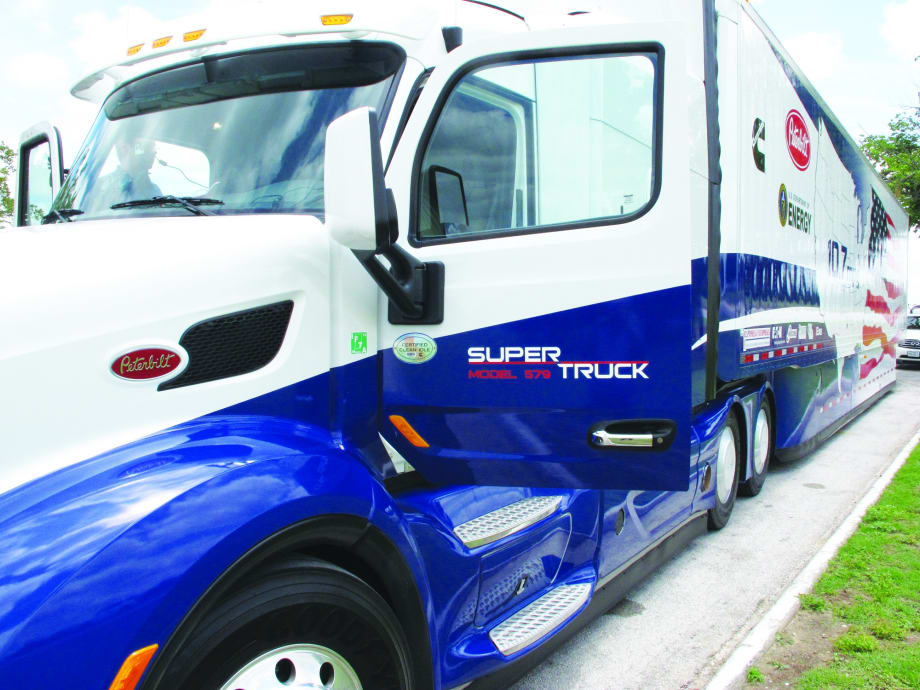
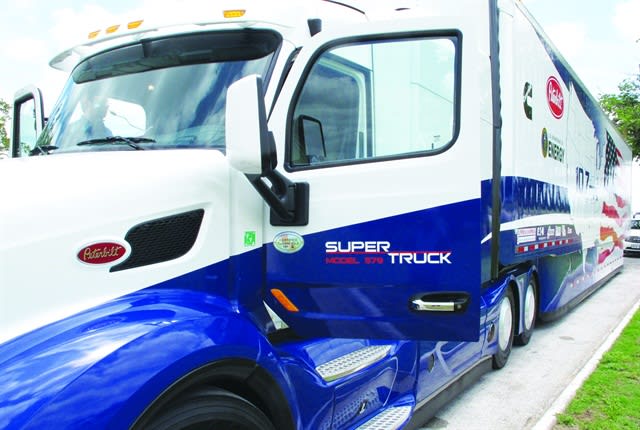
It’s pretty cool driving around in a $40 million tractor-trailer. The sum of its parts don’t add up to quite that much, but the figure represents a portion of the funding grant from the U.S. Department of Energy that enabled Cummins and Peterbilt to turn their best and brightest engineers loose in the DOE SuperTruck sandbox.
I recently spent two days in Denton, Texas, with the Cummins-Peterbilt SuperTruck and two of its creators, Bruce Bezner, a project engineer in the vehicle performance and engineering analysis group, and Ken Damon, the manager of Peterbilt’s SuperTruck Project. I learned a lot about the project and the truck from these two, and spent an eye-opening 10 hours driving the truck with them over parts of the same test route they used to prove the truck’s capabilities — U.S. Route 287 in north-central Texas.
This was no ordinary test drive, as if I was evaluating the latest model or trying out some new option. Many of the “new” components on this truck were literally handmade and genuinely one-of-a-kind.
There was very little different about this truck from the driver’s perspective. It was a typical — albeit highly modified — Model 579.
The modifications included things like aluminum matrix brake drums and magnesium crossmembers, not things that make glaring impressions on a test drive. The seats were the same, and so was the dashboard, more or less. The handling was as I expected, and the visibility from the cab just fine. That’s the kind of stuff one notices on a typical test drive.
What I couldn’t notice was much of the work Cummins did on the project. The engine team, led by David Koeberlein, Cummins’ principal investigator for SuperTruck, achieved better than 22% improvement in brake thermal efficiency for the engine through improvements in design such as gas-flow optimization, a reduction in parasitic losses, improved aftertreatment, an increased compression ratio, and optimization of the piston-bowl shape. They also slowed the cruise rpm of the engine by about 200, which I did notice.
The truck also used a high-efficiency advanced transmission from Eaton, which I’m told, included some “experimental” shift algorithms. I noticed that, let me tell you, and it worked exceptionally well.
The much-touted waste-heat recovery system, I’m sorry to say, was also virtually transparent to me, the driver. I can’t report in detail on that either, except to say it felt good knowing I was operating one of — if not the — most thermally efficient diesel engines ever installed a truck.
Engineers also developed some technology they call the road-load management system. It’s cruise control, of a sort, but far more advanced than what we see today. The system is loaded with GPS waypoints and terrain data so it knows the road profile. The system then runs the trip from origin to destination and bases its decisions on a predetermined trip time. It will give up speed (and time) where it makes fuel consumption sense, knowing it will make up the time at some later point coasting downhill when the extra speed is free. When the driver sets the cruise control (really the cycle efficiency management system) for 62 mph, the truck accepts that as a trip-time benchmark, not a road-speed benchmark.
I suppose if I hadn’t been brought up to speed on how the system worked, I probably would not have noticed it.
SuperTruck Aerodynamics
I have saved the best for last — the aerodynamics.
Bezner tells me the aero package on this SuperTruck reduced its drag coefficient by an astounding 50%. This became abundantly clear to me on the first significant hill we descended on the test drive. I had just been made aware of the road load management system and expected the truck to climb the hill a little slower than usual, which it did.
But when it took off down the other side, I asked Bezner why the engine was powering us down the hill when it should have been saving fuel and letting gravity do the work.
Bezner, grinning from ear to ear, pointed out that the truck is so aerodynamic it’s just not held back the way lesser trucks are. It was an astounding moment. I’ve rolled down my share of hills, but never before have I seen a truck gain speed so quickly on a modest grade. The implications are staggering, because it works the same way on flat ground, too.
“On our first SuperTruck demo vehicle, while running on flat ground in near-zero wind conditions, pulling 65,000 pounds GVW at 64 mph required about 145 horsepower,” Damon explained. “Our baseline truck and trailer with the same load and speed required about 210 horsepower.”
Under fairly typical conditions, advanced aerodynamics (among other factors) allowed the truck to maintain road speed with 65 horsepower less than the baseline truck. It’s worth noting that in computational fluid dynamics analysis, the aero package on the first demo vehicle showed a 38% drag reduction. The second demo truck, the one I drove, was just under 50% drag reduction.
The Cummins-Peterbilt SuperTruck was the first one to emerge from the program. It exceeded the efficiency targets by handsome margins, and I was impressed – all the more so because the driving experience had changed little. I can’t wait to see what the other three SuperTruck teams put on the table.
For more SuperTruck stories and photos click here.
More Drivers

Truck Drivers Need More Than Another Alert
Fleets have more visibility into truck health, safety events, and driver activity than ever. The next challenge is turning all that information into useful guidance for the person who has to decide what to do next.
Read More →
FMCSA Removes 110 Truck Driver Training Schools from Certified ELDT List
Federal regulators also are targeting more than 160 additional training providers and launching a nationwide audit of third-party CDL skills testers as part of a broader crackdown on trucking fraud.
Read More →
Hours of Service Pilot Programs: FMCSA Readies for 2027 Rollout
Two pilot programs could eventually reshape hours-of-service rules, giving truck drivers options to pause their 14-hour clock or use longer split sleeper rest periods.
Read More →
Medical Cards, English Proficiency Reshape Roadcheck Violations
Medical-card violations jumped to the top of the driver out-of-service list during CVSA’s 2026 International Roadcheck, while English-language proficiency violations appeared among the leading violations for the first time.
Read More →
Driver Trust Can Make or Break the Success of Fleet Safety Technology
New Teletrac Navman research suggests that onboarding, transparency about driver data, and positive feedback can play a significant role in how commercial drivers respond to safety and coaching technology.
Read More →
EEOC Sues KLLM Over Alleged Sex Discrimination in Driver Training
KLLM is facing a federal sex-discrimination lawsuit over policies the EEOC alleges put female truck driver trainees at a disadvantage.
Read More →
FMCSA Moves to Codify English Language Requirements for Commercial Drivers
By changing regulations on English-language proficiency requirements for commercial drivers, rather than relying on a guidance memo, the FMCSA said future administrations won't be able to walk back the Trump administration's stricter enforcement with just a memo.
Read More →
Drivers Put Western Star Trucks to the Test at Star Nation Experience
Watch to get an inside look at the Western Star trucks, technology, and community behind the Star Nation Experience 2026!
Read More →
Trump Administration Looks to Put More Veterans Behind the Wheel
The Freedom Haulers program pulls together existing and expanded programs at several federal agencies to recruit veterans to drive commercial heavy-duty trucks and cut the red tape for them to get a CDL, training, and employment.
Read More →
Putting Mack’s Command Steer to the Test
A test drive of Mack’s Command Steer active steering system evaluates how it can make truck driving easier and less tiring.
Read More →