




Driver Shortage Ahead: Why Liquid Trucking Bet on a Bulldog to Win Recruiting Battles
Finding qualified commercial truck drivers may not be a primary concern for trucking fleet executives today, but that will change. Two companies are confronting the driver recruiting and retention challenge head-on.


“Drivers can sniff out inauthenticity instantly,” says Jason Eisenman, vice president of safety and human resources at Liquid Trucking and Bulldog’s COO.
Photo: Liquid Trucking
Finding qualified truck drivers may not be a primary concern for fleet executives right now, but that will change.
Thanks to the freight recession, the driver shortage fell to ninth place on the American Transportation Research Institute’s Top 10 list of industry concerns in 2024. This was its lowest ranking in the survey’s 20-year history.
But it won't stay that way
As freight volumes rebound and demand exceeds capacity, recruiting challenges are set to reemerge. The shift is already in progress.
Recruiting drivers in an increasingly noisy, digital-first marketplace is becoming more complex daily.
Two companies are confronting this challenge head-on. In 2021, Liquid Trucking partnered with Bulldog Works, a consultancy specializing in data-driven marketing, to reevaluate its approach to driver recruitment. That partnership has since evolved into a blueprint that other fleets may soon follow.
Truck Driver Recruiting: Time For An Upgrade
Liquid Trucking, based in Plattsmouth, Nebraska, operates 225 tractors and 415 tanker trailers.
On April 1, the company transitioned from being a client to becoming a co-owner of Bulldog Works, forming a 50:50 joint venture. This enables Bulldog to scale while providing Liquid Trucking with front-line access to the next generation of recruiting tools.
Yet both companies share a broader mission: to democratize recruiting success.
They aim to help fleets of all sizes access the tools, strategies, and insights that have reduced Liquid’s cost-per-lead and improved overall driver retention.
Jason Eisenman, vice president of safety and human resources at Liquid Trucking and Bulldog’s COO, describes their approach as “hot sauce,” since it is bold.
“If a fleet is still using barbecue sauce from 10 years ago, it’s time for an upgrade,” he says.
What began with Facebook ads and creative content for Liquid Trucking has become a robust media ecosystem. Bulldog’s ability to immerse itself in client cultures, test new formats, and launch creative campaigns pushes both companies forward.
Ditching the Old-School Driver Recruiting Playbook
One standout initiative is Liquid Trucking’s weekly podcast, launched by Bulldog. With 1,700 weekly downloads, the podcast brings together drivers, dispatchers, and leadership in candid conversations. It’s more than content; it’s community.
And that’s the point.
Bulldog’s goal isn’t just to generate clicks. It’s to optimize every touchpoint, from the first impression to the driver’s first 90 days on the job. The focus is on connection, not just conversion.
Where many fleets rely on cookie-cutter approaches, Bulldog and Liquid Trucking advocate for tailored strategies and open-minded experimentation.
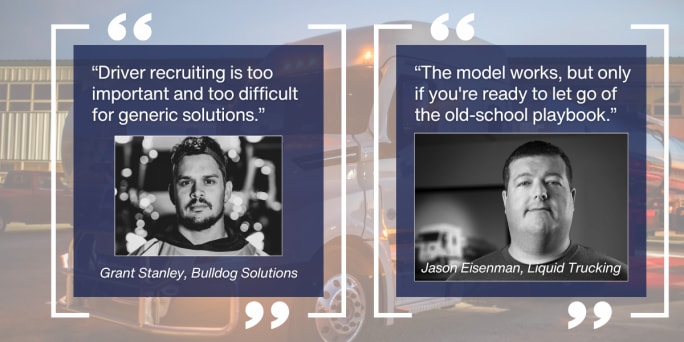
Image: HDT Graphic
“If you're willing to listen and collaborate, Bulldog brings the talent and ideas,” Eisenman says. “The model works, but only if you're ready to let go of the old-school playbook.”
Bulldog CEO Grant Stanley adds, “Everything we do is custom. Driver recruiting is too important and too difficult for generic solutions.”
Empathy and understanding are central to successful recruiting, he emphasizes. Drivers don’t just want a job; they want to belong. Bulldog helps fleets convey why their culture matters before asking drivers to apply.
“You earn intent before you earn an application,” Stanley explains. “And that starts with being human.”
Connecting With Truck Drivers on YouTube
While most fleets saturate Facebook with flashy ads, Bulldog is tapping into the vastly underutilized potential of YouTube, where few fleets are presently mining for drivers’ attention.
“YouTube is open sky,” Stanley says. “The challenge is producing enough content, quickly and affordably.”
Weekly podcasts are one way to feed the platform. User-generated content, such as driver testimonials and “day-in-the-life” videos, adds authenticity that no marketing team can replicate.
Real stories, told by drivers, are the backbone of Bulldog’s content strategy.
Another competitive edge, Eisenman says, is Bulldog’s fluency in the language of drivers.
“Drivers can sniff out inauthenticity instantly,” he says. “You need to understand the long hours, the sacrifices, the pride.”
To that end, Bulldog hires creatives with backgrounds in radio, design, and technology and trains them on the trucking industry and the driver lifestyle. They use their expertise to develop and test campaigns that resonate in the real world, resulting in increased applications, improved matches, and longer retention.
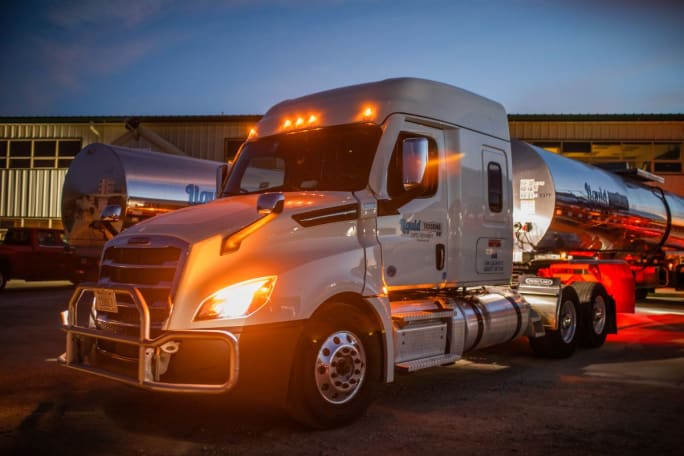
Liquid Trucking, based in Plattsmouth, Nebraska, operates 225 tractors and 415 tanker trailers.
Photo: Liquid Trucking
Liquid Trucking's Mobile App for Drivers
Liquid Trucking’s driver-focused innovations go beyond marketing.
In 2016, the company launched DeliveRecon, a driver mobile app combining location intelligence and operational functionality. The app streamlines delivery, incident reporting, document submission, and more.
It also gamifies engagement. Drivers earn points for uploading tips, photos, and videos about customer sites. Submissions are vetted and rewarded with redeemable incentives.
The results are tangible. Since rolling out DeliveRecon, Liquid Trucking has reduced turnover by 19.2%, maintaining a rate of 36.4% compared to the industry average of 94%.
“With DeliveRecon, we’re creating a system where drivers train each other,” Eisenman says. “They love it so much, they ask if they can take the app with them when they leave.”
Bulldog Works plans to offer DeliveRecon as a software-as-a-service solution to other fleets.
With measurable improvements in recruitment efficiency and retention, Bulldog and Liquid Trucking present a model for the industry to attract and support drivers in a complex and crowded digital landscape.
More Drivers

Truck Drivers Need More Than Another Alert
Fleets have more visibility into truck health, safety events, and driver activity than ever. The next challenge is turning all that information into useful guidance for the person who has to decide what to do next.
Read More →
FMCSA Removes 110 Truck Driver Training Schools from Certified ELDT List
Federal regulators also are targeting more than 160 additional training providers and launching a nationwide audit of third-party CDL skills testers as part of a broader crackdown on trucking fraud.
Read More →
Hours of Service Pilot Programs: FMCSA Readies for 2027 Rollout
Two pilot programs could eventually reshape hours-of-service rules, giving truck drivers options to pause their 14-hour clock or use longer split sleeper rest periods.
Read More →
Medical Cards, English Proficiency Reshape Roadcheck Violations
Medical-card violations jumped to the top of the driver out-of-service list during CVSA’s 2026 International Roadcheck, while English-language proficiency violations appeared among the leading violations for the first time.
Read More →
Driver Trust Can Make or Break the Success of Fleet Safety Technology
New Teletrac Navman research suggests that onboarding, transparency about driver data, and positive feedback can play a significant role in how commercial drivers respond to safety and coaching technology.
Read More →
EEOC Sues KLLM Over Alleged Sex Discrimination in Driver Training
KLLM is facing a federal sex-discrimination lawsuit over policies the EEOC alleges put female truck driver trainees at a disadvantage.
Read More →
FMCSA Moves to Codify English Language Requirements for Commercial Drivers
By changing regulations on English-language proficiency requirements for commercial drivers, rather than relying on a guidance memo, the FMCSA said future administrations won't be able to walk back the Trump administration's stricter enforcement with just a memo.
Read More →
Drivers Put Western Star Trucks to the Test at Star Nation Experience
Watch to get an inside look at the Western Star trucks, technology, and community behind the Star Nation Experience 2026!
Read More →
Trump Administration Looks to Put More Veterans Behind the Wheel
The Freedom Haulers program pulls together existing and expanded programs at several federal agencies to recruit veterans to drive commercial heavy-duty trucks and cut the red tape for them to get a CDL, training, and employment.
Read More →
Putting Mack’s Command Steer to the Test
A test drive of Mack’s Command Steer active steering system evaluates how it can make truck driving easier and less tiring.
Read More →