





"Just having something in a manual that you gave to somebody isn't enough.”
Don’t Let Your Fleet's Safety Manuals Hurt You in Court
Did you know your driver manuals and safety policies could be used against you? Find out how plaintiffs’ attorneys use the ‘Rules of the Road.’
February 27, 2024
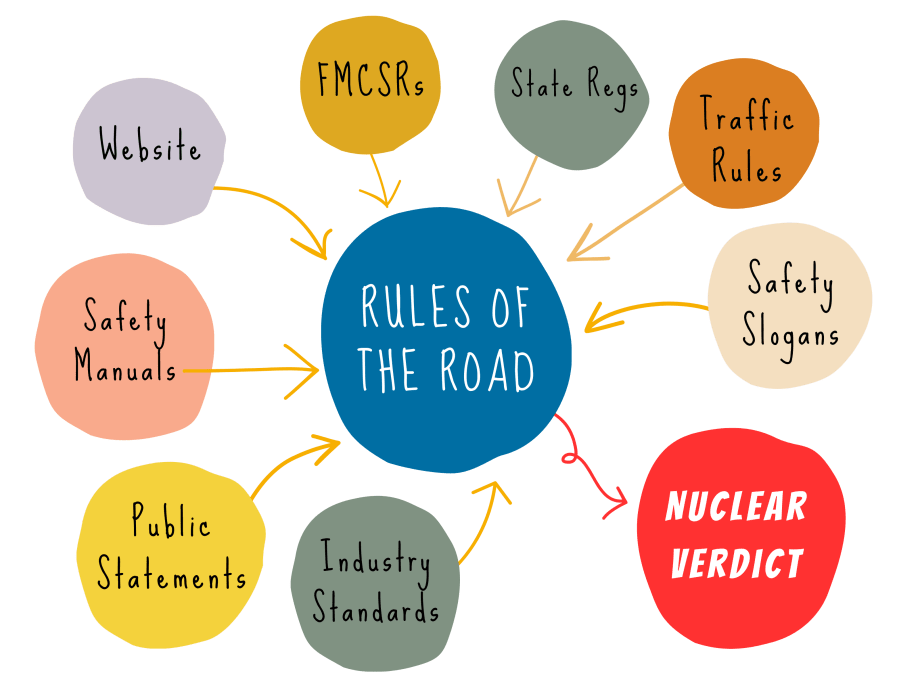
If your driver has violated any of these “rules of the road,” the argument is, your company should be at fault.
HDT Graphic
5 min to read
Attorneys targeting trucking companies in liability lawsuits are increasingly using a tactic that often has nothing to do with the facts of the crash that triggered the litigation.
When asked by a judge to decide what’s reasonable under the circumstances, many jurors will admit that they have made similar mistakes in the past, explains Doug Marcello, a trucking defense attorney with Saxton and Stump and chief legal officer for Bluewire.
“They had to come up with something else,” Marcello explains. “So they said, if somebody runs a stop sign, they violated a rule of the road that's black and white. Why can’t we make more things black and white, set up these rules so we can say there’s a violation there and so they’re negligent.”
The purpose of these “rules of the road,” he says, is to create a black-and-white definition of negligence for the jury. It seeks to create rules against which your driver and your company are measured — to make it automatically negligence if you don’t follow “your rule.”
Attorneys go beyond looking at whether a driver violated vehicle code or federal motor carrier safety regulations or state laws. They look to “industry standards” such as the Smith System. And they go through your company safety manuals, policies and procedures.
If your driver has violated any of these “rules of the road,” the argument is, your company should be at fault.
Attorneys can get access to this information through the discovery process in a legal claim. But beyond that, Marcello says, they will comb through a company’s websites, internet newsletters, and more.
Internal company literature and safety slogans consistently trip up trucking companies. When companies claim “safety is our top priority” publicly, plaintiffs’ attorneys can use it against you.
“Anything they can find that will be something that they can say, ‘Here's a principle that they adopted. And this driver or the company didn't live up to it.”
Read on below for common mistakes fleets make, or watch our interview with Doug Marcello:
6 Common Mistakes Fleets Make in Safety Manuals
1. Using absolutes.
If your safety manual tells drivers to never pull off the side of the road or never make a U-turn, and that circumstance arises in the accident, attorneys will use it — no matter how legitimate a reason the driver may have had to need an exception to that rule.
2. Adding safety platitudes.
Marcello says fleets often see safety manuals as an opportunity to include “platitudes of safety.” Some of these things might be more aspirational and can come back to haunt you later on.
3. Citing other manuals.
Some fleets will include quotes from other safety publications, Marcello says. The problem with that is that during a deposition or trial a plaintiffs’ attorney may ask about that source and allege that the fleet should live up to all the standards in that other document.
4. Setting standards you don’t enforce.
Don’t set standards for your drivers and company that you're not willing or able to enforce, Marcello says. For example, he says, if you have a phone policy for your drivers, you need to enforce it. And don’t limit it to your commercial drivers.
“One of the worst verdicts was a phone-related accident that occurred from a salesperson,” using their phone, Marcello says. “And the plaintiff's argument was, well, you know that they shouldn't be on the phone, because this is what you do with your truck drivers.”
5. Letting revisions get out of control.
It’s not unusual for something to happen that causes a fleet to add or change a safety policy. “What you want to do is to make sure that you don't have conflicts within those policies,” Marcello says. Make sure the effective dates are clear.
“You can imagine in litigation, they’ll say, what was the manual the driver had? We need to know what date or what volume it was that applied.”
What can happen is that the safety manual the driver got is different from the updated policies you’ve added since he was handed that manual during orientation.
6. Not keeping your safety manual updated.
Marcello recommends reviewing your safety manual at least once a year and asking yourself questions such as, “Do I still need that policy? Is it still applicable? Am I still enforcing it?”
Rethink Your Safety Manual
Marcello says fleets should think of their safety manuals and policies as the things they want and need drivers to follow and not add extraneous materials that could backfire in court.
“Look at the policies and procedures you want, the emphasis you have for your drivers, and then reduce it to those things,” Marcello says. Reduce the “target” by stripping down your manual and policies to what is needed, what is effective, and what is enforced.
Do your drivers actually read the safety manual?
Safety manuals, Marcello says, should be something that drivers will actually read and learn from. And thick safety manuals may not be the best way to do that.
What can happen in a deposition goes something like this:
Plaintiff’s attorney to driver: “Is that your signature on this page?”
Driver: “Yep.”
Attorney: “And did you sign for the manual?”
Driver: “Yeah.”
Attorney: “Did you receive a copy of the manual?”
Driver: “Yeah.”
Attorney: “Did you read the manual?”
Driver: “Well, some of it.”
Marcello emphasizes that “just having something in a manual that you gave to somebody isn't enough.”
Checklists or bullet points, or short videos, may be more effective ways of making sure drivers understand your safety policies and procedures.
He says he knows of one trucking company that has simplified its policies down to six principles. “And if you follow those six principles, you have adhered to all that they want you to do.”
Subscribe to Our Newsletter
More Safety & Compliance

FMCSA Pauses Biennial-Update Enforcement Amid Motus Transition
Carriers whose updates were due on or after June 1 have more time, while FMCSA works to stabilize its new registration system and warns of phishing sites impersonating its new carrier registration system, Motus.
Read More →
ZF Expands Commercial Vehicle Push in North America
ZF is expanding its North American commercial-vehicle presence with new transmission applications, electrification, trailer technology and autonomous-driving systems.
Read More →
Truck Drivers Need More Than Another Alert
Fleets have more visibility into truck health, safety events, and driver activity than ever. The next challenge is turning all that information into useful guidance for the person who has to decide what to do next.
Read More →
Tesla Wants a Self-Driving Semi. Are Cameras Enough?
Could Tesla’s camera-only autonomous driving technology work on an 80,000-pound Semi? In this commentary, HDT's Deborah Lockridge takes a look at Tesla, Cybercab, and how autonomous trucks see the road.
Read More →
What DOT’s Automated Vehicle Strategy Means for Trucking
The U.S. Department of Transportation issued a new automated-vehicle strategy that outlines plans for driverless-truck regulations, cross-state freight corridors, and federal safety standards.
Read More →
NYC Expands Speed, Pedestrian Safety Tech Across Fleet
New York City is expanding intelligent speed assistance and pedestrian-alert systems across its municipal fleet, moving the technologies from pilot programs into vehicle procurement and retrofit requirements.
Read More →
FMCSA Removes 110 Truck Driver Training Schools from Certified ELDT List
Federal regulators also are targeting more than 160 additional training providers and launching a nationwide audit of third-party CDL skills testers as part of a broader crackdown on trucking fraud.
Read More →
Beyond DOT Compliance: What Makes a Trucking Fleet Truly Safe?
A trucking fleet can follow every rule and still make unsafe decisions. The real test comes when safety conflicts with freight, productivity, or cost.
Read More →
Hours of Service Pilot Programs: FMCSA Readies for 2027 Rollout
Two pilot programs could eventually reshape hours-of-service rules, giving truck drivers options to pause their 14-hour clock or use longer split sleeper rest periods.
Read More →
New Guide Offers Pet Safety Tips for Truck Drivers
Hundreds of thousands of pets travel in truck cabs. A new safety guide from Volvo Trucks and the Center for Pet Safety offers practical advice for truck drivers who bring dogs and cats along for the ride.
Read More →