




Related: Bolt Rolls Out New Driver App
Dedicated Hauler Smooths Dispatching with Tailored System
When your business is primarily dedicated carriage, productivity must be top of mind. And it is for Bluegrass Trucking, according to Director of Operations Chris Hart, who says, “We capitalize on utilization of our equipment.”
by HDT Staff
September 5, 2019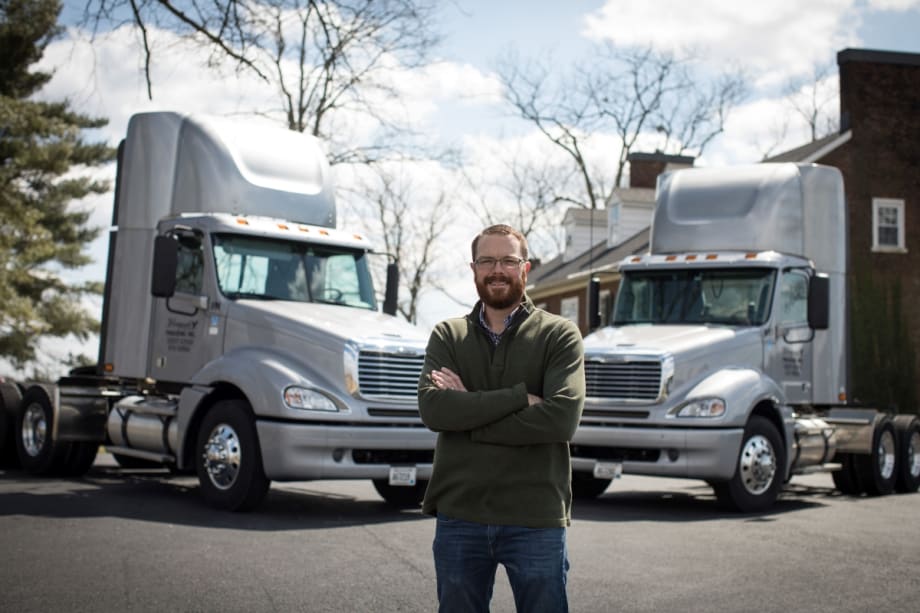
Chris Hart of Bluegrass Trucking says the primarily dedicated carrier has “so many moving pieces” that a fully automated dispatching program is just not the answer.
Photo: Bluegrass Trucking
4 min to read
When your business is primarily dedicated carriage, including hauling just-in-time freight, productivity must be top of mind. And it is for Bluegrass Trucking, according to Director of Operations Chris Hart, whose father launched the family business in 1991 with one truck and one driver.
“We capitalize on utilization of our equipment,” says Hart. “Our business consists of roughly 90% dedicated freight, which requires a different structure than a lot of other trucking companies.” The Harrodsburg, Kentucky-based firm, which also operates a terminal in Murfreesboro, Tennessee, has grown into a fleet of some 70 powered units and 350 trailers operated by a team of 115 drivers.
Bluegrass is the epitome of a niche operation. Even though 50% of the company’s lanes are local, within a 100 air-mile radius of its terminals, its trucks roll up more than 5 million miles annually. About 65% of its business revolves around hauling automotive freight, with general freight, including paper products, accounting for the other 35%.
Some dedicated routes cover less than 20 miles— but they may be run upwards of 35 times a day. Add in all the shuttling and spotting of trailers that entails, and you have a sense of the flow of a workday at Bluegrass.
Providing just-in-time service is a given when serving the automotive industry. JIT means trucks and cargo must arrive within a precise and predetermined window, often open only hours before the ordered parts and supplies are needed on an assembly line. Making JIT work requires keeping every link of the supply chain unbroken. That puts pressure on transportation logistics, which must work with maximum efficiency to keep up.
Making that happen at Bluegrass is a team of in-house dispatchers and account managers who keep track of shipments and make sure that everything is moving smoothly. “We need eyes constantly on the loads,” Hart says. Bluegrass has so many moving pieces, he says, that a fully automated dispatching program is just not the answer.
Instead, the carrier has opted for a solution from Bolt System that “allows a dispatcher or an account manager to take on other roles because of the information that's being compiled and made available within the system.”
Hart points out that the biggest thing driving Bluegrass to leverage dispatching software within its existing operation is customers demanding to be continually updated on schedules and gaining the ability to track progress in real time. He says Bolt provides a customer portal through which the carrier can selectively allow customers the ability to log into the system to view the details of their shipments — whether scheduled, in-transit or delivered. It can also provide automated emails with delivery ETAs based on onboard computer data. The Bolt system handles all electronic data interchange (EDI) transactions with Bluegrass’s customers, which frees up the carrier’s staff even more.
“Before, when we used a dispatch software, it required our people to make manual updates throughout the day and night,” says Hart. “Bolt creates a more effective communication device between the truck carrying a load and the customer, and that lets our team step back and simply monitor things.” He says the dispatching system also “makes it easier for our team to be able to quickly pull up the necessary information should a customer call in with inquiries about a load.”
In turning to Bolt for a dispatching system, Bluegrass wanted to be able to continue using Breakthrough Fuel, a third party that calculates the actual price of fuel paid by carriers on specific lanes each day and aligns freight costs with real-time fuel costs based on time, price, tax, and geography. That enables Bluegrass to manage the fluctuating cost of fuel by assessing a fuel surcharge to pass through to customers that’s based on solid research.
Hart notes that if a carrier is running a lane from Lexington, Kentucky, to Nashville, Tennessee, historically the process would require collecting the average fuel cost for that region via the Department of Energy and applying it to your fuel surcharge chart to obtain a billable rate. Bolt integrated the Breakthrough Fuel program into its software. Breakthrough emails Bolt daily fuel prices that correlate to specific lanes. Bolt then takes that information and applies it in the system so that the carrier can bill from it directly.
Bluegrass had tried out other dispatching programs, but Hart says none proved especially user-friendly. For the most part, he characterizes them as “cookie-cutter solutions” focused on handling the standard business processes of a specific type of company.
“Most dispatch programs are tailored to long-haul trucking situations where guys run routes with varying pickup and delivery points,” Hart says. “But we're completely dedicated and most of our routes are roundtrip. In saying that, a huge advantage with Bolt, as opposed to other fleet management software providers, is their willingness to adapt and be a real player for our specific operation."
Subscribe to Our Newsletter
More Fleet Management

Sponsored•September 16, 2026
Color Match Smarter: Tools That Restore & Perform
For fleet managers and collision repair professionals keeping heavy-duty trucks on the road, getting the color right the first time isn't just about appearance — it's about efficiency, turnaround time, and bottom-line results. Discover how today's digital color tools are transforming the repair process from guesswork to precision.
Read More →
FMCSA Pauses Biennial-Update Enforcement Amid Motus Transition
Carriers whose updates were due on or after June 1 have more time, while FMCSA works to stabilize its new registration system and warns of phishing sites impersonating its new carrier registration system, Motus.
Read More →
Sponsored•September 14, 2026
2026 Blueprint for Countering Smarter Supply Chain Theft
Cargo theft is no longer just the cost of doing business. It's a multi-billion-dollar criminal enterprise exploiting vulnerabilities across your fleet, drivers, and supply chain.
Read More →


Sponsored•September 1, 2026
How Telematics Improves Visibility, Control, and Performance in Refrigerated Fleets
Explore how telematics help refrigerated fleets improve visibility, uptime, efficiency, compliance, and cargo protection across connected cold chain operations.
Read More →
What the U.S.-Canada Trade War Means for Trucking
Escalating U.S.-Canada tariffs could disrupt cross-border freight, reduce truck volumes, raise costs, and create new uncertainty for carriers on both sides of the border.
Read More →
What Are Trucking’s Top Concerns for 2026?
The American Transportation Research Institute wants to know what's worrying trucking fleet managers, drivers, and other stakeholders in its annual Industry Issues survey.
Read More →
American Trucking Associations Looks for a New Leader
ATA President and CEO Chris Spear abruptly left his job at the association on August 21, at a pivotal time for the trucking industry.
Read More →
Public Wi-Fi Cybersecurity Risks: How Truck Drivers and Fleets Can Protect Their Data
Public Wi-Fi can expose truck drivers and fleets to credential theft, malware, and other cyber threats. Here’s how to reduce the risk on the road.
Read More →
For Nicky Cupp, Fleet Innovation Starts With Frustration
HDT Truck Fleet Innovator Nicky Cupp turns everyday pain points at Fraley & Schilling into opportunities for better technology and smarter processes.
Read More →
Adam Buttgenbach’s Approach to Electric Trucks: Start With Where They Fit
HDT Truck Fleet Innovator Adam Buttgenbach helped PepsiCo build one of North America’s largest EV fleets by focusing on where electric trucks make operational sense.
Read More →