




CVSA Ponders Driverless-Truck Enforcement
It will be impractical to have autonomous trucks pull into inspections stations, so CVSA and the industry are examining alternatives to traditional vehicle inspections.
July 26, 2021

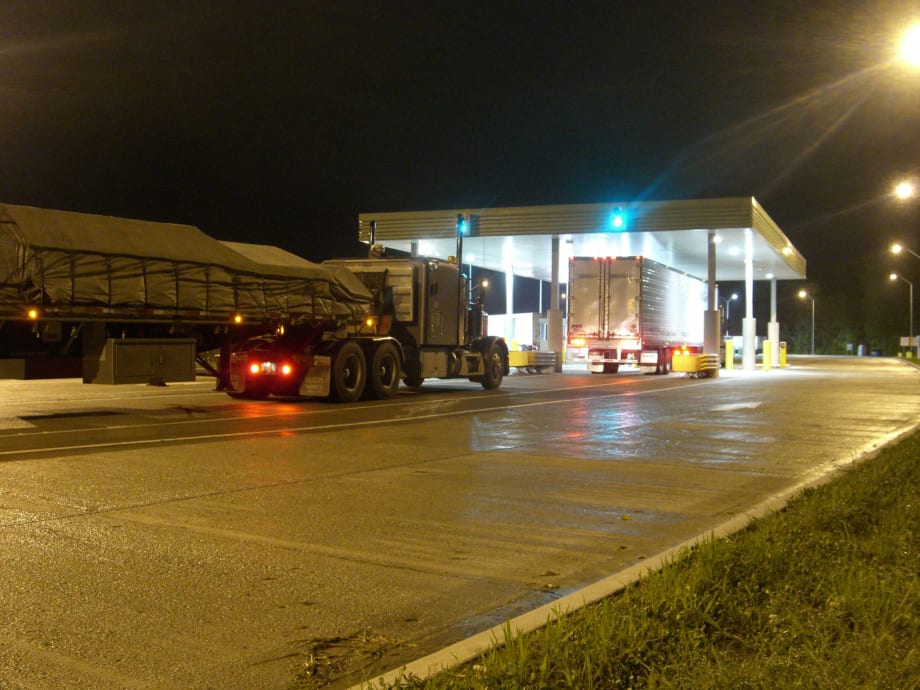
It will be impractical to have driverless trucks pull into inspections stations, so CVSA and industry are examining alternatives to traditional vehicle inspections.
Photo: Jim Park
5 min to read
There are currently about 100 autonomous-capable trucks operating on U.S. highways, with safety drivers in the cab. But by mid-decade, these vehicles and many more could be driving around with nobody aboard. The Commercial Vehicle safety Alliance recognizes the challenge of keeping an eye on driverless trucks. That's why it is developing standards and processes to ensure they are operating safely and in compliance with applicable motor carrier safety regulations.
Inspectors will obviously be limited in how they interact with trucks lacking a human point of contact. The question looking forward will be how to determine that the trucks are working properly and are defect free – in other words, how to hold them to the same compliance standards as human-piloted trucks.
Outlining these challenge and potential solutions at a July 21 CVSA webinar on driverless truck monitoring and enforcement were Dan Goff, head of policy at Kodiak Robotics, and Will Schaefer, director of safety programs with CVSA.
Goff said driverless trucks are fundamentally no different from piloted trucks, except they don’t need drivers and instead have a bunch of sensors, computers and other components that traditional trucks don’t need.
“The trucks have the same underlying hardware and maintenance needs, so the maintenance concerns should be pretty consistent for what we're doing and for traditional trucks,” said Goff. “We will also be hauling regular trailers, which I think is important. These trucks and trailers are a new link in supply chain, and not a brand-new technology.”
CVSA’s challenge will be coming up with a reliable alternative to the random roadside Level I inspection so familiar to fleets and drivers. Level I inspections are possible today, but once the safety drivers are pulled from the truck and they are operating on their own, the truck itself is incompatible with the Level 1 inspection.
“I would be uncomfortable suggesting that our inspectors interact with the vehicle,” said Schaefer. “How do you get access to the cargo or get inside the cab for whatever reason? Do you crawl under the vehicle to look at the chassis, the brakes, suspension, while interacting with the automated driving system?”
Schaefer said that while such inspections are important for road safety, he believes an alternative to hands-on inspections could be developed. CVSA has already established the Level VIII Electronic Inspection criteria. That, in conjunction with robust and reported pre-trip inspections, might be sufficient.
“With the Level VIII inspection, we believe that we would still have to build a viable set of data to be exchanged electronically, that would include information about the vehicle, the carrier and the automated driving system,” he explained. “It might also include confirmation that the enhanced pre-trip inspection was conducted. And I believe that there should be some vehicle safety information included from certain systems, such as brake brakes, lights and tires.”
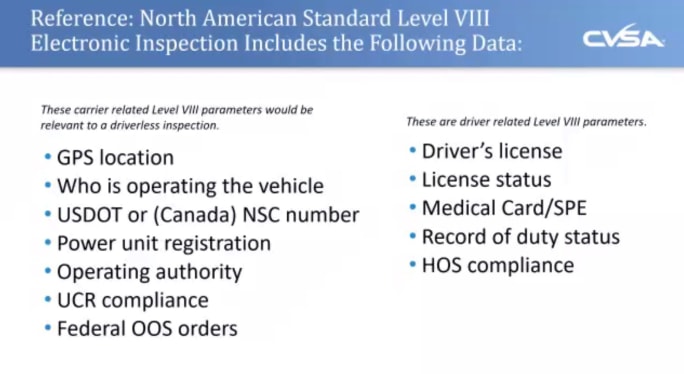
The Level VIII inspection is in limited use today, but when it’s applied to driverless trucks, the driver-related data, such as hours of service and medical, would not be required.
Photo: Screen capture of CVSA webinar
What Schaefer suggests is a practical alternative, with emerging telematic reporting capabilities on tire pressure, lighting function, and possibly brake-stroke or air reservoir pressure readings. Much of that data could be available through the truck’s on-board diagnostic system.
He called that a “trust and verify” approach.
From an on-road enforcement perspective, officials are still looking at ways driverless vehicles could be pulled over and stopped should the need arise, such as if it were to be involved in a collision or some defect was noticed that might present a hazard to road users. That remains a work in progress.
Where do Trailers Fit In?
Schaefer indicated trailers should also be included in these “enhanced” pre-trip inspection, but that’s not the consensus of the entire Enforcement and Industry Modernization Committee at CVSA.
“That is my opinion, and the opinion of many in the working group, but not all the working group,” his said, responding to a question from HDT. “We're considering that going forward. That is a topic that we need to have more discussion on.”
Goff indicated that trailers equipped with cameras, radar and various specialized sensors will not necessarily be used in the early days, at least, of autonomous trucks. But that doesn’t mean autonomous trucks will just hook up to any old trailer.
“We understand that a lot of the out-of-service violations, etc., are with trailers, not tractors, so, as an industry, we are very, very sensitive to trailer quality,” Goff said. "We inspect every trailer we take very carefully. For example, last week we started with a new customer. They wanted us to use their trailers, but we had to reject several trailers in a row because of the condition they were in. That's definitely one of the big questions here: how to ensure that the trailers we use are in the condition they need to be for us to operate safely.”
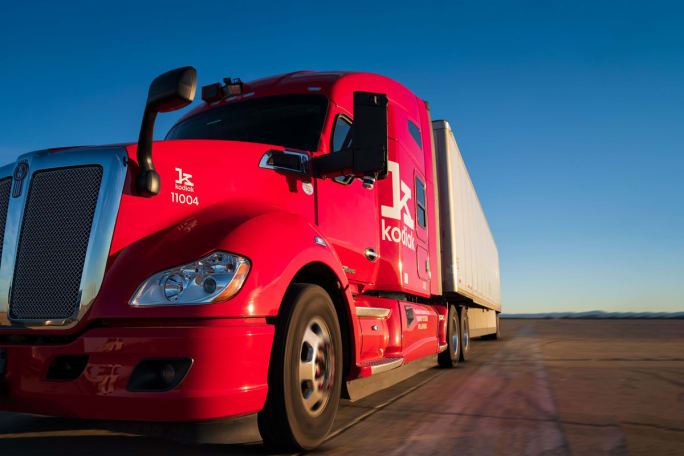
“These trucks and trailers are a new link in supply chain, and not a brand-new technology.”
— Dan Goff, Kodiak Robotics
Photo: Kodiak Robotics
Next Steps in Autonomous Truck Enforcement Plans
This is going to be a going concern with a very few years, and multiple groups and agencies are looking at how to enforce safety regulations in a practical way.
Schaefer said during the webinar that he and Goff have agreed to co-chair a Task Force on Automated Truck Inspection and Enforcement within the American Trucking Associations' Technology & Maintenance Council.
Earlier this year, the Federal Motor Carrier Safety Administration conducted a test of electronic transmission of Level VIII inspection data. On a test track, data was sent from a truck to a patrol car while in motion.
“They sent data on the operating condition of the automated driving system as well as data from the truck, including the pre-trip inspection report, the health status of the vehicle, and what I'll call the level-eight stuff — the vehicle identification, the license plate, the carrier’s name, the DOT number, etc.,” Schaefer said.
“This was a proof of concept,” he added, “and FMCSA is not the only one thinking about this. There has been considerable interest from inspection bypass services like Drivewyze and PrePass. They are thinking about electronic inspections publicly, and not just automated trucks.”
Subscribe to Our Newsletter
More Safety & Compliance

FMCSA Pauses Biennial-Update Enforcement Amid Motus Transition
Carriers whose updates were due on or after June 1 have more time, while FMCSA works to stabilize its new registration system and warns of phishing sites impersonating its new carrier registration system, Motus.
Read More →
ZF Expands Commercial Vehicle Push in North America
ZF is expanding its North American commercial-vehicle presence with new transmission applications, electrification, trailer technology and autonomous-driving systems.
Read More →
Truck Drivers Need More Than Another Alert
Fleets have more visibility into truck health, safety events, and driver activity than ever. The next challenge is turning all that information into useful guidance for the person who has to decide what to do next.
Read More →
Tesla Wants a Self-Driving Semi. Are Cameras Enough?
Could Tesla’s camera-only autonomous driving technology work on an 80,000-pound Semi? In this commentary, HDT's Deborah Lockridge takes a look at Tesla, Cybercab, and how autonomous trucks see the road.
Read More →
What DOT’s Automated Vehicle Strategy Means for Trucking
The U.S. Department of Transportation issued a new automated-vehicle strategy that outlines plans for driverless-truck regulations, cross-state freight corridors, and federal safety standards.
Read More →
NYC Expands Speed, Pedestrian Safety Tech Across Fleet
New York City is expanding intelligent speed assistance and pedestrian-alert systems across its municipal fleet, moving the technologies from pilot programs into vehicle procurement and retrofit requirements.
Read More →
FMCSA Removes 110 Truck Driver Training Schools from Certified ELDT List
Federal regulators also are targeting more than 160 additional training providers and launching a nationwide audit of third-party CDL skills testers as part of a broader crackdown on trucking fraud.
Read More →
Beyond DOT Compliance: What Makes a Trucking Fleet Truly Safe?
A trucking fleet can follow every rule and still make unsafe decisions. The real test comes when safety conflicts with freight, productivity, or cost.
Read More →
Hours of Service Pilot Programs: FMCSA Readies for 2027 Rollout
Two pilot programs could eventually reshape hours-of-service rules, giving truck drivers options to pause their 14-hour clock or use longer split sleeper rest periods.
Read More →
New Guide Offers Pet Safety Tips for Truck Drivers
Hundreds of thousands of pets travel in truck cabs. A new safety guide from Volvo Trucks and the Center for Pet Safety offers practical advice for truck drivers who bring dogs and cats along for the ride.
Read More →