




Related: Autonomous Trucks Need More than Self-Driving Tech to Become Reality
Commentary: What a Car-Trends Survey Tells Us About Future Truck Tech
74% believe that mixing autonomous and non-autonomous traffic will lead to severe safety issues.
by Rolf Lockwood
January 15, 2019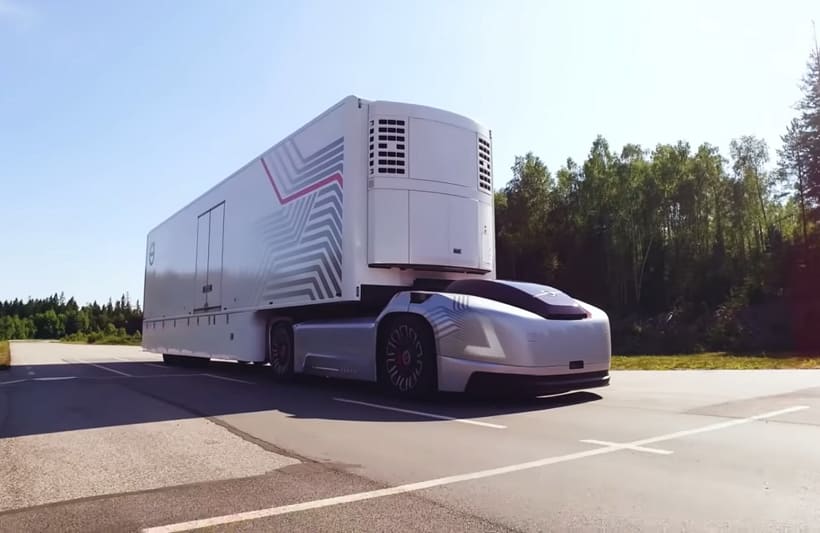
Most of us probably believe that the onset of autonomous vehicles is inevitable, cars and trucks alike. But will go smoothly?
Photo via Volvo Group
3 min to read
Most of us probably believe that the onset of autonomous vehicles is inevitable, cars and trucks alike. But does anyone think it will go smoothly? I sure don’t.
For the most part we’re seeing very capable technology, and it will only get better. But I believe the mixing of autonomous vehicles and those piloted by real people is fraught with risk. The reason is simple: People are stupid. Their driving skills are nearly non-existent. They’re also unpredictable. They sneeze, they get distracted by billboards, they can’t resist texting – you name it, they do it. So they often lose control, and I would challenge even the most sensor-laden autonomous truck to deal with all the resulting surprises.
So here’s an idea that comes out of a study by KPMG that surveyed car-maker executives and car-buying consumers as to the trends they see.
Of the executives, 74% believe that mixing autonomous and non-autonomous traffic will lead to severe safety issues. Mixed traffic is not possible, they conclude, saying it’s unlikely that fully autonomous vehicles and human drivers will use the same roads. As a result, they predict, we’ll see the trend of separation instead of integration, and with it the implementation of new road concepts and traffic systems over the next 10 years.
But that timeline doesn’t quite square with another conclusion about our future: 94% of those executives believe that a fully working and effective driving policy and regulations for autonomous vehicles will be set up no later than 2040. I should think that, if we’re fooling with new road and traffic strategies that could start to be seen within a decade, we’ll want to have those other policies well in hand at more or less the same time.
Does any of that square with your own thinking? I’d love to hear what you think.
The KPMG report is the giant consulting firm’s 19th annual Global Automotive Executive Survey by its Automotive Institute. Bearing in mind that the survey focused on the automotive world, we’re not dealing with an exact mirror of what’s going on with commercial vehicles. Still, there are significant points of overlap.
For instance, the report has confirmed my thinking about power sources of the near future.
I’ve written a few times this year that my money is on the hydrogen fuel cell as the eventual power source of the future, the one that will seize the biggest chunk of the internal combustion engine’s territory, and maybe not so long into the future.
Executives in the survey project this kind of split by 2040: battery electric vehicles (26%), fuel cell electric vehicles (25%), internal combustion engines (25%), and hybrids (24%). That’s about cars, remember. I think you can almost discount hybrids in our world.
Interestingly, KPMG respondents said: “Fuel-cell electric vehicles have replaced battery electric vehicles as this year’s No. 1 key trend until 2025.”
And this next one is especially interesting: Of the executives surveyed, 55% believe that pure battery-electric vehicles will fail due to the challenge of setting up the required infrastructure.
Thought-provoking, I’d say.
And with that, I wish you a Happy New Year. May all your miles be smooth and all your challenges small.
Subscribe to Our Newsletter
More Safety & Compliance

From One Generation to the Next: How Mentorship Builds Safer Truck Drivers
After three decades in trucking, Harold Perry shares what he's learned about driver safety, mentorship, and helping the next generation build confidence behind the wheel.
Read More →
FMCSA Pauses Biennial-Update Enforcement Amid Motus Transition
Carriers whose updates were due on or after June 1 have more time, while FMCSA works to stabilize its new registration system and warns of phishing sites impersonating its new carrier registration system, Motus.
Read More →
ZF Expands Commercial Vehicle Push in North America
ZF is expanding its North American commercial-vehicle presence with new transmission applications, electrification, trailer technology and autonomous-driving systems.
Read More →
Truck Drivers Need More Than Another Alert
Fleets have more visibility into truck health, safety events, and driver activity than ever. The next challenge is turning all that information into useful guidance for the person who has to decide what to do next.
Read More →
Tesla Wants a Self-Driving Semi. Are Cameras Enough?
Could Tesla’s camera-only autonomous driving technology work on an 80,000-pound Semi? In this commentary, HDT's Deborah Lockridge takes a look at Tesla, Cybercab, and how autonomous trucks see the road.
Read More →
What DOT’s Automated Vehicle Strategy Means for Trucking
The U.S. Department of Transportation issued a new automated-vehicle strategy that outlines plans for driverless-truck regulations, cross-state freight corridors, and federal safety standards.
Read More →
NYC Expands Speed, Pedestrian Safety Tech Across Fleet
New York City is expanding intelligent speed assistance and pedestrian-alert systems across its municipal fleet, moving the technologies from pilot programs into vehicle procurement and retrofit requirements.
Read More →
FMCSA Removes 110 Truck Driver Training Schools from Certified ELDT List
Federal regulators also are targeting more than 160 additional training providers and launching a nationwide audit of third-party CDL skills testers as part of a broader crackdown on trucking fraud.
Read More →
Beyond DOT Compliance: What Makes a Trucking Fleet Truly Safe?
A trucking fleet can follow every rule and still make unsafe decisions. The real test comes when safety conflicts with freight, productivity, or cost.
Read More →
Hours of Service Pilot Programs: FMCSA Readies for 2027 Rollout
Two pilot programs could eventually reshape hours-of-service rules, giving truck drivers options to pause their 14-hour clock or use longer split sleeper rest periods.
Read More →