




Commentary: Are Autonomous Trucks Job Killers?
We’re on a path where tech developers and big companies decide what technologies get introduced, while workers and the public bear the cost.
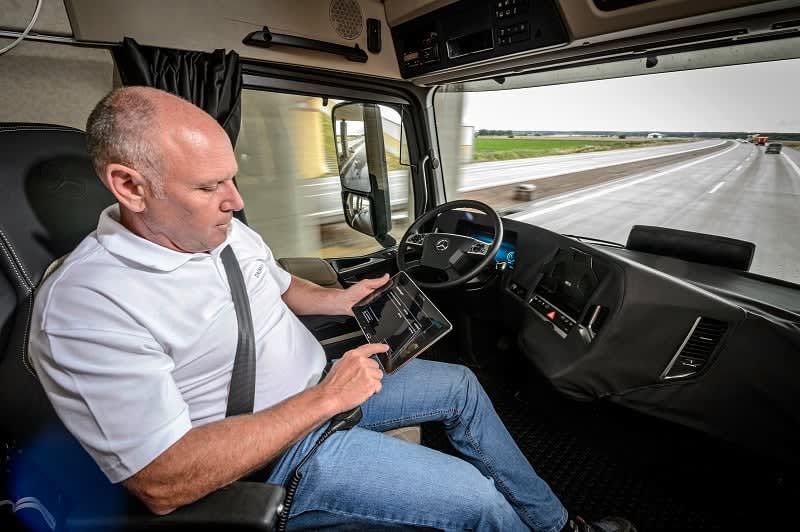
Autonomous trucks could potentially change the entire industry and it may affect trucking jobs first.
Photo via Daimler Trucks
When Daimler showed off its first semi-autonomous Actros tractor in 2014 on an empty stretch of German autobahn (they rented it!), the press almost universally called it a truck that drives itself. They were wrong.
Well, wrong to a point. And an important point, because amidst staged traffic on that highway, the Future Truck 2025 had limitations. It could indeed travel with no driver intervention without bumping into other vehicles, and the driver could indeed concentrate on his tablet to reserve a parking spot down the road. But there was lots it couldn’t do – like pass another truck or exit the highway on its own. This was Level 3 autonomy, which most definitely requires a driver. Level 5 would be truly driverless, and we’re not there yet, though the requisite technology is close.
Nevertheless, that Actros was labelled a “driverless truck,” and the folks who earn their living at the wheel hauling stuff down the interstates immediately cried en masse, “There goes our livelihood.”
They were wrong, too, as I wrote at the time, saying that such a huge transformation wouldn’t happen anytime soon. I still think that way, but a new report offers an in-depth look at the potential impact of autonomous trucks on driving jobs, and it doesn’t paint a pretty picture. Jointly commissioned by the UC Berkeley Center for Labor Research and Education and Working Partnerships USA, its title is “Driverless? Autonomous Trucks and the Future of the American Trucker.”
Written by Steve Viscelli, a sociologist and trucking expert at the University of Pennsylvania, it suggests that driverless trucks could replace many of the nation’s best long-distance trucking jobs, while shifting the industry toward more low-wage “gig” jobs. Viscelli says that without the right public policy decisions, eroding job quality should be as serious a concern as job loss.
The study argues that, under the adoption scenario that leading technology firms are presently working toward, autonomous trucks would primarily handle long-distance highway driving, while human drivers would navigate local routes.
Autonomous trucks could replace as many as 294,000 long-distance driving jobs, Viscelli suggests. Some 83,000 of the best trucking jobs, meaning stable careers and average annual earnings between $60,000 and $70,000, would be at high risk.
Another 211,000 lesser-quality jobs would also be at risk, the report says. Their annual earnings average between $46,000 and $53,000 and workers suffer from “exploitative labor practices” and high turnover.
While new local driving and delivery jobs (with humans at the wheel) would be created, data suggests these jobs could pay about half as much as those lost through automation.
The study identifies and analyzes six possible scenarios for how autonomous trucks could be introduced, each with different job impacts. The best of them is this one: Establish a “multi-stakeholder ‘Trucking Innovation and Jobs Council’ to develop a shared innovation agenda, create career pathways, and support displaced workers.”
“Right now, we’re on a path where tech developers and big companies decide what technologies get introduced, while workers and the public bear the cost of those choices,” said Derecka Mehrens, executive director of Working Partnerships USA. “If we want innovation to benefit all of us, we need a more balanced approach: one where workers and the public play an active role in guiding innovation, and those who profit from new technology also take responsibility for its impacts.”
I couldn’t possibly agree more.
Rolf Lockwood is vice president, editorial, at Newcom Business Media, which publishes Today’s Trucking. He writes for HDT each month on the making, maintaining and using of trucks. He can be reached at rolf@newcom.ca or 416-315-1829.
More Drivers

Truck Drivers Need More Than Another Alert
Fleets have more visibility into truck health, safety events, and driver activity than ever. The next challenge is turning all that information into useful guidance for the person who has to decide what to do next.
Read More →
FMCSA Removes 110 Truck Driver Training Schools from Certified ELDT List
Federal regulators also are targeting more than 160 additional training providers and launching a nationwide audit of third-party CDL skills testers as part of a broader crackdown on trucking fraud.
Read More →
Hours of Service Pilot Programs: FMCSA Readies for 2027 Rollout
Two pilot programs could eventually reshape hours-of-service rules, giving truck drivers options to pause their 14-hour clock or use longer split sleeper rest periods.
Read More →
Medical Cards, English Proficiency Reshape Roadcheck Violations
Medical-card violations jumped to the top of the driver out-of-service list during CVSA’s 2026 International Roadcheck, while English-language proficiency violations appeared among the leading violations for the first time.
Read More →
Driver Trust Can Make or Break the Success of Fleet Safety Technology
New Teletrac Navman research suggests that onboarding, transparency about driver data, and positive feedback can play a significant role in how commercial drivers respond to safety and coaching technology.
Read More →
EEOC Sues KLLM Over Alleged Sex Discrimination in Driver Training
KLLM is facing a federal sex-discrimination lawsuit over policies the EEOC alleges put female truck driver trainees at a disadvantage.
Read More →
FMCSA Moves to Codify English Language Requirements for Commercial Drivers
By changing regulations on English-language proficiency requirements for commercial drivers, rather than relying on a guidance memo, the FMCSA said future administrations won't be able to walk back the Trump administration's stricter enforcement with just a memo.
Read More →
Drivers Put Western Star Trucks to the Test at Star Nation Experience
Watch to get an inside look at the Western Star trucks, technology, and community behind the Star Nation Experience 2026!
Read More →
Trump Administration Looks to Put More Veterans Behind the Wheel
The Freedom Haulers program pulls together existing and expanded programs at several federal agencies to recruit veterans to drive commercial heavy-duty trucks and cut the red tape for them to get a CDL, training, and employment.
Read More →
Putting Mack’s Command Steer to the Test
A test drive of Mack’s Command Steer active steering system evaluates how it can make truck driving easier and less tiring.
Read More →