




Related: Focus On... Behind the Scenes of Mack RoadLife 2.0 [Video]
Business is Booming for Mobile Concrete Pumps
The interest in truck-mounted concrete pumps continues to grow amid the push for ever-higher productivity gains on modern construction sites.
by John G. Smith
September 9, 2019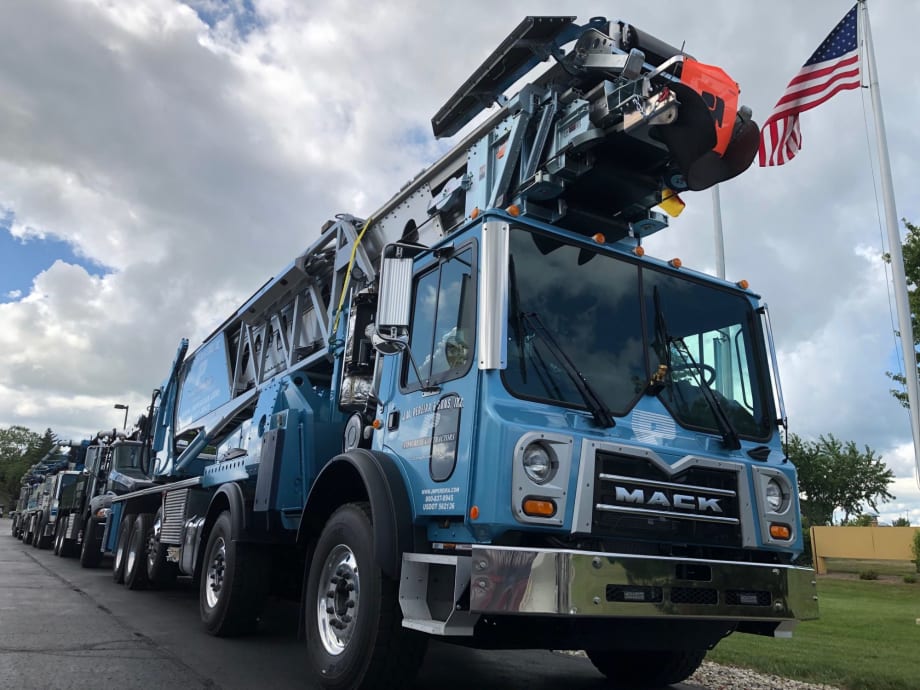
Belt-driven equipment can be used to transfer coarse material, and they can be simpler to maintain.
5 min to read
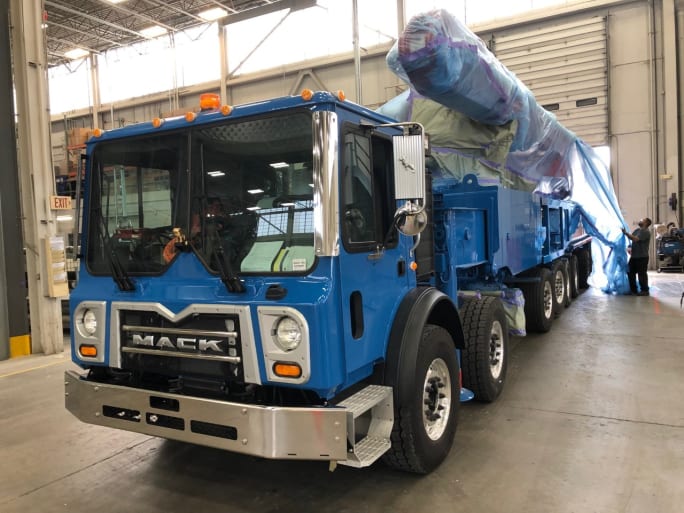
A member of the Putzmeister production team removes the wraps from a freshly painted concrete pump destined for Pompages De Beton in Quebec.
Photos via Today's Trucking
The interest in truck-mounted concrete pumps continues to grow amid the push for ever-higher productivity gains on modern construction sites.
Maybe you could call these the boom times.
Forty-five percent of concrete is still poured directly off trucks, in a process referred to as tailgating, but 34% of the material is now pumped into place, Concrete Pumping Holdings reports. The rest is left to move by old-school buckets and wheelbarrows.
Barely two decades ago, concrete pumps accounted for 20% of such work.
It means the business of pumping concrete is annually worth an estimated $1.75 billion in the U.S. and it’s expected to be worth $2.3 billion by 2021.
There is now a market for about 1,000 mobile concrete pumps in North America per year, say officials with Putzmeister, a global supplier of the equipment. Around 10% of those are destined for job sites in Canada.
“These,” says Jonathan Randall, “are the toys we love at Mack Trucks.”
The OEM’s senior vice-president of North American sales and marketing has a good reason to love such equipment. Trucks with bulldogs on their hood serve as the underlying platform for a significant share of concrete pumps.
The engineering behind concrete pumps
These are impressive pieces of machinery.
Picture a truck like a Mack Granite or TerraPro with a giant arm — sometimes more than 196 feet long — that unfolds and stretches out to the precise location where concrete needs to be poured. Concrete is fed into a hopper at the rear, while an S-tube shifts back and forth to push the building material up the length of a corresponding five-inch pipe.
Putzmeister America president and CEO Jonathan Dawley says sales of these concrete pumps grew steadily between 2013 and 2019, as fleets replenished equipment that was shed during the last economic downturn.
It’s a global business, too.
The company he oversees, which produces North American concrete pumps at a facility in Wisconsin, was purchased in 2012 by Sany Heavy Industries, which produces pumps for China. Other facilities are located as far afield as India, Germany and Turkey.
In Minnesota, Schwing America produces competing concrete pumps along with truck mixers, truck-mounted loop conveyors, batch plants, and reclaimers. It has seven global manufacturing facilities and a presence in China’s Xushou Construction Machinery Group (XCMG).
Concrete pumps of one form or another have been behind some of the most widely recognized construction projects in the world. Putzmeister refers to its equipment used to build locks for the Panama Canal, and a bypass for the Hoover Dam. It actually set a Guinness World Record in February 2014 when pumping 21,200 cubic yards of concrete for the Wilshire Grand Center’s foundation in Los Angeles. Schwing projects include New York City’s Freedom Tower, which required a pair of high-pressure stationary pumps to push concrete over 1,600 vertical feet.
But the mobile truck-mounted equipment requires advanced engineering in its own right.
Putzmeister is currently placing the finishing touches on an eight-axle truck with a 63-meter boom destined for Quebec’s Pomages De Beton TPG, once the loads are equalized on axles in the fourth, fifth and sixth positions. The final piece will weigh in at 128,900 pounds. A similar unit is destined for Pompes a Beton Tremblay. Schwing America, meanwhile, is preparing to ship a truck of its own to Montreal. That unit will feature a 200-foot boom and weigh in at 113,000 pounds.
“The rigidity of the product, the durability of the product is paramount,” Dawley says, referring to the trucks that can push 238 cubic yards of concrete per hour up to 230 feet in the air.
Concrete pumps can last 10-15 years with the right care, too, and they can be profitable despite price tags that sometimes reach above $1 million.

Concrete pumps deliver building material with a high degree of accuracy, but the work involves a race against the clock.
Concrete pump maintenance
It doesn’t mean the work is easy, though. Pouring concrete involves a race against the clock. A load of ready-mix concrete has a shelf life of just 90 minutes, says Tom O’Malley, Schwing America’s senior vice-president of sales and marketing.
To compound matters, new additives and accelerators continue to shrink the available timelines, which can already vary depending on everything from the time of year to concrete temperatures.
“It’s not just sand, water, and rock,” says Tom Inglese, general manager for Pioneer Concrete Pumping, headquartered in Atlanta, Ga.
“Concrete pumping is tricky business. Concrete don’t wait for anybody.”
His observation is especially true when it comes to any concrete that remains in the pipe. Left to harden, the building material can cause expensive and irreversible damage.
Once a pour is completed, hard rubber plugs known as “go devils” need to be forced through the pipe under the power of compressed air, squeezing through curves known as the “candy cane” until they emerge.
That’s when everything goes as planned. Teams are sometimes left to manually knock and shake the pipes to try to clear any blockages.
“It can be a really stressful thing at times,” Inglese says.
If the pipes are not cleared? “You’ve got really expensive fence posts.”
Maintenance support for concrete pumps
Ongoing maintenance support makes the difference when it comes to maintaining the all-important uptime.
This equipment moves undeniably abrasive material, and the S-tubes themselves are a source of metal-on-metal wear.
The pipes themselves, traditionally the biggest wear items, typically last two to three years. The booms, meanwhile, are moving mechanisms that require care of their own.
“That boom tip can be damaged, either hitting things or doing things it wasn’t meant to do,” Dawley says.
And there are clearly plenty of bearings to grease.
While automatic lubricating systems are available, most operations choose to apply their grease manually. “The takeup on that option might be 10% of sales,” Dawley says.
But no matter what process is followed, the goal is to keep everything on the move.
John G. Smith is the editor of the award-winning Canadian publication Today's Trucking. This article was used under a cooperative editorial sharing agreement between HDT and its Canadian counterpart.
Subscribe to Our Newsletter
More Equipment

How Volvo Updated Its D13 for EPA 2027 [Watch]
Volvo’s updated D13 promises lower emissions without sacrificing performance or fuel economy. Take a closer look at what changed inside the engine in this HDT Spotlight video.
Read More →
Michelin Tire Improves Efficiency and Durability for Regional Fleets
The Michelin X Multi Energy D2 is a regional haul drive tire engineered to help fleets improve fuel efficiency, durability and traction in demanding stop-and-go operations.
Read More →
ZF Expands Commercial Vehicle Push in North America
ZF is expanding its North American commercial-vehicle presence with new transmission applications, electrification, trailer technology and autonomous-driving systems.
Read More →
Tesla Wants a Self-Driving Semi. Are Cameras Enough?
Could Tesla’s camera-only autonomous driving technology work on an 80,000-pound Semi? In this commentary, HDT's Deborah Lockridge takes a look at Tesla, Cybercab, and how autonomous trucks see the road.
Read More →
Kodiak: Driverless Long-Haul Truck Launch on Track for 2026
Kodiak AI says its driverless long-haul safety case is 93% complete and it remains on track to begin commercial operations by year-end 2026.
Read More →
What DOT’s Automated Vehicle Strategy Means for Trucking
The U.S. Department of Transportation issued a new automated-vehicle strategy that outlines plans for driverless-truck regulations, cross-state freight corridors, and federal safety standards.
Read More →
East Coast Port Launches $45M Electric Truck Push
The Port Authority of New York and New Jersey announced millions in incentives for zero-emission drayage trucks, yard tractors, and new charging hubs near the port.
Read More →
PlusAI Going Public to Fund Autonomous Truck Launch
A SPAC deal could provide PlusAI with up to $300 million as it works toward a 2027 commercial launch of factory-built autonomous trucks.
Read More →
NHTSA Moves to Rewrite Truck Fuel-Economy Rules
The National Highway Traffic Safety Administration says it lacks authority to regulate medium- and heavy-duty truck engines separately from complete vehicles, but the existing standards have not yet been eliminated.
Read More →
Detroit Opens Orders for EPA 2027 Engines
Detroit isn’t starting from scratch to meet EPA 2027 diesel emissions standards. Its Gen 6 DD13 and DD15 engines keep much of today’s platform while updating the fuel and aftertreatment systems.
Read More →