





Related: DOT Considers Mandating Crash Mitigation on Class 3-8 Trucks
Behind UPS' Decision to Make Collision Mitigation Standard
While UPS announced that it would be making collision mitigation technology standard on its Class 8 trucks, the decision had its beginnings as far back as 2012.
October 23, 2015
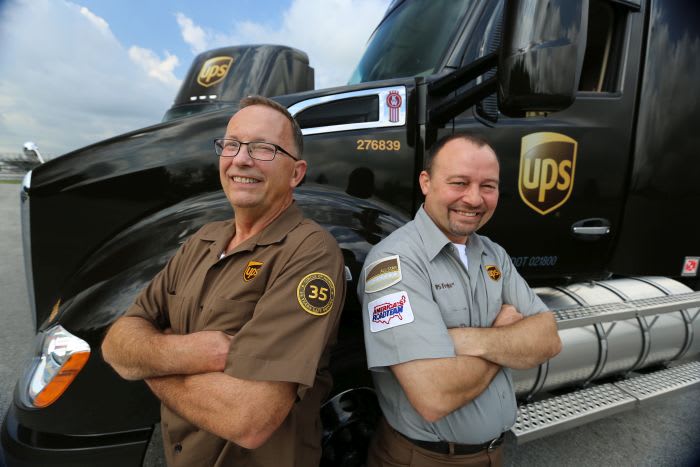
UPS driver Bill Lazarski of Chicago (left) and UPS Freight driver Paul Savill of Cincinnati (right) are fans of the collision mitigation technology that’s now standard equipment on every new UPS Class 8 tractor the company orders.
5 min to read
UPS driver Bill Lazarski of Chicago (left) and UPS Freight driver Paul Savill of Cincinnati (right) are fans of the collision mitigation technology that’s now standard equipment on every new UPS Class 8 tractor the company orders.
In July, UPS announced that it is making collision mitigation technology standard equipment on every new Class 8 tractor the company orders.
Each of the more than 2,600 new heavy-duty tractors that UPS takes delivery of this year have Bendix Wingman Advanced systems, which alert drivers to moving and stationary objects in front of the tractor and moving objects surrounding the vehicle.
The collision mitigation system also features adaptive cruise control, which maintains a constant distance behind the vehicle in front of the UPS tractor. With the adaptive cruise control turned on, the UPS tractor will automatically slow down to avoid a collision.
It’s a decision that actually had its beginnings in 2012, explains Emilio Lopez, global fleet safety manager, when UPS started adding stability control to its Class 8 tractors. Then about two years ago, the company implemented a pilot program to evaluate collision mitigation technology.
Bill Lazarski, a UPS Circle of Honor driver, was one of the drivers in the pilot program. Today, he says he “can’t say enough good things about the collision mitigation technology,” adding, “I would not want to do without it now.”
But he didn’t start out feeling that way.
“At first I was hesitant. I thought, ‘What can an electronic system do just as well as if not better than my experience of over 36 years without having a crash?’ But everyone who’s human will make a mistake now and then. What this technology taught me is sometimes maybe I’m not as accurate as I thought I was.”
Lazarski is a big fan now, saying the technology “makes a good driver into a better driver.” For instance, he says, when a driver is checking his or her mirrors every five to eight seconds, trying to predict what’s coming up behind and on the sides, sometimes that can allow the truck to close up some of that safe cushion between it and the vehicle ahead. The collision mitigation technology offers a warning to widen that cushion back up.
“I’ve never actually had the system fully engage,” Lazarski says. “I constantly strive to try to watch what traffic patterns are doing in front of me and try to predict. Again, the Wingman System is a great tool for a driver. I as a driver am still responsible for the safe operation of that vehicle.”
When asked about how they evaluated their return on investment in the pilot program, Lopez responded, “It’s hard to put a ROI on saving someone’s life…The feedback we get [from drivers] is, ‘I thought I was a good driver, but this is making me a better driver.’ [The decision] was more about the positive feedback we were getting from employees, that it was the right thing to do for them.”
Nevertheless, the company did look at the crash rates for the 50 vehicles in the pilot program per million miles driven and saw significant improvements in crash rates compared to the rest of the fleet.
There’s also a secondary benefit — fuel economy, thanks to a lessening of the “accordion effect” of traffic, Lopez says, but he emphasizes, “that did not factor into the decision. It’s a safety decision.”
Lopez and Lazarski both stress the fact that the system is an additional tool, not a replacement for UPS drivers’ scrupulous training and policies about following distance.
“The collision mitigation, from my perspective, really validated the comprehensive defensive driving UPS teaches drivers,” Lopez explains. The warning, he says, helps drivers re-focus on keeping that space around them at all times if something happens such as someone changing lanes right in front of the truck.
“This just gives us another method, another process in our defensive driving program, that we can just give that driver one more opportunity when there is a refocusing that needs to take place.”
Lazarski and other drivers who were in the pilot program also helped develop the UPS training program for drivers to go through before they get a truck with the new safety systems.
Bendix provided the training originally, but in expanding the program to 2,600 trucks, that’s not possible.
“I knew we needed to engage the employees who have been using these systems in the pilot program,” Lopez explains. “So we brought a selected group together and they really developed the training for their peers.”
The training includes a PowerPoint presentation and a verbal overview of what to expect and how it works. “Most importantly, we go in the vehicle with them and they get a hands-on demonstration,” he says.
Having drivers involved in developing the training, he says, will help make adoption go more smoothly.
“I think because of what we’ve done having this UPS training we’ve built from their peers, they do not see this as management-driven education,” Lopez says. “It’s really a collaborative training, and they’re getting first-hand experience. They’re really getting it from the driver and the benefits they’ve seen on the road from the system.”
The National Transportation Safety Board recently recommended that all passenger and commercial vehicles use collision avoidance technology. The suppliers of the technology prefer the term “collision mitigation,” because it’s impossible to avoid all accidents, but it can lessen the severity.
The collision mitigation systems on UPS’s new Class 8 tractors also feature Bendix AutoVue lane departure warning system, Blindspotter side detection radar; Bendix ESP electronic stability control, and anti-lock air disc brakes.
UPS stresses that the most important stop for its drivers is the last stop of the day: at home with their families.
“When I’m on the highway and you’re next to me, I consider you my family,” Lazarski says. “I want you to be protected. And I know the UPS family feels the same way.”
Subscribe to Our Newsletter
More Safety & Compliance
PrePass, Kodiak Connect Driverless Trucks to Roadside Enforcement
The system will allow enforcement agencies to verify Enhanced Inspection information and decide whether Kodiak’s autonomous trucks can bypass roadside screening sites.
Read More →
From One Generation to the Next: How Mentorship Builds Safer Truck Drivers
After three decades in trucking, Harold Perry shares what he's learned about driver safety, mentorship, and helping the next generation build confidence behind the wheel.
Read More →
FMCSA Pauses Biennial-Update Enforcement Amid Motus Transition
Carriers whose updates were due on or after June 1 have more time, while FMCSA works to stabilize its new registration system and warns of phishing sites impersonating its new carrier registration system, Motus.
Read More →
ZF Expands Commercial Vehicle Push in North America
ZF is expanding its North American commercial-vehicle presence with new transmission applications, electrification, trailer technology and autonomous-driving systems.
Read More →
Truck Drivers Need More Than Another Alert
Fleets have more visibility into truck health, safety events, and driver activity than ever. The next challenge is turning all that information into useful guidance for the person who has to decide what to do next.
Read More →
Tesla Wants a Self-Driving Semi. Are Cameras Enough?
Could Tesla’s camera-only autonomous driving technology work on an 80,000-pound Semi? In this commentary, HDT's Deborah Lockridge takes a look at Tesla, Cybercab, and how autonomous trucks see the road.
Read More →
What DOT’s Automated Vehicle Strategy Means for Trucking
The U.S. Department of Transportation issued a new automated-vehicle strategy that outlines plans for driverless-truck regulations, cross-state freight corridors, and federal safety standards.
Read More →
NYC Expands Speed, Pedestrian Safety Tech Across Fleet
New York City is expanding intelligent speed assistance and pedestrian-alert systems across its municipal fleet, moving the technologies from pilot programs into vehicle procurement and retrofit requirements.
Read More →
FMCSA Removes 110 Truck Driver Training Schools from Certified ELDT List
Federal regulators also are targeting more than 160 additional training providers and launching a nationwide audit of third-party CDL skills testers as part of a broader crackdown on trucking fraud.
Read More →
Beyond DOT Compliance: What Makes a Trucking Fleet Truly Safe?
A trucking fleet can follow every rule and still make unsafe decisions. The real test comes when safety conflicts with freight, productivity, or cost.
Read More →