





Editor's Note: This article originally was published in 2020. It has been updated with 2024 information.
Are Your Truck Drivers Getting Enough Sleep?
There's much more to preventing tired or drowsy driving than just complying with federal hours of service rules. A sleep expert and author offers a few tips on how to keep truck drivers awake and alert at the wheel.
March 5, 2025
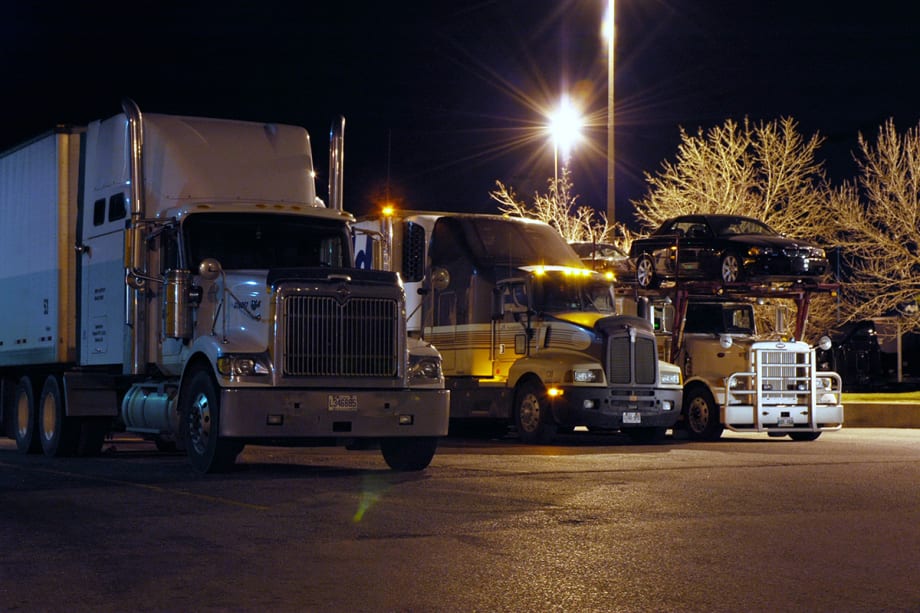
Humans are wired to sleep at night and be awake during the day. When schedules upset our sleep, sleep quality can suffer, along with safety and health.
Photo: Jim Park
5 min to read
The National Sleep Foundation says drowsy driving is reaching epidemic proportions. It's just as dangerous as driving while intoxicated. A 2024 survey found that only four in 10 adults are likely to find alternatives to driving when they haven’t gotten enough sleep — yet nearly seven in 10 adults are likely to find alternatives to driving after having a few drinks.
According to the National Highway Traffic Safety Administration, every year about 100,000 police-reported crashes involve drowsy driving. These crashes result in more than 1,550 fatalities and 71,000 injuries.
The real number may be much higher, however, as it is difficult to determine whether a driver was drowsy at the time of a crash.
Data from the AAA Foundation for Traffic Safety and other studies show drowsy driving is responsible for one out of every five deadly motor vehicle crashes and one out of every 10 motor vehicle crashes causing hospitalization.
Other estimates total more than 300,000 police-reported crashes, 100,000 injuries, and 6,400 deaths in the U.S. annually.
Drowsy driving is a public health and safety issue. NSF data have shown that as many as six in 10 adult drivers admit to having driven a car when they were so tired they had difficulty keeping their eyes open.
And beyond the human toll is the economic one. The National Highway Traffic Safety Administration estimates fatigue-related crashes resulting in injury or death cost society $109 billion annually, not including property damage.
Truck Driver Hours of Service and Drowsy Driving
The NSF doesn't mention truck drivers in particular in its statistics on drowsy driving, but surely there are a few incidents within these numbers.
Commercial drivers are, of course, subject to hours of service rules intended to mitigate the impact of fatigue, but they don't always have the intended effect. In some cases, they can exacerbate the problem for drivers whose schedules are turned upside-down.
Nor do the rules account for individuals' need for sleep. Some people biologically require six or seven hours of sleep, while others may require eight or nine. Nor do the rules — and probably few fleet operations departments — account for drivers' personal chronotypes, whether they are a night owl or a morning person.
"Some of the rules that are intended to protect drivers are great, but some of these duty-cycles create consequences and problems because they're not particularly well thought out," says Chris Winter, a board-certified neurologist and an internationally recognized sleep expert with his own practice, Charlottesville Neurology and Sleep Medicine, in Charlottesville, Virginia.
"The rules don't take individual chronotypes into account. For example, I'm a much more dangerous driver in the morning than I am at night. But if you restrict my ability to drive at night, are we really making things that much safer for me and for the people on the road when I'm driving?"
What Happens When You Don't Get Enough Sleep?
Winter was the subject of an HDT Talks Trucking podcast episode, The Need for Sleep. He describes some of the problems that can arise from not getting sufficient sleep over a long period.
He says lack of sleep can affect almost every organ and system in the body in some way, including our immune systems, cardiovascular system, and even our moods. Do you ever wonder why you feel a bit grumpy on Fridays? Lack of sleep may have something to do with it.
"When individuals don't get the sleep they need, they tend not to make great decisions," he says.
"Sleep-deprived individuals tend to suffer a decline in short-term concentration, as well as their ability to focus. It also affects their mood and interestingly, the ability to interpret the moods or the feelings of somebody that we're talking to."
Those are common but lesser-known manifestations of a lack of sleep. Some of the more commonly associated problems can be the vascular effects, like hypertension, and the risk of heart attacks and strokes.
"You can go all the way down the list to even how we look," he says. "Lack of sleep tends to age our appearance.
"I tell people that sleep loss is sort of like rust; it just kind of eats away at whatever you're talking about."
Why Truck Drivers' Irregular Sleep Schedules Are a Problem
If insufficient sleep isn't enough a problem, irregular sleep schedules can wreak havoc on our bodies, too.
Everything that happens inside us is based on a highly regulated internal clock, called a circadian rhythm. We are biologically wired to sleep at night and be awake and alert during the day, which is pretty obvious.
What's not so obvious is what happens to digestion and other processes when you eat a meal at 3 a.m., when your system thinks it should be sleeping.
"And so, what happens with a truck driver who is driving all around the clock? If you ask them when they go to bed, when do they wake up, when do they drive, when do they rest, they can't answer the question because every day is different," Winter says.
"If you could peer deep inside that individual's brain and body, you'd see all these other processes – digestion, metabolism, cognition – are all going to be sort of haphazard as well."
Even shift workers have a fighting chance of regulating some bodily functions if they stay on a certain shift for a period of time, but drivers who start and stop and different times of the day quickly throw those functions into disarray.
Subscribe to Our Newsletter
More Drivers

Truck Drivers Need More Than Another Alert
Fleets have more visibility into truck health, safety events, and driver activity than ever. The next challenge is turning all that information into useful guidance for the person who has to decide what to do next.
Read More →
FMCSA Removes 110 Truck Driver Training Schools from Certified ELDT List
Federal regulators also are targeting more than 160 additional training providers and launching a nationwide audit of third-party CDL skills testers as part of a broader crackdown on trucking fraud.
Read More →
Hours of Service Pilot Programs: FMCSA Readies for 2027 Rollout
Two pilot programs could eventually reshape hours-of-service rules, giving truck drivers options to pause their 14-hour clock or use longer split sleeper rest periods.
Read More →
Medical Cards, English Proficiency Reshape Roadcheck Violations
Medical-card violations jumped to the top of the driver out-of-service list during CVSA’s 2026 International Roadcheck, while English-language proficiency violations appeared among the leading violations for the first time.
Read More →
Driver Trust Can Make or Break the Success of Fleet Safety Technology
New Teletrac Navman research suggests that onboarding, transparency about driver data, and positive feedback can play a significant role in how commercial drivers respond to safety and coaching technology.
Read More →
EEOC Sues KLLM Over Alleged Sex Discrimination in Driver Training
KLLM is facing a federal sex-discrimination lawsuit over policies the EEOC alleges put female truck driver trainees at a disadvantage.
Read More →
FMCSA Moves to Codify English Language Requirements for Commercial Drivers
By changing regulations on English-language proficiency requirements for commercial drivers, rather than relying on a guidance memo, the FMCSA said future administrations won't be able to walk back the Trump administration's stricter enforcement with just a memo.
Read More →
Drivers Put Western Star Trucks to the Test at Star Nation Experience
Watch to get an inside look at the Western Star trucks, technology, and community behind the Star Nation Experience 2026!
Read More →
Trump Administration Looks to Put More Veterans Behind the Wheel
The Freedom Haulers program pulls together existing and expanded programs at several federal agencies to recruit veterans to drive commercial heavy-duty trucks and cut the red tape for them to get a CDL, training, and employment.
Read More →
Putting Mack’s Command Steer to the Test
A test drive of Mack’s Command Steer active steering system evaluates how it can make truck driving easier and less tiring.
Read More →