




Aerodynamic Designs Help Cut Water Spray
Good vehicle aerodynamics not only increase fuel economy, but also can reduce splash and spray, a safety bonus that also mitigates wear and tear on vehicles.

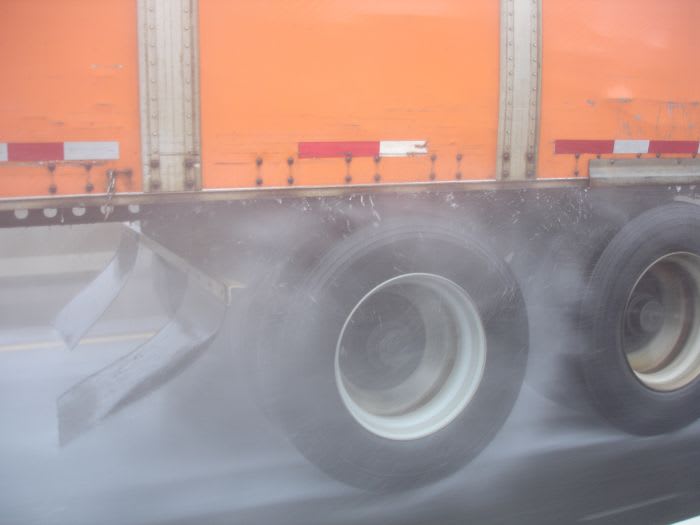
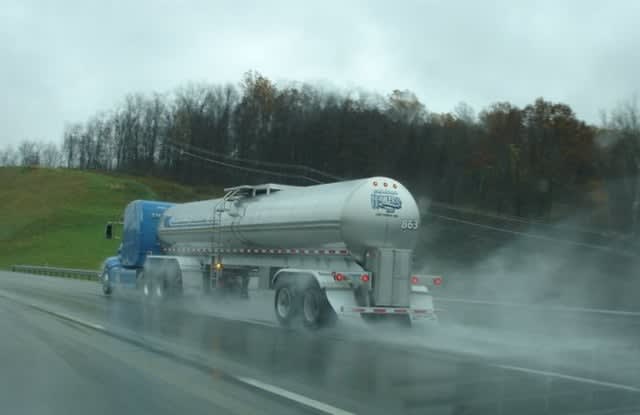
Tanker fenders protect the tank itself, but water splashed against them atomizes into spray. Sailing mudflaps let splash and spray fly high and onto following vehicles.
Good vehicle aerodynamics not only increase fuel economy, but also can reduce splash and spray, a safety bonus that also mitigates wear and tear on vehicles.
“One-third of all accidents in the United States occur during bad weather, and the majority of these occur when pavement is wet in the aftermath of a rain shower,” says the introduction in the Technology & Maintenance Council’s Recommended Practice 759, “Splash and Spray Suppression Guidelines.”
“The major culprit in these situations is reduced visibility from road spray, and the resulting change in driver reaction times due to unforeseen circumstances. In fact, every millimeter of standing water on the road surface reduces driver visibility by 10%. Not only does road spray alter a driver’s forward view, it also changes driver perception of color and vehicle proximity.”
Pavement type affects how water puddles or runs off, and therefore how much splash is kicked up by vehicle tires. You can’t change that, but vehicle configuration determines how much the water is atomized into spray when it hits surfaces, whether on bodies, fenders, mud flaps or running gear. Altering those surfaces can mitigate the splash-to-spray effect, and good vehicle aerodynamics cuts the blowing of spray to the sides and in the wake of a vehicle. This makes it easier for drivers and motorists to see.
Trailers and spray
While the RP covers areas such as reducing speed, tire tread design and inflation, the gap between tractor and trailer, and objects like quarter fenders, the trailer itself is the major source of spray in wet weather. This is partly because of poor aerodynamics along a trailer’s bottom and at its rear. Another reason is components that block oncoming air and water, amplifying spray.
“Taking steps to improve the aerodynamics of any trailer can significantly cut the volume of road spray generated by a Class 8 tractor-trailer,” it says.
For regular box vans and refrigerated trailers, the main generators of spray are the landing gear, rear axle, suspension, tires and mudflaps, the RP notes. For tankers, the long fenders at the front of the equipment, the rear underride configuration, and the rear of the tank itself are additional sources of heavy spray at highway speeds in wet weather.
“Car carriers and step-decks have steel structures that are perpendicular to the direction of travel that are major obstructions that throw standing water out into the airflow surrounding the trailer, and compound the volume of spray generated. Flatbeds, due to their varying loads and poor aerodynamic profiles (including the load), generate a tremendous amount of spray from the entire undercarriage area.”
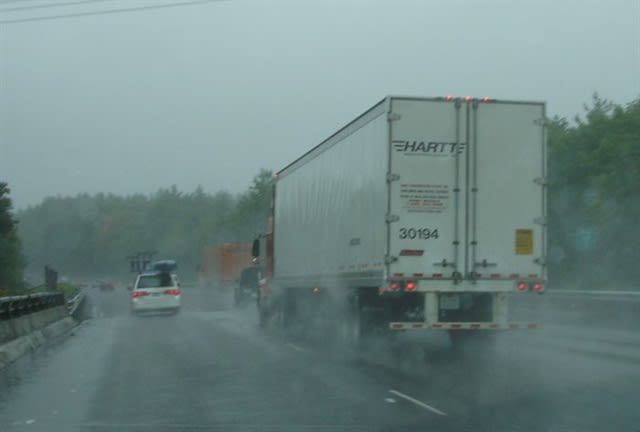
Multi-lane highways have reduced the blinding effects of water spray because motorists don’t have to see very far past a truck. TMC’s recommended practice suggests using stiff, anti-sail mounts for mud flaps.
Certain equipment hung on tractor-trailers also causes spray, the RP explains. Toolboxes, spare tires, liftgates and extra fenders all redirect splash and spray, sometimes to protect other components, but generate new spray. That’s especially so if water spray is ejected into the air flow racing past the vehicle. That’s why aerodynamic designs help; they cover much equipment and keep it out of the air and water flow, thus cutting drag, which saves fuel and reduces spray at the same time.
“Eliminating, downsizing, or repositioning undercarriage obstructions; adapting more aerodynamic add-ons to the trailer; minimizing the gap between tractor and trailer; keeping trailers clean; tidying up the layout of hoses and air tanks that can block air flow at the rear axle; and eliminating redundant fenders or mudflaps can all help reduce drag and eliminate a large portion of road spray at highway speeds.”
The types of fenders and mudflaps can also make a difference. For instance, special “fly swatter” mudflaps can reduce air drag and water spray. Some mudflaps are specifically marketed as spray-reduction devices. The RP recommends using stiff anti-sail flap mountings.
More Equipment

How Volvo Updated Its D13 for EPA 2027 [Watch]
Volvo’s updated D13 promises lower emissions without sacrificing performance or fuel economy. Take a closer look at what changed inside the engine in this HDT Spotlight video.
Read More →
Michelin Tire Improves Efficiency and Durability for Regional Fleets
The Michelin X Multi Energy D2 is a regional haul drive tire engineered to help fleets improve fuel efficiency, durability and traction in demanding stop-and-go operations.
Read More →
ZF Expands Commercial Vehicle Push in North America
ZF is expanding its North American commercial-vehicle presence with new transmission applications, electrification, trailer technology and autonomous-driving systems.
Read More →
Tesla Wants a Self-Driving Semi. Are Cameras Enough?
Could Tesla’s camera-only autonomous driving technology work on an 80,000-pound Semi? In this commentary, HDT's Deborah Lockridge takes a look at Tesla, Cybercab, and how autonomous trucks see the road.
Read More →
Kodiak: Driverless Long-Haul Truck Launch on Track for 2026
Kodiak AI says its driverless long-haul safety case is 93% complete and it remains on track to begin commercial operations by year-end 2026.
Read More →
What DOT’s Automated Vehicle Strategy Means for Trucking
The U.S. Department of Transportation issued a new automated-vehicle strategy that outlines plans for driverless-truck regulations, cross-state freight corridors, and federal safety standards.
Read More →
East Coast Port Launches $45M Electric Truck Push
The Port Authority of New York and New Jersey announced millions in incentives for zero-emission drayage trucks, yard tractors, and new charging hubs near the port.
Read More →
PlusAI Going Public to Fund Autonomous Truck Launch
A SPAC deal could provide PlusAI with up to $300 million as it works toward a 2027 commercial launch of factory-built autonomous trucks.
Read More →
NHTSA Moves to Rewrite Truck Fuel-Economy Rules
The National Highway Traffic Safety Administration says it lacks authority to regulate medium- and heavy-duty truck engines separately from complete vehicles, but the existing standards have not yet been eliminated.
Read More →
Detroit Opens Orders for EPA 2027 Engines
Detroit isn’t starting from scratch to meet EPA 2027 diesel emissions standards. Its Gen 6 DD13 and DD15 engines keep much of today’s platform while updating the fuel and aftertreatment systems.
Read More →