




5 Ways to Coach Truck Drivers Using Telematics
Using telematics as a driver coaching tool can improve driver performance, boosting fleet fuel economy and reducing idling. It can also improve safety.
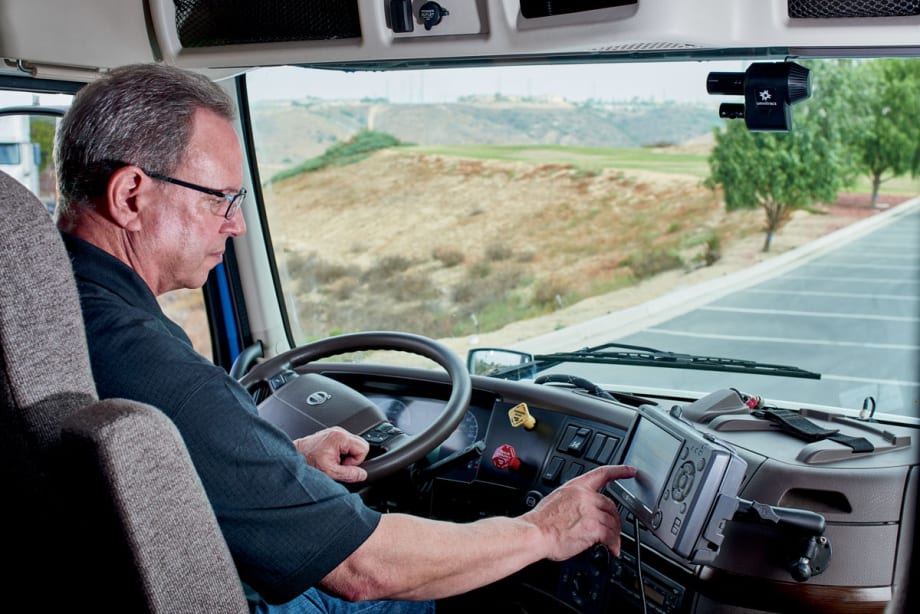
Capturing data is one thing. Properly analyzing it and following up with effective coaching is what delivers the payback.
Photo: Omnitracs
Steve Fields, a professional driver with YRC and America’s Road Team Captain, doesn’t mind having his driving critiqued using video. He likens it to an NFL team that analyzes every play in the video room after each game in the pursuit of continuous improvement.
“It makes you aware if you’re slipping into bad habits. It’s a coaching device that kind of keeps me in check. We all develop bad habits,” Fields said during a virtual American Trucking Associations Management Conference & Exhibition panel on telematics and driver coaching.
Using telematics as a driver coaching tool can improve driver performance, boosting fleet fuel economy and reducing idling. It can also improve safety. Derek Gaston, supervisor of truck operations with CN Rail, said the fleet has seen a 40% decrease in high-cost accidents since it began using in-cab coaching tools.
“Because of all the data that’s coming in, you can focus your training on different aspects of the driver’s day, and once you can focus on those aspects you can correct the behaviors and actually bring down your accidents,” he said.
Steven Atnikov, director of sales for Omnitracs in Canada, said fleets of all sizes are beginning to tap into the potential of telematics as a driver coaching tool. This includes smaller fleets, whose introduction to telematics largely came with the electronic logging device mandate.
“A lot of fleets bought ELDs, which was great, but they really weren’t doing anything to manage how their trucks were being driven,” Atnikov said. “Their first goal was to be compliant. Now they realize they connect to the ECM of the truck, and they can get that information that allows them to manage fuel costs, reduce idle time and improve how drivers are driving the truck.”
Fuel consumption, idle time, speeding and hard braking are a few of the driver behavior a telematics system can capture – behaviors that drive up fuel and maintenance costs. And it can all be captured without physically plugging into the truck, generating weekly or daily reports for analysis and follow-up coaching.
But capturing such data is one thing. Properly analyzing it and following up with effective coaching is what delivers the payback. Here are five ways to get the most out of a telematics-based driver coaching program:
1. Use peer reviews
An effective strategy to get drivers on-board is to have their peers provide the coaching. That’s the approach YRC has taken, and Fields spends a couple days each week coaching, and the rest of the week on the same roads his peers travel. He feels his current over-the-road experience helps him relate to drivers during coaching.
“I’m out there doing what they do,” he said. “I know the traffic they’re in – we run the same areas.”
2. Celebrate the positives
Video-based driver coaching platforms give fleets an opportunity to share footage of near misses, and heroic actions.
“We have to find that win and be positive about it,” said Lisa Gonnerman, vice-president of safety and security with Transport America. “With all these programs, the positive recognition is absolutely critical.”
Fields recently shared video of some exceptional driving a YRC driver to avoid a deer strike. Drivers appreciate the recognition and even come to him to see if he has seen a particular avoidance maneuver. That footage is also invaluable in vindicating drivers who weren’t at fault for an incident.
3. Pay it back
Omnitracs’ Atnikov said fleets typically save about a quarter mile to half a mile per gallon in fuel when telematics is used to monitor driver behavior, resulting from more efficient driving and idling reductions. He suggested fleets give some of that savings back to drivers in the form of incentives.
“It puts a little competition among drivers if there is a bonus program,” he said.
Putting a bonus program in place will improve driver retention, as well as acceptance, Atnikov pointed out. The technology can also be used within owner-operator fleets, giving the fleet manager peace of mind in knowing how the trucks carrying its company name are being driven, and empowering owner-operators to become better businesspeople.
4. Establish policies and procedures
When implementing a driver coaching system, Gonnerman said policies, procedures, and performance improvement guidelines must also be put in place and followed.
“Look at it from the perspective of sitting in a deposition chair, defending those policies and procedures if there were to be one of those accidents,” she said. “You have to be able to fall back on those, explain the why of what you did, and how you did it.”
Coaches must be consistent in how they approach all drivers – no favoritism – which is another reason policies must be implemented and followed. Gonnerman suggested getting driver coaches and legal counsel involved in developing those policies.
Driver coaches should even consider their approach to a fellow driver when it comes to reviewing an event.
“When I approach a driver, I always have a smile on my face,” Fields said. “A lot of times it’s the first few seconds in that conversation that determines what happens during the coaching bit.”
5. Get management buy-in
Gonnerman said upper management and operations buy-in is also needed for an effective driver coaching program. To convince them to make the investment in coaching, she suggested putting the cost of not doing so in terms they understand.
“Relate it to the number of loads,” she said. “If you have a $5,000 accident, how many loads are you going to have to pull to pay for that one accident? It can be an eye-opener in the rest of the organization when we relate it to that bottom line and it takes 85 loads now to make up for that accident we just had that operations said was a ‘minor accident.’ There’s no minor – it all impacts the bottom line.”
Another way to convey the benefits to decision makers is to put the fuel and maintenance savings into real dollar figures.
“With a half-mpg improvement in driving habits, a fleet can save $500 per month (per truck),” said Atnikov, citing the example of a typical driver traveling 10,000 miles a month who can improve from 5.5 mpg to 6 mpg, reducing fuel costs by $505 a month. Extrapolate that across an entire fleet, and there’s significant savings to be had.
James Menzies is editor of Today's Trucking, where this article first appeared. He has been covering the Canadian trucking industry for more than 18 years and holds a CDL. This content is used with permission through an editorial sharing agreement with Today's Trucking.
More Drivers

Truck Drivers Need More Than Another Alert
Fleets have more visibility into truck health, safety events, and driver activity than ever. The next challenge is turning all that information into useful guidance for the person who has to decide what to do next.
Read More →
FMCSA Removes 110 Truck Driver Training Schools from Certified ELDT List
Federal regulators also are targeting more than 160 additional training providers and launching a nationwide audit of third-party CDL skills testers as part of a broader crackdown on trucking fraud.
Read More →
Hours of Service Pilot Programs: FMCSA Readies for 2027 Rollout
Two pilot programs could eventually reshape hours-of-service rules, giving truck drivers options to pause their 14-hour clock or use longer split sleeper rest periods.
Read More →
Medical Cards, English Proficiency Reshape Roadcheck Violations
Medical-card violations jumped to the top of the driver out-of-service list during CVSA’s 2026 International Roadcheck, while English-language proficiency violations appeared among the leading violations for the first time.
Read More →
Driver Trust Can Make or Break the Success of Fleet Safety Technology
New Teletrac Navman research suggests that onboarding, transparency about driver data, and positive feedback can play a significant role in how commercial drivers respond to safety and coaching technology.
Read More →
EEOC Sues KLLM Over Alleged Sex Discrimination in Driver Training
KLLM is facing a federal sex-discrimination lawsuit over policies the EEOC alleges put female truck driver trainees at a disadvantage.
Read More →
FMCSA Moves to Codify English Language Requirements for Commercial Drivers
By changing regulations on English-language proficiency requirements for commercial drivers, rather than relying on a guidance memo, the FMCSA said future administrations won't be able to walk back the Trump administration's stricter enforcement with just a memo.
Read More →
Drivers Put Western Star Trucks to the Test at Star Nation Experience
Watch to get an inside look at the Western Star trucks, technology, and community behind the Star Nation Experience 2026!
Read More →
Trump Administration Looks to Put More Veterans Behind the Wheel
The Freedom Haulers program pulls together existing and expanded programs at several federal agencies to recruit veterans to drive commercial heavy-duty trucks and cut the red tape for them to get a CDL, training, and employment.
Read More →
Putting Mack’s Command Steer to the Test
A test drive of Mack’s Command Steer active steering system evaluates how it can make truck driving easier and less tiring.
Read More →