




4 Ways HDT’s Top Green Fleets Pursue Sustainability Beyond Trucks
Top Green Fleets are finding new ways to shrink their environmental footprint — think solar panels, smarter shops, even better landscaping.

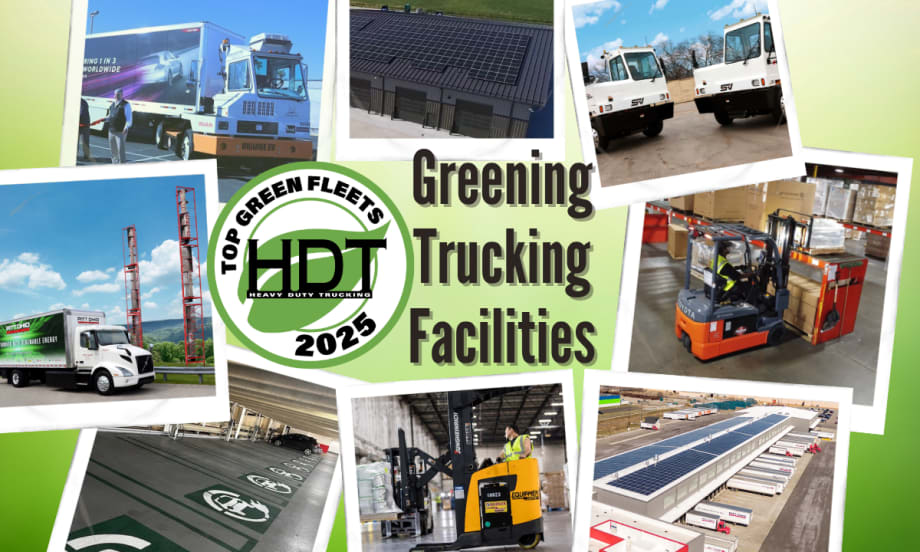
HDT's Top Green Fleets pursue environmental strategies in their facilities and shops, not just their trucks.
Image: HDT Graphic
When you're talking about trucking, environmental sustainability is often equated with truck fuel economy, alternative fuels, and zero-emission powertrains.
Heavy Duty Trucking’s Top Green Fleets for 2025 show that there’s more to environmental sustainability beyond the rolling assets.
From green buildings and renewable energy to smarter maintenance and low-emission equipment, these forward-thinking fleets are proving that reducing emissions doesn’t stop at the tailpipe.
Here are four ways they’re leading by example:
1. Greening Buildings and Trucking Facilities
Warehouses, maintenance shops, offices, and other facilities offer trucking companies several opportunities to improve their sustainability.
For instance, one of Schneider’s sustainability goals is to achieve net zero status in all company-owned facilities by 2035.
In 2023, the company achieved a 9.7% reduction in emissions at owned facilities. To help identify additional improvement opportunities, it completed energy audits of all its owned facilities.
Pitt Ohio operates six LEED-certified facilities across four terminal locations.
LEED (Leadership in Energy and Environmental Design) is the most widely used green building rating system in the world. According to the U.S. Green Building Council, LEED provides a framework for healthy, efficient, and cost-saving green buildings.
These buildings are designed, built, and operated considering energy use, water use, indoor environmental quality, material selection, and site and location within the surrounding community.
Pitt Ohio's LEED facilities include features such as sustainable energy, geothermal heating and cooling, radiant floor heating in the shop, natural light panels, energy-efficient HVAC, water conservation, low-flow plumbing fixtures, recycling, LED lighting, and so on.
Landscaping with native, drought-resistance plants saves water. Buildings may be situated to take advantage of maximum daylight capacities, meaning less energy needed for lighting.
Improving your facilities' environmental footprint can also be small things.
At D.B. Schenker’s U.S. land operations (USA Truck), facilities have low-energy LED lighting and carefully managed shop interior thermostat settings.
At FTC Transportation, the company that handles its shredding/paper recycling does not take cardboard. So a staff member loads up all boxes and cardboard as needed and takes them to a local recycling location.
2. Harnessing the Power of Renewable Energy
Solar and wind installations help reduce dependency on traditional grid energy:
Three of Pitt Ohio’s facilities produce renewable energy, and in the summer months, the surplus electricity is sold back to the power grid.
Two are home to a new patented microgrid design that stores and uses renewable energy for facility operations. The design uses both wind and solar to power direct current (DC) applications, avoiding energy loss from alternating current (AC) conversions.
Pitt Ohio is also evaluating a solar technology that, if feasible, will be widely rolled out to many of its terminal locations.
Other examples:
Nussbaum Transportation partnered with Halo Solar to install a 160kW solar array on the roof of its new maintenance facility. According to the company, 30-year projections include $1.2 million in utility savings and electricity to offset 4,700 metric tons of CO2.
NFI has solar installations in New Jersey and California and is expanding solar and adding battery storage this year in the Golden State.
A. Duie Pyle operates a 570,000-square-foot solar-powered warehouse and has launched waste reduction programs to minimize environmental impact.
TCI Transportation is adding another 400kWh of solar power, increasing its renewable energy capacity and reducing reliance on traditional energy sources.
3. Rethinking Sustainable Maintenance Shops
Green thinking also extends on to the shop floor.
The maintenance shop at Pitt Ohio’s Cincinnati, Ohio, terminal was the company’s first LEED-certified building. It is projected to save 20.75% on energy costs. A water management plan focused on proper drainage and a drain filtering system for water runoff. The company also increased ventilation and insulation values for thermal efficiency.
Schenker is using smart chargers for battery recharging stations. It eliminated purchasing fossil-fuel-burning boost-off equipment and has moved instead to capacitor jump start equipment.
At Missouri-based Artur Express, the company reduces waste through recycling and reuse programs; using sustainable materials in operations and maintenance; and minimizing water usage in cleaning and maintenance processes.
FTC Transportation’s maintenance department recycles oil, scrap metal, florescent light bulbs, and tires to reduce the company's environmental impact.
4. Addressing Yard and Warehouse Sustainability
A number of the Top Green Fleets have been replacing yard spotters and forklifts with cleaner versions.
Pitt Ohio notes that electrification of off-road equipment, in particular forklifts, has been an effective way to reduce fuel costs and carbon emissions; 40% of its forklifts are electric.
It recently added its first Class 8 electric yard jockey to its Indianapolis terminal. After only four months, the company has already seen cost savings and emissions reductions.
Schneider has replaced diesel yard spotters with electric in multiple states. The new vehicles run for a full 24-hour period before needing to be recharged, and each saves an estimated 35,000 pounds of CO2 each year.
Knight-Swift Transportation operates electric forklifts in key California less-than-truckload locations.
Nussbaum Transportation, whose longer lengths of haul and Midwest location make many electrification and alt-fuel operations for trucks unfeasible, has two propane-powered forklifts and four battery-electric scissor lifts.
TCI Transportation has approximately 50 EV yard tractors.
Through January 2024, NFI had deployed 17 battery-electric yard tractors in Southern California and Texas.
Ruan operates some 700 electric forklifts throughout the country and is working this year to grow its number of ZEV yard tractors from 20% to 30% of its current diesel yard tractor fleet.
Green From the Ground Up
While trucks remain central to the industry’s sustainability efforts, HDT’s Top Green Fleets demonstrate that significant environmental gains can also come from the yards, shops, warehouses, and offices that also are integral to keeping the freight moving.
By investing in renewable energy, smart infrastructure, and efficient facility operations, these fleets are driving sustainability from the ground up.
More Fuel Smarts

How Volvo Updated Its D13 for EPA 2027 [Watch]
Volvo’s updated D13 promises lower emissions without sacrificing performance or fuel economy. Take a closer look at what changed inside the engine in this HDT Spotlight video.
Read More →
Diesel Price Spike Shortens Payback for Natural Gas Trucks, Report Says
Energy Vision estimates fleets could recover the higher purchase price of an RNG-fueled Class 8 tractor in 1.3 to 2.8 years under current fuel-price scenarios.
Read More →
Calstart Becomes Catalyst Mobility, Reflecting Broader Focus
Calstart is now Catalyst Mobility, reflecting the nonprofit’s growing national role in clean transportation, including zero-emission trucks, infrastructure and incentive programs.
Read More →

Record Diesel Prices Squeeze Trucking Fleets
Average U.S. diesel prices have climbed to nearly $6 a gallon, surpassing the 2022 record as tight refinery capacity and Middle East disruptions keep fuel costs elevated.
Read More →
How Fuel Delivery Shapes Engine Performance
Fuel delivery depends on more than what happens at the injector. For fleet, maintenance and technical professionals, looking at the full path from pump to injector can provide useful context for understanding engine performance.
Read More →
East Coast Port Launches $45M Electric Truck Push
The Port Authority of New York and New Jersey announced millions in incentives for zero-emission drayage trucks, yard tractors, and new charging hubs near the port.
Read More →
California Bill Could Shed Light on Electric Truck Prices
Why do battery-electric Class 8 trucks remain so expensive? A California bill headed to Gov. Gavin Newsom would give fleets and state agencies more visibility into what manufacturers charge.
Read More →
Detroit Opens Orders for EPA 2027 Engines
Detroit isn’t starting from scratch to meet EPA 2027 diesel emissions standards. Its Gen 6 DD13 and DD15 engines keep much of today’s platform while updating the fuel and aftertreatment systems.
Read More →
Zero-Emission Truck Corridor Planned for West Coast
California, Oregon, Washington, British Columbia and Baja California are coordinating plans for truck charging and hydrogen fueling from Canada to Mexico.
Read More →
A Closer Look at Kenworth’s Electric T880E Vocational Truck [Video]
Learn more about Kenworth's T880E battery-electric vocational truck at the Paccar Technical Center, including its range, applications, upfitting considerations, and PTO options, in this HDT Spotlight video.
Read More →