





Related: Visibility, Communication Key to Shipper-Carrier Relationships
How Freight Visibility is Evolving
Long before the information technology revolution, “Where’s my load?” was a constant question from shippers. Technology has made providing an answer much easier for carriers.
January 10, 2020
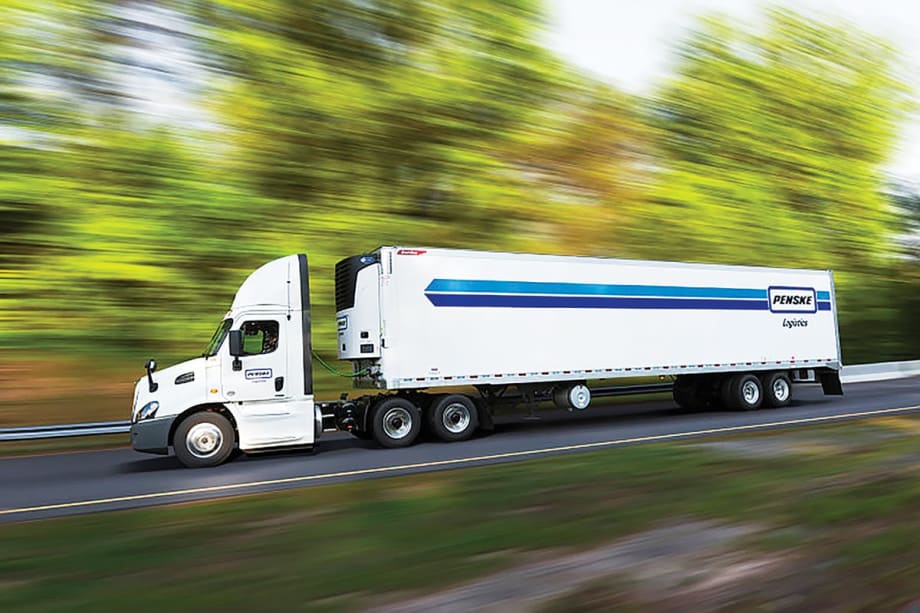
Freight visibility products provide shippers real-time information on load status.
Photo: Penske Logistics
8 min to read
As long as there have been loads, shippers have wanted to know the status of their freight. Long before the information technology revolution, “Where’s my load?” was a constant question. Technology has made providing an answer much easier, and in the process may offer opportunities for improved efficiencies all along the supply chain.
What do we mean by freight visibility? “In simple terms, the ability to track and monitor cargo throughout the supply chain from origin to destination,” says Scott Sutarik, vice president commercial vehicle solutions for Geotab, a fleet management software and telematics company. Carriers have tried for years to satisfy customer demands for freight visibility, adopting new technologies as they became available.
“The industry has been trying to create a real-time information flow for decades,” says Ben Wiesen, president of transportation software provider Carrier Logistics Inc. “What has changed is the execution of accomplishing this.”
In addition to having a shipment delivered on-time and in good shape, a carriers’ customers want to know more; and they want to know it now, Wiesen says. In response, “the information highway has evolved.” The industry has progressed from phone calls to automated faxes to EDI status updates to web portals and to APIs (application program interfaces that allow various systems used by carriers and their customers to share data). More recently, third-party vendors offer platforms to manage the data shared between shippers and carriers and also to collect carrier data into a central point for shipper access.
Sutarik notes that a fleet’s customers today want “100% visibility and real-time data” on their shipments. Beyond GPS position, that might include route, mileage, or trailer data such as temperature.
Why is Visibility so Important to Shippers?
Chalk it up as one more effect of the Amazon phenomenon. “Consumer expectations have been elevated. Consumers want it on that day,” says Jerry Robertson with Bolt System, a provider of fleet management and freight tracking software. “That’s created a whole new game. We see it in everything from tires to groceries.”
“For shippers, this is critical information,” explains Jay Delaney, senior director of product management for Trimble’s Transportation division. “Visibility gives them some level of comfort, is it really on time, is it going to be late. Shippers are saying ‘I need more than ETA [estimated time of arrival]; I need to know where it is.’”
For consignees, the stakes are much higher when a shipment is late than they might be for consumers. “Shippers are acutely aware of the high cost of carrying inventory. Hence the supply chain to them is quite fragile,” Wiesen says. Lean inventories mean that retailers, manufacturers and others must know the status of their shipments to keep operations moving and on schedule. Real-time visibility of their shipments means they are aware of problems sooner, allowing them to take action sooner. Schedules can be adjusted; loading docks can handle a truck that is already there instead of holding a dock open for a truck that’s going to be three hours late.
Sutarik notes that in certain segments, regulations also play a role. The Food Modernization Safety Act resulted in specific rules on the sanitary transportation of food products. Those rules, which took effect in 2017, placed new responsibilities on shippers and on carriers for ensuring that proper temperatures are maintained during food transport within the United States. Food producers and shippers have a lot at stake if refrigerated loads are not kept within acceptable temperature ranges. They need to know the status of their freight all along the supply chain.
How do Shippers Get More Visibility?
We noted earlier the evolution of freight visibility from phone calls to APIs. Each step of the way has meant trucking companies adopting new technologies.
“It’s funny how much a shipper can influence a trucking company’s need for technology,” says Dustin Strickland, senior product manager for McLeod Software. Some shippers require fleets deploy or provide an interface with specific technologies as a condition of getting their business.
A number of companies market visibility platforms to shippers and logistics companies that integrate with that organization’s supply chain to provide web-based tools and applications that track the movement of freight, explains Kevin Art, director of freight management at Penske Logistics. Basically, these services offer the ability for shippers to get status updates on pickup, arrivals and other information while a load is in transit. The services might also include geofencing capabilities that automate arrival and departure information when a carrier is near the delivery or pickup location. Weather and traffic data can also be incorporated with the GPS and geospatial data for even more accurate ETAs.
There are a number of visibility providers in the market, and each week seems to bring more players. But they all strive to provide shippers, brokers, and logistics companies the ability to track shipments across all of their transportation vendors.
The expectation in using a third-party service or APIs to access the data instead of an EDI connection is that the “data is more timely, accurate and homogenized across the shipper’s entire carrier base,” explains Jim French, chief technology officer of third-party logistics provider Transplace. That means the shipper doesn’t have different connections to multiple carriers, as the visibility platform provides the information they need in one place. Plus, the data is both “validated and accurate,” French adds.
As for what kind of data shippers want, he says, “most shippers only focus on the information they’re typically given from carriers and/or third-party providers such as date, time and GPS coordinate.”
Where Does a Carrier’s TMS Come In?
In most cases, a carrier’s transportation management system software or its telematics providers will take care of integrating their systems with shippers and/or third-party visibility platforms, although some administrative effort may still be required on the fleet’s part.
Strickland says McLeod works with 50 or more third-party visibility providers building integrations into their TMS. “The core is getting times, dates, and other things,” he says. Some can also capture documentation such as proof of delivery and pass it on.
CLI’s Wiesen says for most carriers, their TMS provides an “easy button” in terms of integrating with visibility platforms. “The fleets don’t have to worry about how they will get the information to their shippers,” he says. “The TMS technology providers will do that.” Plus, he noted, carriers can make use of the data, too. “The same type of information which helps shippers with visibility also helps the fleets. Just as a shipper may need to make contingency plans when there is a service failure predicted, the fleet also has to do the same.” Trucks and drivers have to be rescheduled, which can impact the schedules of other loads.
Transplace’s French says visibility platforms do not place huge demands on a carrier’s TMS, other than being able to connect to a shipper’s preferred visibility provider. “Most third-party providers try to make it easy on carriers and typically can connect directly to onboard tracking devices,” he says, which are commonplace since the advent of the electronic logging device mandate. On the other hand, many carriers opt to have the connection come through their TMS.
As Trimble’s Delaney explains it, visibility products “create hooks into your TMS to extract and obtain this visibility data.” Which means that each TMS has to have some method to make this data available to visibility products. For some, that means making the data available for the third parties to come and get. In other instances, the TMS pushes the data out to predetermined third parties.
But integrating with such products should not require extra work and may in fact save time for carriers. “In general, visibility platforms reduce that amount of work a carrier must do satisfy shipper requests,” Wiesen says.
Other possible administrative burdens may be imposed, because all visibility products differ from each other in how they handle data, connectivity and other areas, French says. Most use APIs or web services that don’t require significant work, but “it adds an extra administrative burden as more and more providers are in play,” he says.
One company that is working to create a more seamless way to move data around and provide visibility is EKA Solutions. Its Omni-TMS platform (the carrier portion is expected to be available in the first quarter) connects carriers, shippers, and brokers through a cloud-based system. The company believes having a single platform connecting shippers, carriers, and brokers will allow that information to flow more easily. Traditionally, they say, most transportation management systems have shippers, carriers, and brokers in silos, offering limited visibility across the transportation chain.
More Data Points for Analytics
Like most technologies, visibility products produce data. And that data will ultimately be mined for new insights into the supply chain.
“Visibility is just the first thing,” Delaney says. Shippers can look at the data on their shipments to get a better understanding of capacity within a market, for instance, which could lead shippers and carriers to work together more closely – even to the point of allowing shippers to alter routes after trucks have been dispatched. That kind of cooperation may be down the pike a way, but does offer possibilities.
Penske’s Art agrees that the data will ultimately be ripe for mining, noting visibility platforms can generate a lot of historic information shippers can analyze to determine performance information down to the lane level. “Predictive analytics can be used going forward to give confidence levels in on-time deliveries and the actual time that routes may take to operate.”
Analytics of this type of data can even “influence how freight contracts are priced and awarded,” Wiesen says. Performance metrics derived from the data could also potentially be used as criteria for selecting or ranking trucking vendors.
The more data shippers have about specific lanes and capacity on theses lanes, the more it can be used in negotiating rates.
Bottom line? When it comes to hauling someone’s freight, the more technologies change, the more some things stay the same. Whether over the phone or via a piece of code, shippers still want to know: “Where’s my load?”
Subscribe to Our Newsletter
More Fleet Management

Sponsored•September 16, 2026
Color Match Smarter: Tools That Restore & Perform
For fleet managers and collision repair professionals keeping heavy-duty trucks on the road, getting the color right the first time isn't just about appearance — it's about efficiency, turnaround time, and bottom-line results. Discover how today's digital color tools are transforming the repair process from guesswork to precision.
Read More →
FMCSA Pauses Biennial-Update Enforcement Amid Motus Transition
Carriers whose updates were due on or after June 1 have more time, while FMCSA works to stabilize its new registration system and warns of phishing sites impersonating its new carrier registration system, Motus.
Read More →
Sponsored•September 14, 2026
2026 Blueprint for Countering Smarter Supply Chain Theft
Cargo theft is no longer just the cost of doing business. It's a multi-billion-dollar criminal enterprise exploiting vulnerabilities across your fleet, drivers, and supply chain.
Read More →


Sponsored•September 1, 2026
How Telematics Improves Visibility, Control, and Performance in Refrigerated Fleets
Explore how telematics help refrigerated fleets improve visibility, uptime, efficiency, compliance, and cargo protection across connected cold chain operations.
Read More →
What the U.S.-Canada Trade War Means for Trucking
Escalating U.S.-Canada tariffs could disrupt cross-border freight, reduce truck volumes, raise costs, and create new uncertainty for carriers on both sides of the border.
Read More →
What Are Trucking’s Top Concerns for 2026?
The American Transportation Research Institute wants to know what's worrying trucking fleet managers, drivers, and other stakeholders in its annual Industry Issues survey.
Read More →
American Trucking Associations Looks for a New Leader
ATA President and CEO Chris Spear abruptly left his job at the association on August 21, at a pivotal time for the trucking industry.
Read More →
Public Wi-Fi Cybersecurity Risks: How Truck Drivers and Fleets Can Protect Their Data
Public Wi-Fi can expose truck drivers and fleets to credential theft, malware, and other cyber threats. Here’s how to reduce the risk on the road.
Read More →
For Nicky Cupp, Fleet Innovation Starts With Frustration
HDT Truck Fleet Innovator Nicky Cupp turns everyday pain points at Fraley & Schilling into opportunities for better technology and smarter processes.
Read More →
Adam Buttgenbach’s Approach to Electric Trucks: Start With Where They Fit
HDT Truck Fleet Innovator Adam Buttgenbach helped PepsiCo build one of North America’s largest EV fleets by focusing on where electric trucks make operational sense.
Read More →