




10 Things Truck Drivers Do to Get Pulled Over
A longtime state patrol officer offers his real-world observations on the most common reasons truck drivers get pulled over.
iStockPhoto
iStockPhoto
In my experience as a state patrol sergeant, there are a number of heavy-duty truck driver behaviors or situations that “stood out” from the norm when enforcing commercial motor vehicle safety on the highway -- and often result in a citation.
Not every violation mentioned below necessarily results in a citation, but it will, at a minimum, be a reason for a traffic stop and a possible warning. And many of the violation warnings will be evaluated in FMCSA’s safety measurement systems.
1. Following too close
When considering the perception and reaction time of 1.5 seconds, less than 2 seconds exists for the driver to see, acknowledge, and act by steering or braking to avoid a crash.
When trucks are following less than a truck length behind another, it’s obviously too close and an easy traffic stop. Of course, much more distance is needed to just fulfill the perception and reaction time and to meet most states’ following distance laws.
2. Speeding
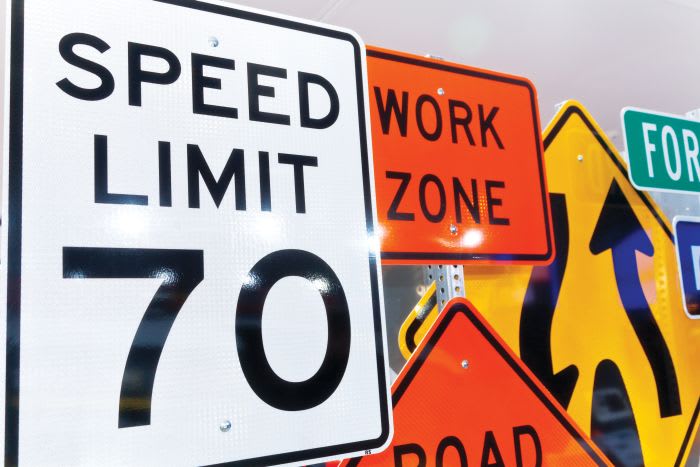
Most commercial motor vehicle officers would prefer to have a reason for a CMV stop rather than random inspections. Speeding is rather easy to find and typically coupled with the above following too close.
Again, many stops may just be a warning, but the truck driver “gave reason” for the traffic stop, and now it’s an opportunity to review the driver’s credentials and the vehicle’s equipment.
3. Lane deviations
Not all lane deviations are unsafe or prohibited by state traffic laws, but for those that are, it’s an easy stop. For the others, significant deviations raise reasonable concerns relating to the driver’s possible illness, fatigue, or impairment.
Typically, once it’s observed that it was not simply a “push of the wind,” officers will initiate a traffic stop for deviations from the traffic lanes that are not typical or stand out from the norm for the conditions and roadway surface.
These stops frequently result in the observance of driver distraction with onboard electronics — and a high frequency of record of duty status concerns, as it’s a stop that was not anticipated by the driver.
4. Inattentiveness
Most officers have observed a truck that was approaching a lane closure or traffic stop at a high speed. At the last moment the driver finally takes the aggressive crash avoidance actions. I have had to drive out of the way to prevent a collision, even with red/blue lights activated and the siren blaring.
These drivers are of high concern to be stopped for illness or fatigue. They demonstrated a threat to themselves or others.
5. Improper load securement
Cargo securement violations literally stare the officer in the face. When equipment is loaded on a flatbed, it’s clearly in plain view, and securement methods, number of devices, and general condition can be readily observed. Any observed deficiency will result in a traffic stop.
While enclosed trailers are out of view during transportation, they will be checked during an inspection. It’s not uncommon to find heavy items or containment systems simply lined down the center of the trailer with no side-to-side securement.
We have seen our fair share of rollovers as a result of non-compliance where cargo has shifted when the drivers felt “it was too heavy to move.”
Related: 5 Things Drivers Never Should Do at the Scene of an Accident
6. Use of handheld phone
If the mirrors are properly adjusted, drivers using a handheld phone is just too easy to observe, particularly in an unmarked cruiser or a patrol vehicle.
Of course the concern relates back to attentiveness and the driver’s ability to respond quickly if crash avoidance is required.
7. Lighting violations
Many of the observed lighting violations could easily be avoided with a proper pre-trip and post-trip inspection.
The filaments of standard bulbs may “connect” and re-connect” with vibrations. In winter a person who has an inoperative headlamp could give it a slight tap and it’s now “working,” but of course it’s very temporary and certainly not a proper repair.
The frequent observation of required lighting devices and perhaps replacement lenses/bulbs carried on the units will reduce on-the-road observances. LED lamps are also promising for reducing lighting violations by eliminating that filament separation.
8. Improper registration or credential display
Although this is not a safety violation, it is a reason to initiate a traffic stop. What a great opportunity to “scratch and sniff,” as I would say.
A CMV officer will at a minimum conduct a Level 3 inspection in this situation. Rest assured that as the officer is walking back and forth, he or she is taking a close look at the equipment, and if a violation is observed it will be upgraded to a Level 2 inspection.
9. Overweight Trucks
Proper weight distribution can prove a challenge for novice drivers. With the dramatic increase of mainline high-speed virtual weigh-in-motion systems, the ease and efficiency of this enforcement strategy has increased carrier contacts for violations.
The system is fantastic in screening a large number of CMVs and highlighting violators, yet minimizing the delays for carriers that are taking proactive measures with weight compliance. The chances are very high an inspection will follow this traffic stop.
10. Failure to obey official traffic signs or signals
Related to overweight violations is overlooking posted signs for weight limitations. Forfeitures where weight violations exist can be staggering, particularly if special weight postings are disregarded.
Other sign violations can also command substantial attention, such as misreading or misjudging a bridge height sign resulting in a bridge strike, where you can expect a CMV inspector to arrive and complete a post-crash inspection.
And failing to follow a state’s lane restriction guidance such as “all trucks use right lane” is entirely preventable.
Mark Abrahamson is a 27-year veteran of the Wisconsin State Patrol. He joined HNI, a non-traditional insurance provider and safety consultancy, in May. A version of this article originally appeared on HNI's Steal These Ideas blog. This article was authored and edited according to the standards of HDT’s editors to provide useful information to our readers.
More Drivers

Truck Drivers Need More Than Another Alert
Fleets have more visibility into truck health, safety events, and driver activity than ever. The next challenge is turning all that information into useful guidance for the person who has to decide what to do next.
Read More →
FMCSA Removes 110 Truck Driver Training Schools from Certified ELDT List
Federal regulators also are targeting more than 160 additional training providers and launching a nationwide audit of third-party CDL skills testers as part of a broader crackdown on trucking fraud.
Read More →
Hours of Service Pilot Programs: FMCSA Readies for 2027 Rollout
Two pilot programs could eventually reshape hours-of-service rules, giving truck drivers options to pause their 14-hour clock or use longer split sleeper rest periods.
Read More →
Medical Cards, English Proficiency Reshape Roadcheck Violations
Medical-card violations jumped to the top of the driver out-of-service list during CVSA’s 2026 International Roadcheck, while English-language proficiency violations appeared among the leading violations for the first time.
Read More →
Driver Trust Can Make or Break the Success of Fleet Safety Technology
New Teletrac Navman research suggests that onboarding, transparency about driver data, and positive feedback can play a significant role in how commercial drivers respond to safety and coaching technology.
Read More →
EEOC Sues KLLM Over Alleged Sex Discrimination in Driver Training
KLLM is facing a federal sex-discrimination lawsuit over policies the EEOC alleges put female truck driver trainees at a disadvantage.
Read More →
FMCSA Moves to Codify English Language Requirements for Commercial Drivers
By changing regulations on English-language proficiency requirements for commercial drivers, rather than relying on a guidance memo, the FMCSA said future administrations won't be able to walk back the Trump administration's stricter enforcement with just a memo.
Read More →
Drivers Put Western Star Trucks to the Test at Star Nation Experience
Watch to get an inside look at the Western Star trucks, technology, and community behind the Star Nation Experience 2026!
Read More →
Trump Administration Looks to Put More Veterans Behind the Wheel
The Freedom Haulers program pulls together existing and expanded programs at several federal agencies to recruit veterans to drive commercial heavy-duty trucks and cut the red tape for them to get a CDL, training, and employment.
Read More →
Putting Mack’s Command Steer to the Test
A test drive of Mack’s Command Steer active steering system evaluates how it can make truck driving easier and less tiring.
Read More →