





Related: Driver Dilemma: A Year-Long, In-Depth Series on the Driver Shortage
In Search of Owner-Operators
After a difficult recession caused many to give up trucking, owner-operators are on the rise again and fleets are doing all they can to recruit and retain them. Part 4 in HDT's Driver Dilemma series on the driver shortage.
April 1, 2015
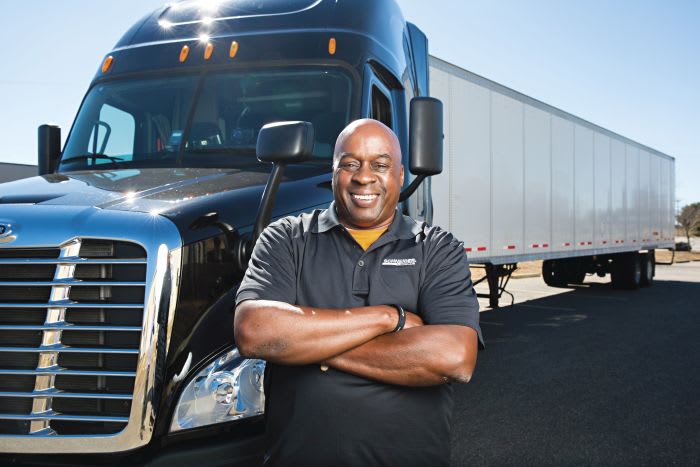
Of Schneider National’s 13,000-plus drivers, more than 2,200 are owner-operators like Andy Mills, shown here. Photo: Schneider National
8 min to read
Of Schneider National’s 13,000-plus drivers, more than 2,200 are owner-operators like Andy Mills, shown here. Photo: Schneider National
The Great Recession was tough on owner-operators. Many parked their trucks or sold them altogether. But as the economy has come back, so has this resilient and entrepreneurial portion of the American trucking industry – and fleets are doing all they can to recruit and retain them.
ATBS, Lakewood, Colo., provides thousands of owner-operators with financial and business services and has been tracking the contractor market for a decade.
“They change, but they don’t die,” says ATBS founder Todd Amen.
“I look at the job of an owner-operator today and think it’s the best economic opportunity it’s ever been for owner-operators,” he continues. “Our number of owner-operator customers has grown about 15% in the last two years.” It’s not quite back to where it was at the pre-recession peak; he estimates the industry lost 20 to 25% of its owner-operators during the downturn.
“I think the owner-operators are really kind of coming back,” says Trent Dye, director of a 100% owner-operator fleet, Paramount Freight Systems, Columbus, Ohio. “The last few years they kind of went away for a while, but we’re starting to see a rebound.”
A major reason, he says, is that “companies have had the ability in the last year, year and a half, to pay more, because we’ve finally been able to put in some nice rate increases that were long overdue. Being able to pay more to owner-operators, that’s bringing them back as well.”
Finding owner-operators
ATBS clients are owner-operators, but it partners with fleets interested in pointing their contractors toward business help. And business is booming, Amen says.
“We bring on new fleet partners every week that we haven’t done business with before, so I’d say everybody wants owner-operators.”
One of the fleets that works with ATBS is Con-way Truckload. The Missouri-based carrier recently revamped its owner-operator program and currently has about 320 independent contractors out of about 2,220 tractors in the fleet.
Owner-operators are now the company’s primary plan for growth, says T.J. Hunt, senior manager of independent contractor relations.
“The biggest reason is obviously the cash flow involved in adding new tractors,” Hunt explains. “As you know, tractors are considerably more expensive. If we want to grow the size of our fleet, we ought to look at guys – and gals – who own their truck.”
Hunt says the number of owner-operators that have failed has dropped considerably since the recession.
“Watching the owners as a whole come back strong is very encouraging,” he says. “There are still people out there who say the owner model is dead and it’s not worth your time, but if that’s true, why is every major carrier going after them?”
Schneider National, the Wisconsin-based megafleet, has more than 2,200 owner-operators out of the 13,000-plus drivers in its fleet.
“We love ‘em,” says spokesman Mike Norder, who observes that today’s owner-operators are a bit different than their forefathers.
“I think they’re better businesspeople. I see the precision in which they select loads and manage their business and the other aspects of it. I see it in the spec of the trucks they buy or lease. It’s fuel-efficient, it’s what a smart businessperson would choose. If you look back years ago, it would be more about raw horsepower and bells and whistles as opposed to driving for fuel efficiency and the bottom line,” says Norder.
It’s not just big fleets like Con-way and Schneider that are using owner-operators. Kevin Burch is president of Ohio-based Jet Express, which has both employee and owner-operator drivers in its fleet of a few hundred trucks.
“Just call me diversified,” he says. “It’s just like stock, you have some cash and some stocks and some bonds. For the last 26 years, our model has not changed and we’re still here to talk about it.”
“When you’re really busy, you probably make some more money buying equipment and putting drivers on, but when you have plant adjustments, slowdowns, suddenly you’ve got 100 trucks along the fence line.” Having some independent contractors in the fleet helps mitigate that risk.
Of course, owner-operators aren’t the right choice for every fleet. Illinois-based Nussbaum Transportation actually moved away from using owner-operators. That was partly to maintain a consistent appearance and image of the fleet, but it’s been more about operations, explains Jeremy Stickling, director of human resources and safety. “They need to be able to pick which loads they want, but our system just doesn’t work very well to build in a choice like that.”
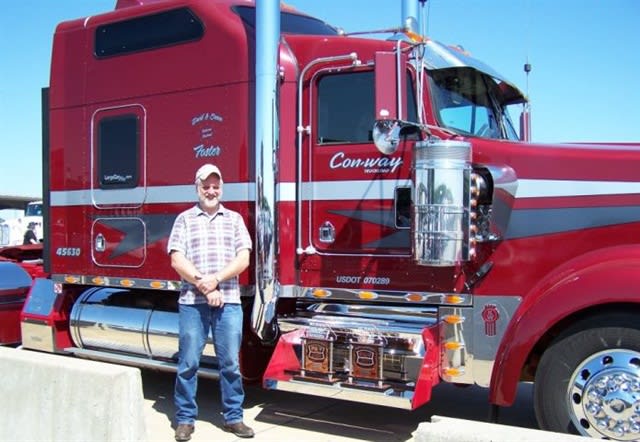
Some owner-operators, like Con-way Truckload’s David Foster, like to compete in truck beauty contests. Photo: Con-way Truckload
Growing your own
The appetite among fleets for owner-operators is greater than the available pool of independents. It’s harder for a driver to buy a truck and go into business these days because the price of trucks has risen significantly and even good, affordable used trucks are hard to come by. Add to that tighter reins on credit.
“Those guys are hard to come by today for a lot of reasons, and everybody’s competing for them, so the fleets that are expanding an owner-operator program of any significance are growing their own,” says Amen. “They facilitate that process with a lease-purchase program or working with someone like Arrow Truck Sales or a local dealership to get them into a [used] truck.”
In the past, there have been some notoriously bad fleet lease-purchase programs.
“Often it looks like indentured servitude to us,” says Todd Spencer, executive vice president of the Owner Operator Independent Drivers Association. “I think too many in trucking got away too long with basically making claims about the possibilities for income that could be realized through trucking, and those claims never materialized,” leaving leased owner-operators unable to make their truck payments. The trucking company would take the truck back and lease it to another unsuspecting driver.
There was a proliferation of such programs in the early and mid 2000s, Amen says. “It was easy for a trucking company to get greedy and say, ‘If we mark up trucks and insurance, we can make more on trucks and drivers than hauling freight.’ But over time, through reputation or lawsuits, those programs and/or the companies failed.”
Amen says ATBS will not partner with a fleet whose lease-purchase program doesn’t offer the owner-operator a good chance of success. It rates programs on factors such as truck payments, fuel costs, maintenance costs and insurance costs.
Con-way Truckload is one of many fleets using a third party to handle the lease arrangements. Drivers have to be in good standing with the company for at least a year before they can be referred to the lease partner. “We don’t want a guy who’s barely hanging on as a company driver to go out and buy a truck,” Hunt says.
The company is also happy to lease on those of its drivers who are able to buy a truck on their own.
With a little over 80 tractors in its lease program, so far Hunt says “turnover has been less than 10%, which is unheard of for a lease program.”
Paramount Transportation, a multi-year honoree in the Truckload Carriers Association’s Best Fleets to Drive For competition, partners with several third-party companies to offer leasing programs.
“There’s a desire out there for company drivers who want to own their own business, so we’re trying to foster that as much as we can,” says Paramount’s Dye. However, he notes, “Some of these companies can put you in a truck but the payment’s $700 a week. I’ve sat down with guys that want to do that and said, ‘This is what I know you can make – can you survive on this much money?’ I hate to let them walk out the door, but I’m not going to set somebody up to fail.”
Dye says about three-quarters of the owner-operators coming to work for him probably can’t cite their cost per mile when they get there, “but after they’re here a while, they understand that, because I kind of force-feed it.”
“Some drivers think they can go from a company position into an owner-operator, but it takes hard, dedicated work to achieve that success,” says Jet Express’ Burch. “Sometimes they’ve got these dreams they can be an owner-operator and everything will fall into place. You have to have maintenance money put aside, you have to have your taxes covered; it’s a complicated occupation. But if you’re disciplined and really want to work, I still think it’s one of the best opportunities.”
Watch out for ‘misclassification’
Government agencies are increasingly targeting trucking fleets for “employee misclassification” — drivers the government claims have been “misclassified” as independent contractors who in reality are treated as employees.
That’s why you have to be careful how you structure your owner-operator program.
At Schneider, explains Norder, “They are truly small business owners. They pick the freight they want, they self-dispatch, they run when they want to run; they run their company the way they want to run it. We just provide the largest freight base in the industry for them to choose their loads from.”
At Con-way Truckload, Hunt says, “The arms’ length approach is the best approach. In states like New York, where they have to be incorporated or an LLC, we try to follow those particular rules. We’re very strict on following guidelines on things like worker’s comp. We try to use ATBS or just flat out don’t cross that line.”
Con-way put together a separate independent contractor team so it would have “experts” on IC issues interacting with the owner-operators “so there’s no risk of treating them like an employee on accident.”
“It’s all about control,” explains Dye. “It’s never a forced dispatch environment. We don’t mandate that they have their tractor a certain color, that they wear uniforms or anything like that. It’s truly a partnership.”
Subscribe to Our Newsletter
More Drivers
Trucker Path Expands Reserved Parking Network
Trucker Path has added close to 6,000 more truck parking spaces to its Trucker Path Reserved Parking Network with the addition of Safe Truck Parking.
Read More →
EEOC Sues Texas Trucking Company Over Driver Age Limits
The agency says Trancasa USA rejected applicants over 65 and applied tougher driving-record standards to those over 60.
Read More →
Nussbaum, Roehl Announce Second Driver Pay Increase This Year
This year has seen a swath of major truck driver pay increases as freight capacity has tightened.
Read More →
From One Generation to the Next: How Mentorship Builds Safer Truck Drivers
After three decades in trucking, Harold Perry shares what he's learned about driver safety, mentorship, and helping the next generation build confidence behind the wheel.
Read More →
Truck Drivers Need More Than Another Alert
Fleets have more visibility into truck health, safety events, and driver activity than ever. The next challenge is turning all that information into useful guidance for the person who has to decide what to do next.
Read More →
FMCSA Removes 110 Truck Driver Training Schools from Certified ELDT List
Federal regulators also are targeting more than 160 additional training providers and launching a nationwide audit of third-party CDL skills testers as part of a broader crackdown on trucking fraud.
Read More →
Hours of Service Pilot Programs: FMCSA Readies for 2027 Rollout
Two pilot programs could eventually reshape hours-of-service rules, giving truck drivers options to pause their 14-hour clock or use longer split sleeper rest periods.
Read More →
Medical Cards, English Proficiency Reshape Roadcheck Violations
Medical-card violations jumped to the top of the driver out-of-service list during CVSA’s 2026 International Roadcheck, while English-language proficiency violations appeared among the leading violations for the first time.
Read More →
Driver Trust Can Make or Break the Success of Fleet Safety Technology
New Teletrac Navman research suggests that onboarding, transparency about driver data, and positive feedback can play a significant role in how commercial drivers respond to safety and coaching technology.
Read More →
EEOC Sues KLLM Over Alleged Sex Discrimination in Driver Training
KLLM is facing a federal sex-discrimination lawsuit over policies the EEOC alleges put female truck driver trainees at a disadvantage.
Read More →