




Combating Corrosion at Wheel-Ends
Careful cleaning extends lives of components, while proper spec’ing heads off rust in the first place.

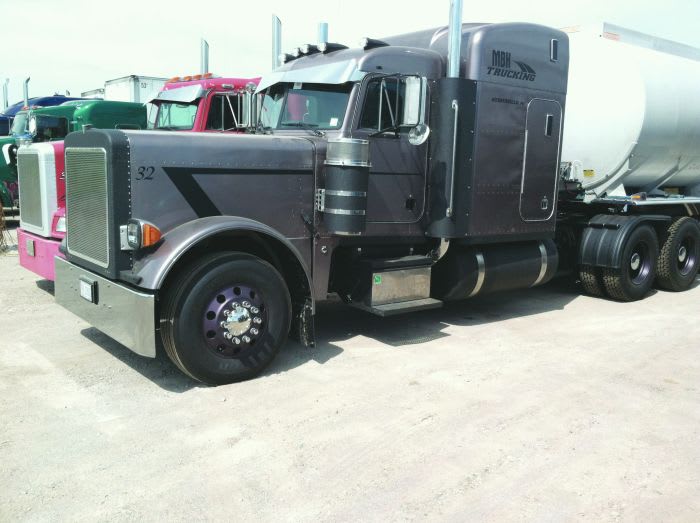
MBH Trucking’s Peterbilt has a blacked-out look because its aluminum parts have been coated with Linex bed-liner material to protect the metal from oxidation.
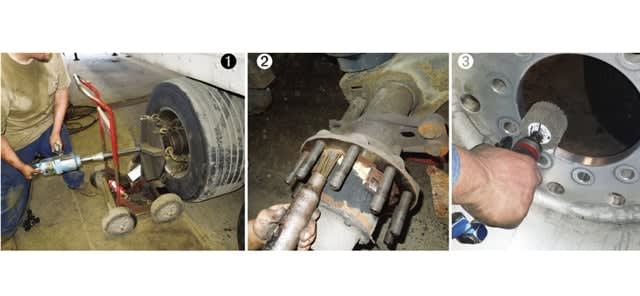
Hartt Transportation’s multi-step cleaning procedure includes removing the wheel with a Kiene Wheel Whiz, then using scaling and grinding tools to remove corrosion from mating surfaces on the wheel and brake drum.
Truck operators and manufacturers are acutely concerned about corrosion of vehicle parts.
“It’s huge,” said Todd Cotier, maintenance manager at Hartt Transportation in Bangor, Maine, during a technical session at last fall’s meeting of the Technology & Maintenance Council, the nuts-and-bolts arm of the American Trucking Associations. ”I don’t remember this happening with rock salt that they used to use.”
He and many other fleet operators have complained about calcium- and magnesium chloride salts that road departments began using more than 25 years ago. They work better at keeping pavement clear than rock salt, which is sodium chloride, but do more damage to vehicles.
One place they can damage is the wheel, thus the session on “Corrosion at Wheel-to-Hub Mating Surfaces.” Cotier and four other presenters emphasized the right way of dealing with rust. One is cleaning, which at Hartt is a multi-step procedure that begins with a non-destructive method of removing wheels.
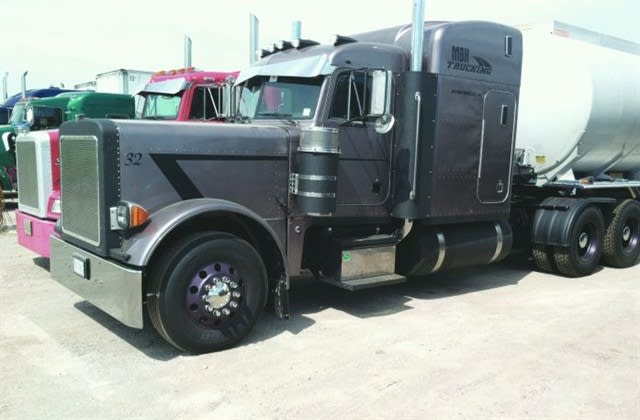
MBH Trucking’s Peterbilt has a blacked-out look because its aluminum parts have been coated with Linex bed-liner material to protect the metal from oxidation.
The typical way is to hammer the wheel away from the brake drum, to which it’s seized by rust. But that can damage a steel wheel and can easily ruin a comparatively soft aluminum wheel, Cotier said. Instead, his shop crews employ a Kiene Wheel Whiz, a contraption that’s chained to a wheel through its hand holes and evenly applies pulling force. The force comes from a 1-inch-drive air gun that, except for its weight, is easier on the mechanic than swinging a heavy hammer. With the wheel pulled free, the clean-up work begins.
An aluminum wheel’s inner hub bore and mating surfaces pick up rust from the steel hub and iron brake drum, and the mechanic removes it with a soft abrasive attachment on a grinder and a 6-inch sander with 100-grit paper. Next, the hub: He wields a needle scaling tool and right-angle die grinder with a fine abrasive to clean the hub’s mounting-pilot pad and the rest of its vertical surface. That done, the drum can come off with the help of a lifting tool, and its mating surfaces are cleaned up.
Fastener treatment
Fasteners require special treatment. Bolts are first tested with a socket-like tool that slides on. If it slides more than four threads, the bolt is too worn and is removed and replaced with a new one. If it passes the test, its threads are wire-brushed clean and get one drop of 30-weight oil to inhibit new rust and allow nuts to spin on freely. The small bit of oil is distributed as the stud nut is spun onto the bolt.
The two-piece flange nuts are checked for integrity and each gets two drops of 30-weight oil between the nut itself and the attached washer, which should easily turn against the nut to ensure even clamping force during tightening. Clamping force, sometimes called a “clutch effect,” is what mates the wheel to the hub and drum, and supports the load (bolts do not shoulder the weight). Hartt mechanics use socket-like wheel guides to mount the wheels and, after removing the guides, torque the nuts at 500 foot-pounds.
Most of Hartt’s truck wheels are wide-base single aluminum. For steel wheels, Cotier said the procedures for cleaning them are the same, except that a thin coat of paint from aerosol cans is applied to a wheel’s mating surfaces to inhibit seizing. Plastic or nylon discs placed between mating surfaces can also discourage rust.
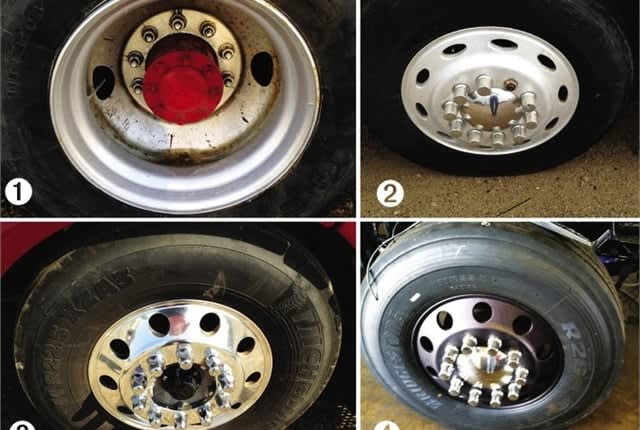
To combat corrosion, MBH has switched from painted steel wheels (1) to unpolished aluminum (2) to treated aluminum wheels. Products include Alcoa’s Dura-Bright (3) and Accuride’s Accu-Shield and Accu-Armor (4).
Chloride hauler’s advice
All the cleaning is a dirty job that simply must be done to preserve the components and keep them safely on trucks and trailers. This is especially true at MBH Trucking in Weberville, Michigan. Its vehicles haul chloride solutions to road departments and spread the stuff on dirt roads and parking lots to control dust. Thus they are more directly exposed to the corrosive materials. Salts of various types are produced by a sister company, Chloride Solutions.
Jim Smith, who works in sales and field service at the companies, said the chloride application trucks are power-washed daily by drivers, who use soap and water. A new maintenance building will have a drive-through washing lane, probably with a high-pressure soap, spray and rinse sequence. Rigs running longer distances regularly visit Blue Beacon truck wash facilities, with the aim of weekly washing.
At the end of an application season, trucks are sprayed with a neutralizer, with an emphasis on underbody components.
Aluminum and stainless steel components stand up well to corrosion, so MBH has converted almost entirely from painted steel wheels to aluminum. The latest are treated aluminum, such as Alcoa’s Dura-Bright and Accuride’s Accu-Shield and Accu-Armor.
The company specs stainless steel clevis pins, MGM brake chambers and Haldex slack adjusters because “our experience shows they stand up better than others,” Smith said. Foundation brakes are Meritor, which are standard on the Peterbilts that the fleet has bought, and now on some Kenworth gliders that shop technicians have assembled.
MBH’s tractors are “show quality,” he says, and with proper maintenance can last for many years. He showed a photo of a 1988 Peterbilt that looks near-new. It was among those completely torn down, refinished with epoxy primer and paint, and reassembled.Another unit got Linex coating on its frame and exterior aluminum components, including the grille bezel, battery box and fuel tanks. Aluminum is more resistant to corrosion than steel, “but it still oxidizes.” The dull-black finish with dark-gray paint gives the tractor a stealth look, but more important, the aluminum surfaces don’t deteriorate.
More Equipment

How Volvo Updated Its D13 for EPA 2027 [Watch]
Volvo’s updated D13 promises lower emissions without sacrificing performance or fuel economy. Take a closer look at what changed inside the engine in this HDT Spotlight video.
Read More →
Michelin Tire Improves Efficiency and Durability for Regional Fleets
The Michelin X Multi Energy D2 is a regional haul drive tire engineered to help fleets improve fuel efficiency, durability and traction in demanding stop-and-go operations.
Read More →
ZF Expands Commercial Vehicle Push in North America
ZF is expanding its North American commercial-vehicle presence with new transmission applications, electrification, trailer technology and autonomous-driving systems.
Read More →
Tesla Wants a Self-Driving Semi. Are Cameras Enough?
Could Tesla’s camera-only autonomous driving technology work on an 80,000-pound Semi? In this commentary, HDT's Deborah Lockridge takes a look at Tesla, Cybercab, and how autonomous trucks see the road.
Read More →
Kodiak: Driverless Long-Haul Truck Launch on Track for 2026
Kodiak AI says its driverless long-haul safety case is 93% complete and it remains on track to begin commercial operations by year-end 2026.
Read More →
What DOT’s Automated Vehicle Strategy Means for Trucking
The U.S. Department of Transportation issued a new automated-vehicle strategy that outlines plans for driverless-truck regulations, cross-state freight corridors, and federal safety standards.
Read More →
East Coast Port Launches $45M Electric Truck Push
The Port Authority of New York and New Jersey announced millions in incentives for zero-emission drayage trucks, yard tractors, and new charging hubs near the port.
Read More →
PlusAI Going Public to Fund Autonomous Truck Launch
A SPAC deal could provide PlusAI with up to $300 million as it works toward a 2027 commercial launch of factory-built autonomous trucks.
Read More →
NHTSA Moves to Rewrite Truck Fuel-Economy Rules
The National Highway Traffic Safety Administration says it lacks authority to regulate medium- and heavy-duty truck engines separately from complete vehicles, but the existing standards have not yet been eliminated.
Read More →
Detroit Opens Orders for EPA 2027 Engines
Detroit isn’t starting from scratch to meet EPA 2027 diesel emissions standards. Its Gen 6 DD13 and DD15 engines keep much of today’s platform while updating the fuel and aftertreatment systems.
Read More →