




Truck Fleet Innovators Tackle Fuel Economy
A combination of driver training and monitoring with careful attention to truck specs and being willing to try unconventional technology all contribute to fuel savings for HDT's 2012 Truck Fleet Innovators

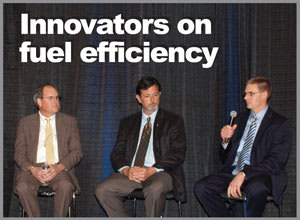
A combination of driver training and monitoring with careful attention to truck specs and being willing to try unconventional technology all contribute to fuel savings for HDT's 2012 Truck Fleet Innovators,
as they explained during a panel discussion as part of the first Mid-America Trucking Show Fleet Forum last week in Louisville, Ky.
HDT's Truck Fleet Innovators are Phil Braker, vice president of operations, Nussbaum Transportation; John Fershtand, director of fleet operations and energy management for Ben E. Keith Foods; Mike Jeffress, vice president of maintenance at Maverick Transportation, and Bill Malone, president of Enviro Express. (Malone was unable to participate in the panel discussion.)
The panel was moderated by HDT Equipment Editor Jim Park, who has written award-winning articles on fuel economy.
Jeffress: We would say 85 to 90% of fuel efficiency goes back to the operator. If you don't take the time to train educate and get them involved, you're kind of wasting your time.
Braker: In order to take out variables such as different engines and different transmissions, we developed groups of trucks within the program, and we adjust point scores up and down based on what that driver is driving. The IT department was very instrumental in putting this program together.
The program not only looks at fuel economy, it also looks at safety and other factors. You may want to reward a driver for fuel but he may have had an accident that cost you $100,000 the day before. All these things get tallied up with points and based on that point level is how much they're going to make.
We found it has to be enough of the driver's pay to make him really want to go for it. It needed to be a big enough carrot. We pay it quarterly. We have bronze, silver and gold level drivers. Gold drivers get $7 a point, $5 for silver, $2 for bronze. This quarter the average payout for gold level drivers was $700; we have drivers making a thousand dollars a quarter.
Fershtand: Because we're local food delivery, the only thing we look at as far as drivers is our idle time, and we monitor that very carefully.
Jeffress: There is a segment out there that says we want to develop the truck regardless of who's behind the wheel. But at the same time I think you have to bring the driver along with that equation. He needs to understand why we're doing it this way, how it's going to help the company, how it's going to help the environment. It takes training and time.
Braker: The technology really is a supplement to the driver. He still is controlling a lot of what's going on behind the wheel. Just because he's got an automated transmission doesn't mean he doesn't still have to be smart about his driving. We've adopted freightliner's predictive cruise control. In the past we told drivers to soft pedal it when they came to a hill and be willing to lose some speed up the hill. But most of us don't like to take the cruise control off while driving. Now we have cruise control that knows that hill is coming. Technology is doing a lot the driver can do but it's hard to get them to do.
Fershtand: Our guys are delivery people as much as they are truck drivers, they may make 50 stops during the day, so we use technology to make it as easy as possible for truck drivers to get to each of their stops.
Braker: If you choose the right driver [to try out new technology] in the beginning that makes it a lot easier down the road. The other thing is every driver wants to know, 'What's in it for me?' With the incentive program it's pretty easy to show the driver. We've brought drivers in recently for a head to head competition with one of our drier trainers. He can many times beat the driver by as much as a mile per gallon. Drivers come back saying I thought my automatic transmission was supposed to do this… they have to be taught and trained.
Jeffress: We went with collision mitigation and automated transmission at the same time. With those together, I can literally bring that truck to a dead stop to avoid a collision. That was something different for the drivers to comprehend.
Fershtand: Driver retention is one of the most significant things the industry faces. We put together a task force that look at every aspect of what a driver goes through to deliver food for us. One of the things we have to take into consideration is they have a career that's like a football player, there's only so long they can spend pulling 15,000 pounds off a trailer and taking it into a commercial kitchen. Sometimes abuse of equipment parallels people who have poor driving skills, and we monitor that very carefully.
Braker: We feel one of the benefits of our scorecard system is a way to evenly compare drivers, and we have let drivers go because they' aren't getting the results - but that doesn't happen without working with the driver first.
Jeffress: Generally when we let someone go, they have other deficiencies, not just fuel mileage.
Jeffress: A flatbed spread-axle configuration is not conducive to wide base tires. You do see an improvement in fuel efficiency but you see a degradation in the cost per mile of your tires, and it also hurts you on retreadibility. So we didn't go that way on flats. I know other carriers running spread axles that don't run into the same problem, but they're running a different spread.
On our reefers and our glass fleets, which run closed tandem, it works well for us, and we do see the fuel efficiency improvements. And automatic Inflation on our trailers, we feel has a significant impact on fuel efficiency. On the tractors we're just doing the tire monitoring systems. That also had a positive impact on our maintenance costs. We pull a lot of curtainside trailer we run side skirts on, and the vans and the reefers, but we're not seeing that on the flats. We're just starting to play with the wheel covers.
Braker: We do run wide-base and recently switched over to them. Roughly a 10th of a mile per gallon is what we attribute to the wide-base tires. As far as aerodynamics, that's really based on application. After 55 mph makes a big difference. Trailer aerodynamics is huge on a van for us, so we have adopted the TrailerTail to reduce the rear end drag and also side skirts on all trailers. Also other little things that can be done, something as minor as moving the license plate on the rear of the trailer so it doesn't catch air going down the highway. On the top of the trailer we found a way to make the rain gutter a little more aerodynamic.
Braker: We feel it's been a success. It's application-specific; there are a few places were we continue to order a 6x4, but the majority of our linehaul tractors will be 6x2s going forward. Traction is a concern among drivers. We have dump valve on the rear axle or put a lift on the front axle. Other things that are a must are an electronically controlled air suspension, so the truck will automatically adjust air to the drive axle as it finds slippage. That is more for tire wear than from a safety standpoint. We haven't seen any safety issues. The biggest thing we're going to continue to push is t
More Fleet Management

Color Match Smarter: Tools That Restore & Perform
For fleet managers and collision repair professionals keeping heavy-duty trucks on the road, getting the color right the first time isn't just about appearance — it's about efficiency, turnaround time, and bottom-line results. Discover how today's digital color tools are transforming the repair process from guesswork to precision.
Read More →
FMCSA Pauses Biennial-Update Enforcement Amid Motus Transition
Carriers whose updates were due on or after June 1 have more time, while FMCSA works to stabilize its new registration system and warns of phishing sites impersonating its new carrier registration system, Motus.
Read More →
2026 Blueprint for Countering Smarter Supply Chain Theft
Cargo theft is no longer just the cost of doing business. It's a multi-billion-dollar criminal enterprise exploiting vulnerabilities across your fleet, drivers, and supply chain.
Read More →


How Telematics Improves Visibility, Control, and Performance in Refrigerated Fleets
Explore how telematics help refrigerated fleets improve visibility, uptime, efficiency, compliance, and cargo protection across connected cold chain operations.
Read More →
What the U.S.-Canada Trade War Means for Trucking
Escalating U.S.-Canada tariffs could disrupt cross-border freight, reduce truck volumes, raise costs, and create new uncertainty for carriers on both sides of the border.
Read More →
What Are Trucking’s Top Concerns for 2026?
The American Transportation Research Institute wants to know what's worrying trucking fleet managers, drivers, and other stakeholders in its annual Industry Issues survey.
Read More →
American Trucking Associations Looks for a New Leader
ATA President and CEO Chris Spear abruptly left his job at the association on August 21, at a pivotal time for the trucking industry.
Read More →
Public Wi-Fi Cybersecurity Risks: How Truck Drivers and Fleets Can Protect Their Data
Public Wi-Fi can expose truck drivers and fleets to credential theft, malware, and other cyber threats. Here’s how to reduce the risk on the road.
Read More →
For Nicky Cupp, Fleet Innovation Starts With Frustration
HDT Truck Fleet Innovator Nicky Cupp turns everyday pain points at Fraley & Schilling into opportunities for better technology and smarter processes.
Read More →
Adam Buttgenbach’s Approach to Electric Trucks: Start With Where They Fit
HDT Truck Fleet Innovator Adam Buttgenbach helped PepsiCo build one of North America’s largest EV fleets by focusing on where electric trucks make operational sense.
Read More →