




What to Know About the Advanced Clean Fleets Proposal
Under CARB’s proposed Advanced Clean Fleets (ACF) regulation, medium- and heavy-duty fleets would have to replace their internal combustion engine trucks, with battery-electric or hydrogen-fuel-cell electric vehicles.

CARB's proposed Advanced Clean Fleets regulation affects fleets in three categories: drayage fleets, federal and high-priority fleets, and state and local government fleets.
Graphic: Canva
The California Air Resources Board will conduct a public hearing on Oct. 27 to consider a proposed regulation that would require all new medium- and heavy-duty vehicle sales in the state to be zero-emission vehicles starting in 2040.
CARB’s proposed Advanced Clean Fleets (ACF) regulation — not to be confused with the Advanced Clean Trucks rule, which targets manufacturers — would require fleets to replace gasoline, diesel and natural gas, and other ICE vehicles, with battery-electric or hydrogen-fuel-cell electric trucks.
It supports existing policies and regulations through a phased-in fleet transition of medium-, heavy-, and light-duty package delivery vehicles to ZEVs from 2024 through 2042. It would also set a clear end date for combustion-powered new vehicle sales in California by requiring all new medium- and heavy-duty vehicles purchased by fleets to be ZEVs starting in 2040.
Graphic: GNA
“To say this is one of the most significant regulations to come out of CARB in the history of the agency is not inaccurate,” wrote Sean Cocca, the director of compliance at Gladstein, Neandross & Associates, in an article for ACT News. “This will be transformative on a level rarely seen in the state.”
Advanced Clean Fleets Regulation by Operation
The regulation categorizes carriers into the following three categories.
State and Local Government Fleets
All government agencies in California cities, counties, and special districts, state agencies and public utilities, that own Class 2b through Class 8 vehicles are subject to the regulation.
When adding vehicles to a California fleet, government fleets must only add ZEVs per the following schedule:
Fleets outside designated low-population counties: 50% of the total number of vehicle additions must be ZEVs beginning Jan. 1, 2024, increasing to 100% beginning Jan. 1, 2027.
Fleets in designated low-population counties: 100% of the total number of vehicle additions must be ZEVs beginning Jan. 1, 2027.
Drayage Trucks
The regulation applies to Class 7-8 trucks transporting containerized, bulk, or break-bulk goods, empty containers or chassis’ to and from California’s intermodal seaports and railyards.
All drayage trucks added* to CARB’s online system, which must visit a regulated seaport or intermodal railyard in California once a year to remain in the system, must be a ZEV beginning January 1, 2024. And by 2035, all drayage trucks entering seaports and intermodal railyards would be required to be ZE.
Existing internal combustion engine drayage trucks that exceed their minimum useful life will not remain in the CARB’s online system.
High-Priority and Federal Fleets
The regulation applies to fleets that meet the following criteria:
Any fleet owner who owns, operates, or directs 50 or more Class 2b-8 vehicles, including vehicles under common ownership and control and that operates at least 1 Class 2b-8 vehicle or off-road yard tractor in California.
Any entity with $50 million or more in annual revenue and operates at least 1 affected vehicle in California.
Federal government agencies that own, operate, or direct one or more affected vehicle in California.
Beginning Jan. 1, 2024, all additions to this category of fleets must be ZEVs, and all ICE vehicles must be removed from the California fleet at the end of their useful lives. Affected vehicles include all Class 2b-8 on-road vehicles, off-road yard tractors, and light-duty package delivery vehicles in the fleet.
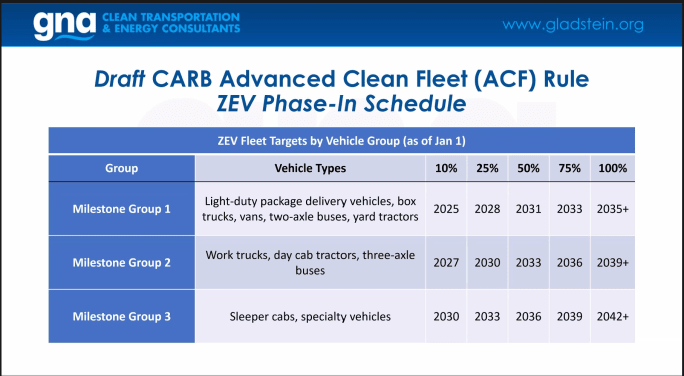
These fleets can also opt for the “ZEV Milestones Option,” which is a phase-in requirement where a portion of the fleet must be ZE-based. There are three schedules:
Group 1: Box trucks, vans, two-axle buses, yard trucks, light-duty delivery vehicles: 10% by 2025, increasing to 100% by 2035.
Group 2: Work trucks, day cab tractors, three-axle buses: 10% by 2027, increasing to 100% by 2039.
Group 3: Sleeper cab tractors and specialty vehicles: 10% by 2030, increasing to 100% by 2042.
CARB believes the proposed regulation would support 100% zero-emission targets set by the board, including zero-emissions of drayage trucks, last-mile delivery and government fleets by 2035; refuse trucks, local buses and utility fleets by 2040; and all trucks and buses by 2045. CARB also believe it would lead the transition away from petroleum fuels and toward electric drivetrains; and contribute to toward carbon neutrality.
The Natural Resources Defense Council says the proposal “lacks ambition and leaves too many of California’s trucks and buses unaccounted for.” Council officials said the regulation should expand the numbers of high-priority fleets trucks to cover more trucks and deter companies from misclassification; require 100% zero-emission vehicle sales by 2036; and accelerate the ZEV purchase timeline for Class 7 and Class 8 tractors.
The public comment period for the regulation began Sept. 2, and will run until Oct. 17.
[Correction: This article was updated on Sept. 9 at 9 p.m. CT to clarify that all drayage trucks added* to CARB’s online system must be ZEV beginning in 2024. Not all drayage trucks in the system in general, as previously implied.]
More Fuel Smarts

How Volvo Updated Its D13 for EPA 2027 [Watch]
Volvo’s updated D13 promises lower emissions without sacrificing performance or fuel economy. Take a closer look at what changed inside the engine in this HDT Spotlight video.
Read More →
Diesel Price Spike Shortens Payback for Natural Gas Trucks, Report Says
Energy Vision estimates fleets could recover the higher purchase price of an RNG-fueled Class 8 tractor in 1.3 to 2.8 years under current fuel-price scenarios.
Read More →
Calstart Becomes Catalyst Mobility, Reflecting Broader Focus
Calstart is now Catalyst Mobility, reflecting the nonprofit’s growing national role in clean transportation, including zero-emission trucks, infrastructure and incentive programs.
Read More →

Record Diesel Prices Squeeze Trucking Fleets
Average U.S. diesel prices have climbed to nearly $6 a gallon, surpassing the 2022 record as tight refinery capacity and Middle East disruptions keep fuel costs elevated.
Read More →
How Fuel Delivery Shapes Engine Performance
Fuel delivery depends on more than what happens at the injector. For fleet, maintenance and technical professionals, looking at the full path from pump to injector can provide useful context for understanding engine performance.
Read More →
East Coast Port Launches $45M Electric Truck Push
The Port Authority of New York and New Jersey announced millions in incentives for zero-emission drayage trucks, yard tractors, and new charging hubs near the port.
Read More →
California Bill Could Shed Light on Electric Truck Prices
Why do battery-electric Class 8 trucks remain so expensive? A California bill headed to Gov. Gavin Newsom would give fleets and state agencies more visibility into what manufacturers charge.
Read More →
Detroit Opens Orders for EPA 2027 Engines
Detroit isn’t starting from scratch to meet EPA 2027 diesel emissions standards. Its Gen 6 DD13 and DD15 engines keep much of today’s platform while updating the fuel and aftertreatment systems.
Read More →
Zero-Emission Truck Corridor Planned for West Coast
California, Oregon, Washington, British Columbia and Baja California are coordinating plans for truck charging and hydrogen fueling from Canada to Mexico.
Read More →
A Closer Look at Kenworth’s Electric T880E Vocational Truck [Video]
Learn more about Kenworth's T880E battery-electric vocational truck at the Paccar Technical Center, including its range, applications, upfitting considerations, and PTO options, in this HDT Spotlight video.
Read More →