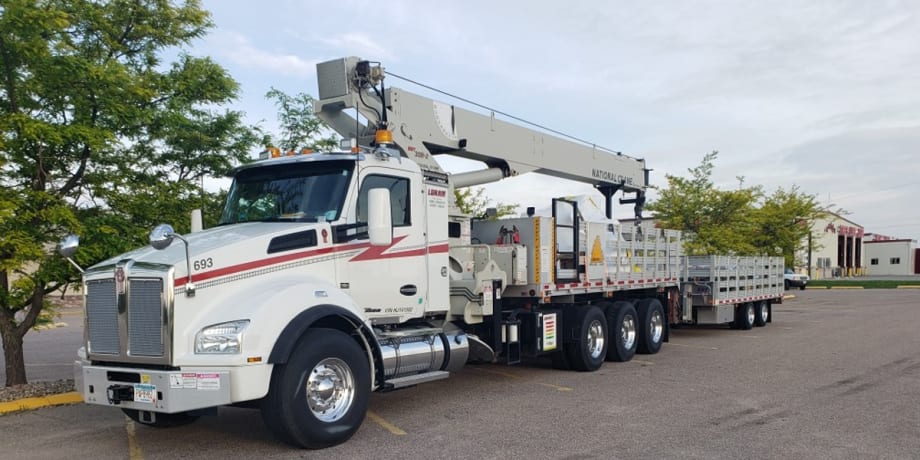
Since implementing Nauto, Loram Maintenance of Way recorded a roughly 79% decrease in accidents.
Photos: Loram Maintenance of Way
3 min to read
As a contractor maintaining railways across North American, Loram Maintenance of Way is held to a high standard of safety. The company is constantly striving for what Vehicle Fleet Manager Graham Rose calls the push for “safety excellence.”
Ad Loading...
The company’s specialized rail maintenance fleet runs 17 heavy-duty trucks, hauling the parts and equipment necessary for doing overhauls or maintenance on Loram’s rail-grinding equipment. Loram also runs a couple of bulk fuel trucks to run things like grease to the company’s rail friction management division.
While Loram had a “good” driving record in 2018, Rose knew there had to be opportunities for improving driver safety, particularly around distracted driving. This led the company to pursue the next step in its fleet safety program: artificial intelligence technology.
Ad Loading...
Fleet Snapshot
Who: Loram Maintenance of Way
Where: Hamel, Minnesota
Fleet: 387 trucks, about 17 heavy-duty
Operations: Railroad maintenance contractor, hauling parts for on-rail equipment
Fun Fact: The fleet manager’s own driver safety score improved around 20 points using the program
Challenge: Reducing distracted driving
“It took me awhile, but I dug around and talked to everybody I could get a hold of to find out who or what was the next best up-and-coming system for safe driving and distracted driving,” Rose says.
Eventually, he came upon Nauto’s fleet safety system, which helps fleets detect distracted and drowsy driving via inward- and outward-facing in-cab cameras. The system also detects and notifies the back office of collisions.
Loram piloted the technology on about 15 vehicles in November 2018. By April 2019, all 387 vehicles in the fleet — from the fleet’s light-duty Ford F-150s to its largest Class 8 trucks — were equipped with the technology.
Distracted driving was the biggest area of opportunity that Loram saw for improvement. Nauto makes it possible to track whether drivers are viewing their cell phones while driving, or if drivers are wearing their seat belts, through video footage.
“We reviewed 15 vehicles’ worth of footage over a couple of months and saw the difference that it was making” in driver habits, Rose says. Since implementing Nauto in late 2018, Loram has recorded a roughly 79% decrease in accidents.
Ad Loading...
Nauto creates a safety score per driver called the visual enhancement risk assessment, or VERA, which grades driver habits such as harsh acceleration/braking, tailgating, and speeding. In the first six months of implementation, no Loram drivers had a Nauto VERA score of 100. Now, 71 drivers in Loram’s fleet have a perfect score, and the top 200 drivers have a score of 90 or better. The average score of fleets Nauto tracks is about 78.
Loram uses the video footage to review incidents and to coach drivers. If the system is picking up a bad habit of tailgating or speeding, for example, Rose’s team can identify a trend and have a productive conversation with the driver.
When the company first introduced the technology, there was some pushback from drivers who were uncomfortable having cameras in the cab. There were fears that management would be watching them in real time.
Loram’s fleet of Kenworth, Peterbilt and Western Star trucks serves the company’s rail maintenance equipment across North America.
Photos: Loram Maintenance of Way
However, Rose says, concerns were addressed when Loram began showing drivers footage of instances where in-cab video helped defend Loram and its drivers against wrongful accusations when an accident occurs.
“Our crew members were able to accept using the system, especially when they saw what it did for them in terms of their driving habits,” Rose says. “It took a little while for the whole Big Brother scare to wear off.”
Ad Loading...
Even some veteran employees who seemed to be the last ones to accept the new system are now some of the biggest proponents.
This article first appeared in the July 2022 issue of Heavy Duty Trucking.
For fleet managers and collision repair professionals keeping heavy-duty trucks on the road, getting the color right the first time isn't just about appearance — it's about efficiency, turnaround time, and bottom-line results. Discover how today's digital color tools are transforming the repair process from guesswork to precision.
Carriers whose updates were due on or after June 1 have more time, while FMCSA works to stabilize its new registration system and warns of phishing sites impersonating its new carrier registration system, Motus.
Cargo theft is no longer just the cost of doing business. It's a multi-billion-dollar criminal enterprise exploiting vulnerabilities across your fleet, drivers, and supply chain.
Explore how telematics help refrigerated fleets improve visibility, uptime, efficiency, compliance, and cargo protection across connected cold chain operations.
Escalating U.S.-Canada tariffs could disrupt cross-border freight, reduce truck volumes, raise costs, and create new uncertainty for carriers on both sides of the border.
The American Transportation Research Institute wants to know what's worrying trucking fleet managers, drivers, and other stakeholders in its annual Industry Issues survey.
HDT Truck Fleet Innovator Adam Buttgenbach helped PepsiCo build one of North America’s largest EV fleets by focusing on where electric trucks make operational sense.