




Global News Roundup: Traton Looks to Modular Approach, Electrification For Growth
ICYMI: A roundup of global trucking news from Traton Group, Volta Trucks, Gaussin, Hyzon Motors and more.


Traton Group CEO Christian Levin and CFO Annette Danielski.
Photo: Traton Group
The Traton Group is looking to its acquisition last year of Navistar, and to the Chinese market, to help it meet what it called “an ambitious margin target for 2024.” Key in its plans for the next few years are development of a modular truck platform and increasing focus on sustainability.
During its May 18 Capital Markets Day in Södertälje, Sweden, where Traton brand Scania is headquartered, company officials said sales are expected to grow in the medium term, primarily driven by a highly competitive product and service offering, the company’s recent entry into the North American market with Navistar, and the establishment of production in China.
As a key part of its strategy, Traton is gradually introducing a common modular system for trucks and buses for all its brands. In the coming years, vehicles from Scania, MAN, Volkswagen Caminhões e Ônibus (which will be renamed Volkswagen Truck & Bus), and Navistar will increasingly be based on the Traton Modular System.
The aim is for all Traton brands to use more common components and parts, mainly within the powertrain, cab, software platforms, and chassis. At the same time, Traton said, each brand will maintain and strengthen its identity and individual offering for its respective customer base.
Navistar is preparing its powertrain plant in Huntsville, Alabama, to produce the Common Base Engine for trucks and buses made in North America. MAN Truck & Bus is aiming to begin production of the joint platform at its Nuremberg site in Bavaria, Germany, in 2024.
Volta Trucks Readies For EV Production
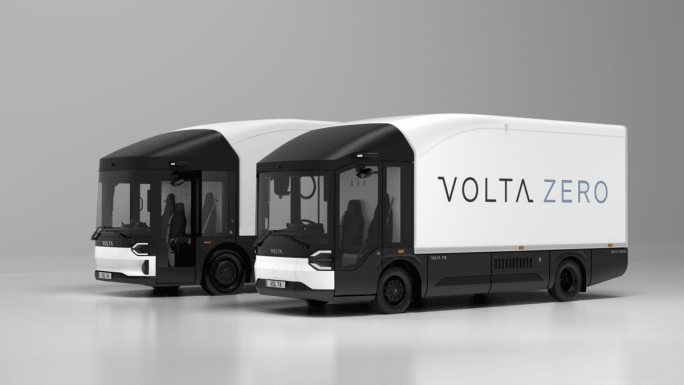
Volta Trucks plans to produce 5,000 16-ton Volta Zero units in 2023.
Photo: Volta Trucks
Volta Trucks unveiled 7.5- and 12-ton variants of the Volta Zero line of medium-duty battery-electric trucks, which will follow the 16-ton version currently undergoing development and testing in readiness for series production by the end of the year.
The Swedish company raised 230 million euros in funding recently to support the production of the truck. It plans to produce 5,000 of the 16-ton Volta Zero units in 2023 at the Steyr plant in Austria, increasing production to 14,000 in 2024 and 27,000 in 2025.
Volta’s first truck-as-a-service hub will be in Paris, France, following customer pilots of the Volta Zero in mid-2022.
New Briefs from Around the World
H2, no driver: Gaussin SA launched what it claims is the world’s first hydrogen-powered fuel cell automated guided vehicle (AGV H2) for seaport applications. The French-based company said the range of transport-related equipment within a central “cluster” at ports make them an ideal location for hydrogen-powered transport.
Autonomous trucks in Germany: Multiple German companies, including MAN Truck & Bus, Knorr-Bremse, and Bosch, are working together to put autonomous trucks on highways by the middle of the decade. The ‘ATLAS-L4’ (Automated Transport between Logistics centers on highways, Level 4) project will use MAN trucks. Knorr-Bremse is developing a redundant braking system architecture and Bosch is making an error-tolerant steering system.
Netherlands H2: Air Products, Schenk Tanktransport and the Netherlands Organization for Applied Scientific Research are collaborating on the Clean Hydrogen and Road Transport Project, focused on developing heavy-duty hydrogen trucks and a public hydrogen refueling station. Subsidized by the Dutch government, the project will create the largest hydrogen refueling station in The Netherlands, initially supplying three zero-emission trucks from Air Products, Schenk Tanktransport and other early hydrogen adopters in the Rotterdam port area.
More BEVs for DHL: Deutsche Post DHL Group plans to intensify its transition to electric trucks by deploying a total of 44 new electric Volvo trucks on routes in Europe. The intended order includes 40 Volvo FE and Volvo FL electric versions to be used for urban package deliveries. DHL has decided to begin using electric trucks for regional hauling, as well, starting with four Volvo FM Electric trucks in the UK.
Hyzon Motors is set to supply 18 fuel-cell-electric trucks to Hylane GmbH, a wholly owned subsidiary of German automotive insurance firm DEVK Versicherung. Deliveries are scheduled to begin late 2022. Hylane is operating a pay-per-use model where fleet owners can deploy Hyzon vehicles through a rental agreement with Hylane. Customers pay for the number of miles they have driven, with Hylane covering maintenance and downtime costs.
Hotline Global is produced in partnership with UK-based Truck & Bus Builder. A free trial subscription to T&BB is available.This news first appeared in the June 2022 issue of Heavy Duty Trucking.
More Fuel Smarts

How Volvo Updated Its D13 for EPA 2027 [Watch]
Volvo’s updated D13 promises lower emissions without sacrificing performance or fuel economy. Take a closer look at what changed inside the engine in this HDT Spotlight video.
Read More →
Diesel Price Spike Shortens Payback for Natural Gas Trucks, Report Says
Energy Vision estimates fleets could recover the higher purchase price of an RNG-fueled Class 8 tractor in 1.3 to 2.8 years under current fuel-price scenarios.
Read More →
Calstart Becomes Catalyst Mobility, Reflecting Broader Focus
Calstart is now Catalyst Mobility, reflecting the nonprofit’s growing national role in clean transportation, including zero-emission trucks, infrastructure and incentive programs.
Read More →

Record Diesel Prices Squeeze Trucking Fleets
Average U.S. diesel prices have climbed to nearly $6 a gallon, surpassing the 2022 record as tight refinery capacity and Middle East disruptions keep fuel costs elevated.
Read More →
How Fuel Delivery Shapes Engine Performance
Fuel delivery depends on more than what happens at the injector. For fleet, maintenance and technical professionals, looking at the full path from pump to injector can provide useful context for understanding engine performance.
Read More →
East Coast Port Launches $45M Electric Truck Push
The Port Authority of New York and New Jersey announced millions in incentives for zero-emission drayage trucks, yard tractors, and new charging hubs near the port.
Read More →
California Bill Could Shed Light on Electric Truck Prices
Why do battery-electric Class 8 trucks remain so expensive? A California bill headed to Gov. Gavin Newsom would give fleets and state agencies more visibility into what manufacturers charge.
Read More →
Detroit Opens Orders for EPA 2027 Engines
Detroit isn’t starting from scratch to meet EPA 2027 diesel emissions standards. Its Gen 6 DD13 and DD15 engines keep much of today’s platform while updating the fuel and aftertreatment systems.
Read More →
Zero-Emission Truck Corridor Planned for West Coast
California, Oregon, Washington, British Columbia and Baja California are coordinating plans for truck charging and hydrogen fueling from Canada to Mexico.
Read More →
A Closer Look at Kenworth’s Electric T880E Vocational Truck [Video]
Learn more about Kenworth's T880E battery-electric vocational truck at the Paccar Technical Center, including its range, applications, upfitting considerations, and PTO options, in this HDT Spotlight video.
Read More →