




Autonomous Yard Truck Company Develops Trailer Backing Capabilities
Outrider’s proprietary technology enables autonomous yard trucks to back dry van trailers, containers, and refrigerated trailers into tight spaces without human interaction.

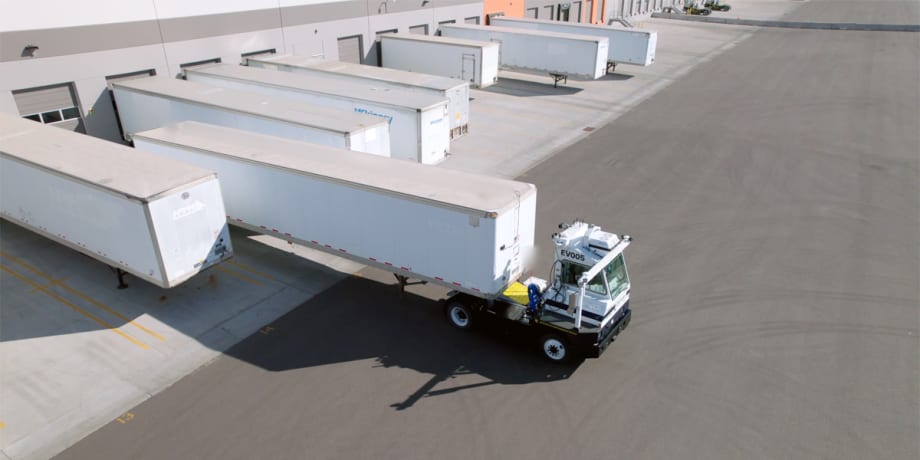
Outrider’s articulated backing technology is fully autonomous, adheres to strict operational requirements, and is capable of controlling a trailer through its full range of motion.
Photo: Outrider
Outrider has released fully autonomous trailer backing capabilities to its fleet of yard trucks.
This proprietary technology enables autonomous yard trucks to back trailers into tight spaces with precision and without modifications to trailers. These capabilities are now available as part of the Outrider System, which automates distribution yards for large, logistics-dependent enterprises.
“Automation is key to relieving the inflationary pressure on the supply chain," said Andrew Smith, founder and CEO of Outrider in a press release. “Distribution yards are critical links in the supply chain and prime targets for automating the flow of goods between over-the-road transportation and fulfillment centers, warehouses and manufacturing plants. Automating yards requires backing trailers of all kinds safely and precisely into parking spots and dock spots billions of times a year.”
Articulated backing is one of the most challenging maneuvers in the trucking industry, especially in confined distribution yards, the company explains. Backing technology is crucial to autonomous yard operations because a wide variety of trailers must be backed into dock spots and parking spots without damage. Specific to backing into dock spots, trailers must be on-center and in exact contact with the docks.
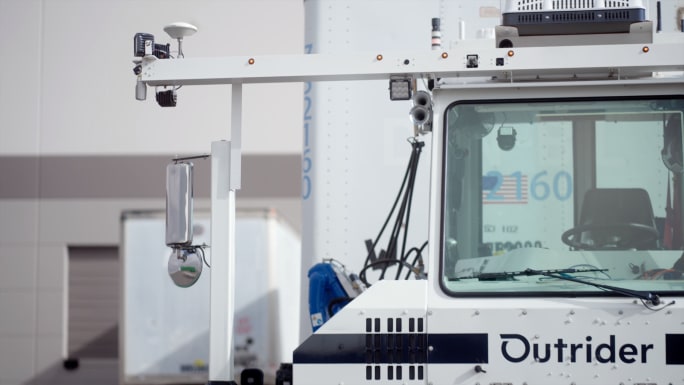
"By developing advanced algorithms and integrating with sensors and actuation, we've delivered the accurate trailer backing necessary for yard automation," said Jeremy Nett, vice president of software engineering at Outrider.
Photo: Outrider
Outrider’s articulated backing technology is fully autonomous, adheres to strict operational requirements, and is capable of controlling a trailer through its full range of motion. With this technology, the Outrider System is able to precisely back the diversity of semi-trailers that are used in the industry, including 28-foot, 48-foot, and 53-foot dry van trailers, containers, and refrigerated trailers – all without teleoperation or other types of human interaction.
"By developing advanced algorithms and integrating with sensors and actuation, we've delivered the accurate trailer backing necessary for yard automation," said Jeremy Nett, vice president of software engineering at Outrider. "Outrider validated this proprietary technology at its advanced testing facility and customer sites – running under multiple conditions, day and night. This achievement is a result of a highly collaborative cross-functional effort across our perception, motion planning and controls, hardware, and test teams to develop and commercialize this technology."
The Outrider System consists of three integrated parts — management software, autonomous vehicles, and site infrastructure. In addition to the latest articulated backing technology, the Outrider System uses proprietary autonomy technology to hitch to and unhitch from trailers, robotically connect and disconnect trailer brake lines, interact safely with loading docks, track trailer locations, and centrally manage and monitor all system functions.
Outrider has partnered with multiple Fortune 500 companies. To date, the company has raised a total of $118 million in funding, developed an extensive patent portfolio, completed multiple pilot programs and opened a test site.
More Equipment

How Volvo Updated Its D13 for EPA 2027 [Watch]
Volvo’s updated D13 promises lower emissions without sacrificing performance or fuel economy. Take a closer look at what changed inside the engine in this HDT Spotlight video.
Read More →
Michelin Tire Improves Efficiency and Durability for Regional Fleets
The Michelin X Multi Energy D2 is a regional haul drive tire engineered to help fleets improve fuel efficiency, durability and traction in demanding stop-and-go operations.
Read More →
ZF Expands Commercial Vehicle Push in North America
ZF is expanding its North American commercial-vehicle presence with new transmission applications, electrification, trailer technology and autonomous-driving systems.
Read More →
Tesla Wants a Self-Driving Semi. Are Cameras Enough?
Could Tesla’s camera-only autonomous driving technology work on an 80,000-pound Semi? In this commentary, HDT's Deborah Lockridge takes a look at Tesla, Cybercab, and how autonomous trucks see the road.
Read More →
Kodiak: Driverless Long-Haul Truck Launch on Track for 2026
Kodiak AI says its driverless long-haul safety case is 93% complete and it remains on track to begin commercial operations by year-end 2026.
Read More →
What DOT’s Automated Vehicle Strategy Means for Trucking
The U.S. Department of Transportation issued a new automated-vehicle strategy that outlines plans for driverless-truck regulations, cross-state freight corridors, and federal safety standards.
Read More →
East Coast Port Launches $45M Electric Truck Push
The Port Authority of New York and New Jersey announced millions in incentives for zero-emission drayage trucks, yard tractors, and new charging hubs near the port.
Read More →
PlusAI Going Public to Fund Autonomous Truck Launch
A SPAC deal could provide PlusAI with up to $300 million as it works toward a 2027 commercial launch of factory-built autonomous trucks.
Read More →
NHTSA Moves to Rewrite Truck Fuel-Economy Rules
The National Highway Traffic Safety Administration says it lacks authority to regulate medium- and heavy-duty truck engines separately from complete vehicles, but the existing standards have not yet been eliminated.
Read More →
Detroit Opens Orders for EPA 2027 Engines
Detroit isn’t starting from scratch to meet EPA 2027 diesel emissions standards. Its Gen 6 DD13 and DD15 engines keep much of today’s platform while updating the fuel and aftertreatment systems.
Read More →