




Report Questions Yellow CARES Act Loan
The Congressional Oversight Commission is questioning a $700 million loan that Yellow Corp. (then-YRC Worldwide) received last year under the CARES Act.

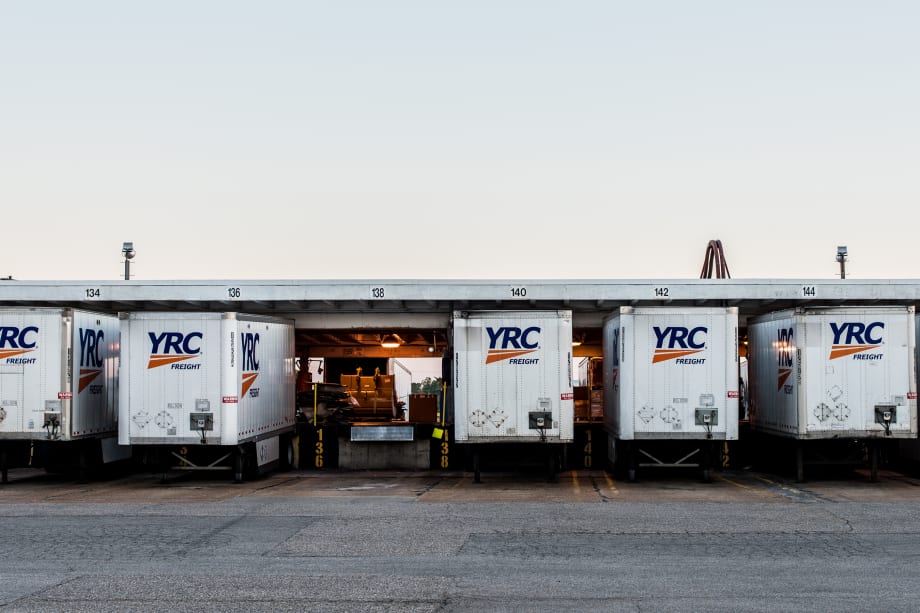
A government report wants to know who determined that YRC (now Yellow) was critical to U.S. security.
Photo: File (YRC Worldwide)
The Congressional Oversight Commission is questioning a $700 million loan that Yellow Corp. (then-YRC Worldwide) received last year under the Coronavirus Aid, Relief, and Economic Security Act, better known as the CARES Act.
A report issued April 30 notes that the commission’s role is to conduct oversight of the implementation of parts of the CARES Act by the U.S. Treasury and the Federal Reserve.
Subtitle A provided $500 billion to the Treasury for lending and other investments “to provide liquidity to eligible businesses, states, and municipalities related to losses incurred as a result of coronavirus," according to the report; $17 billion was available for businesses “critical to maintaining national security.”
The Treasury provided national security loans to 11 businesses, totaling $735.9 million. Yellow accounted for 95% of the total outstanding loans.
This was the 12th report from the commission, and it’s not the first one to question the Yellow loan. The seventh report focused on it, with the commission expressing concerns regarding the Treasury’s process for certifying Yellow as “critical to maintaining national security” and questioning whether Yellow’s precarious financial position at the time of the loan exposed taxpayers to a significant risk of loss.
This latest document reports on the subsequent communications between the commission, Treasury, and Defense Department. Among the questions those correspondence raises, the commission says, is who determined that the less-than-truckload carrier was critical to national security?
TRANSCOM (U.S. Transportation Command) did not ask the military’s main logistics contractor, Crowley Logistics, reports the commission. In fact, TRANSCOM told the commission that the loss of YRC could be readily absorbed by the LTL market, based on an analysis provided by Crowley.
The commission also said it has been unable to substantiate the assertion Treasury and DOD made indicating that Yellow provides 68% of LTL services to DOD.
“The commission believes that part of the reason for these unsubstantiated numbers, or inconsistencies, is due to the complexity associated with the seven-layer chain of command at DOD implemented to designate a company as critical to national security… With so many layers, information is bound to get lost in translation.”
Lastly, the commission called attention to Yellow’s increased lobbying efforts in 2020. Yellow spent $570,000 on lobbying efforts in 2020, compared to zero in 2019, $80,000 in 2018 and $75,000 in 2017. The Commission pointed out the correlation between the lobbying and Yellow’s ability to secure a $700 million loan. The Treasury confirmed that several senators and members of Congress sent letters to Treasury urging them to underwrite Yellow’s loans, according to the report.
It also pointed out that this was not the first time the company had lobbied the government to help it out of a tight financial spot. In 2009 during the financial crisis, Yellow also was on the verge of bankruptcy and had planned on applying for a $1 billion federal government bailout before entering into a debt swap arrangement with a group of banks. Yellow’s lobbying efforts, in conjunction with intensive political contacts by organized labor, totaled $800,000 for that year.
The Northwest Arkansas Democrat Gazette dug into the report in a May 1 article, “Trucking firm's loan of $700M from U.S. 'a mistake,' Hill says.”
U.S. Rep. French Hill, R-Ark., who is on the three-person commission, told the Democrat-Gazette that the company didn't appear to qualify for the narrowly tailored program.
"The $700 million taxpayer backed loan Treasury made to Yellow, formerly YRC, was a mistake," Hill said in a written statement, according to the paper. "Based on the oversight work conducted by the commission, there is no evidence to support Yellow being critical to national security which means these loans should never have been executed."
A spokeswoman for Yellow, Heather Nauert, said in a written statement reported by the paper: "Our agreement with the U.S. Department of the Treasury was mutually beneficial. The department invested in the future of the company and our 30,000 employees with the belief that it would pay off. Today, taxpayers are beneficiaries of this investment.”
The federal government ended up with about a 30% stake in the company.
She also told the paper that transporting goods for the federal government is highly complex and not all carriers can or want to do it.
“We provide a highly specialized service that enables our equipment to access Department of Defense facilities. This requires drivers to have specific credentials and training. In addition, our more than 300 terminals across the United States enable Yellow to quickly and efficiently access Department of Defense distribution hubs and bases. We are proud to continue to be critical to the national security of this great nation.”
More Fleet Management

Color Match Smarter: Tools That Restore & Perform
For fleet managers and collision repair professionals keeping heavy-duty trucks on the road, getting the color right the first time isn't just about appearance — it's about efficiency, turnaround time, and bottom-line results. Discover how today's digital color tools are transforming the repair process from guesswork to precision.
Read More →
FMCSA Pauses Biennial-Update Enforcement Amid Motus Transition
Carriers whose updates were due on or after June 1 have more time, while FMCSA works to stabilize its new registration system and warns of phishing sites impersonating its new carrier registration system, Motus.
Read More →
2026 Blueprint for Countering Smarter Supply Chain Theft
Cargo theft is no longer just the cost of doing business. It's a multi-billion-dollar criminal enterprise exploiting vulnerabilities across your fleet, drivers, and supply chain.
Read More →


How Telematics Improves Visibility, Control, and Performance in Refrigerated Fleets
Explore how telematics help refrigerated fleets improve visibility, uptime, efficiency, compliance, and cargo protection across connected cold chain operations.
Read More →
What the U.S.-Canada Trade War Means for Trucking
Escalating U.S.-Canada tariffs could disrupt cross-border freight, reduce truck volumes, raise costs, and create new uncertainty for carriers on both sides of the border.
Read More →
What Are Trucking’s Top Concerns for 2026?
The American Transportation Research Institute wants to know what's worrying trucking fleet managers, drivers, and other stakeholders in its annual Industry Issues survey.
Read More →
American Trucking Associations Looks for a New Leader
ATA President and CEO Chris Spear abruptly left his job at the association on August 21, at a pivotal time for the trucking industry.
Read More →
Public Wi-Fi Cybersecurity Risks: How Truck Drivers and Fleets Can Protect Their Data
Public Wi-Fi can expose truck drivers and fleets to credential theft, malware, and other cyber threats. Here’s how to reduce the risk on the road.
Read More →
For Nicky Cupp, Fleet Innovation Starts With Frustration
HDT Truck Fleet Innovator Nicky Cupp turns everyday pain points at Fraley & Schilling into opportunities for better technology and smarter processes.
Read More →
Adam Buttgenbach’s Approach to Electric Trucks: Start With Where They Fit
HDT Truck Fleet Innovator Adam Buttgenbach helped PepsiCo build one of North America’s largest EV fleets by focusing on where electric trucks make operational sense.
Read More →