




Will Drug Clearinghouse be a New Annual Stress on Driver Capacity?
What happens to the driver workforce when most motor carriers wait until the end of the year to do their required annual Drug and Alcohol Clearinghouse queries?
by Avery Vise, FTR
April 9, 2021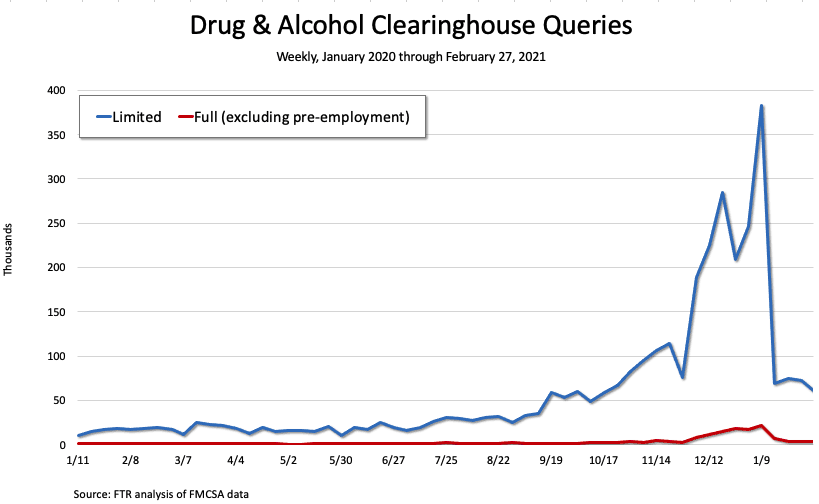
A spike in required yearly partial queries of the clearinghouse may affect driver hiring.
3 min to read
In the fourth quarter of 2020, the for-hire trucking industry added nearly 29,000 payroll jobs – the most in any three-month period in 25 years. Since year-end, however, trucking has added a net of only 3,800 jobs through the end of March, which is not very strong considering robust freight indicators.
This sudden deceleration of the hiring spree seems odd, given that most indicators of freight demand – such as spot market volume and rates, consumer spending, and industrial production – suggested continued upward pressure on hiring.
A weak patch in the middle of an employment surge is uncommon, but we might be seeing the first instance of what could become an annual phenomenon. Data from the Federal Motor Carrier Safety Administration’s Drug and Alcohol Clearinghouse suggests that December and early January saw a disproportionately large loss of drivers due to positive drug tests.
The clearinghouse, which went into effect in early 2020, lacks a mechanism to alert a current employer if a driver working for that carrier tests positive while applying for a job at another carrier. To counter that blind spot, the FMCSA requires carriers to conduct a "partial" query on all drivers it uses at least once a year to see if any have tested positive in pre-employment tests.
The deadline for the first annual query was January 5, 2021. Nearly half of those queries occurred in December and the first five days of January, so the loss of drivers due to pre-employment testing almost certainly was higher during this period than during the rest of 2020. This loss would have been a drain on payroll employment, which could help explain the weak net increase in January and the loss in February.
How many additional drivers did trucking lose during December and early January? We do not have enough data to know for sure, but we can make an educated guess.
We start with the number of pre-employment positive results during 2020 and make conservative assumptions regarding the number of drivers already employed when testing positive and the number of those drivers who might have been removed anyway due to random testing. We further assume that half of the remaining drivers were removed during December and the first five days of January 2021, given that half the queries were conducted during that period.
Given these assumptions, we estimate that at least 3,500 drivers were removed during this period in addition to those who were disqualified through the normal clearinghouse process. That might not sound like a large number, but it is equivalent to the 13th largest truckload carrier shutting down over about a month.
This probably is a conservative estimate. Due to the pandemic, FMCSA granted considerable flexibility in random testing, so random testing probably removed fewer drivers than normal. We also assumed that only half of drivers testing positive in pre-employment tests were already driving for another carrier. That percentage likely is higher, but we do not know.
Although carriers might have regretted putting off annual queries, we generally expect this pattern to hold each year. Due to high turnover, carriers likely will find it easier to conduct all their annual queries at one time rather than try to space them out. However, if the clearinghouse does its job in exiling drug-using drivers, we should see fewer drivers added to the ranks of the disqualified each year.
EDITOR'S NOTE: Article corrected 4/12/2021 to reflect revised federal job numbers.
More Drivers

EEOC Sues Texas Trucking Company Over Driver Age Limits
The agency says Trancasa USA rejected applicants over 65 and applied tougher driving-record standards to those over 60.
Read More →
Nussbaum, Roehl Announce Second Driver Pay Increase This Year
This year has seen a swath of major truck driver pay increases as freight capacity has tightened.
Read More →
From One Generation to the Next: How Mentorship Builds Safer Truck Drivers
After three decades in trucking, Harold Perry shares what he's learned about driver safety, mentorship, and helping the next generation build confidence behind the wheel.
Read More →
Truck Drivers Need More Than Another Alert
Fleets have more visibility into truck health, safety events, and driver activity than ever. The next challenge is turning all that information into useful guidance for the person who has to decide what to do next.
Read More →
FMCSA Removes 110 Truck Driver Training Schools from Certified ELDT List
Federal regulators also are targeting more than 160 additional training providers and launching a nationwide audit of third-party CDL skills testers as part of a broader crackdown on trucking fraud.
Read More →
Hours of Service Pilot Programs: FMCSA Readies for 2027 Rollout
Two pilot programs could eventually reshape hours-of-service rules, giving truck drivers options to pause their 14-hour clock or use longer split sleeper rest periods.
Read More →
Medical Cards, English Proficiency Reshape Roadcheck Violations
Medical-card violations jumped to the top of the driver out-of-service list during CVSA’s 2026 International Roadcheck, while English-language proficiency violations appeared among the leading violations for the first time.
Read More →
Driver Trust Can Make or Break the Success of Fleet Safety Technology
New Teletrac Navman research suggests that onboarding, transparency about driver data, and positive feedback can play a significant role in how commercial drivers respond to safety and coaching technology.
Read More →
EEOC Sues KLLM Over Alleged Sex Discrimination in Driver Training
KLLM is facing a federal sex-discrimination lawsuit over policies the EEOC alleges put female truck driver trainees at a disadvantage.
Read More →
FMCSA Moves to Codify English Language Requirements for Commercial Drivers
By changing regulations on English-language proficiency requirements for commercial drivers, rather than relying on a guidance memo, the FMCSA said future administrations won't be able to walk back the Trump administration's stricter enforcement with just a memo.
Read More →