




Westport Introduces Next-Gen NatGas Fuel Injectors
Long development time for next-generation HPDI system, sales uncertainties, and lack of 'comfort' with a customer will reduce revenues this year.


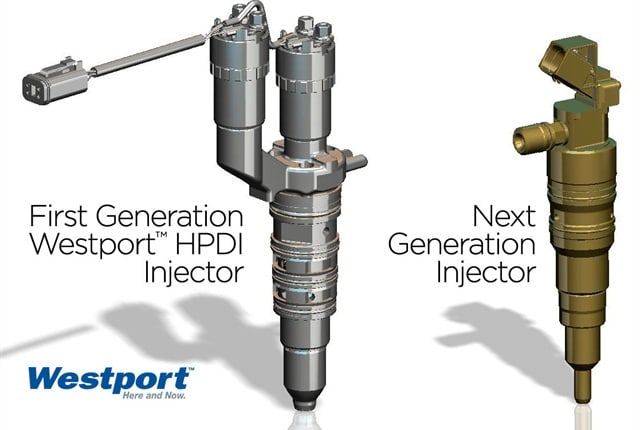
Westport Innovations Inc. announced that a new family of high-pressure fuel injectors, co-developed with Delphi Automotive PLC, will be part of its high pressure direct injection second generation, or HPDI 2.0, system for adoption by truck builders.
“The introduction of Westport HPDI 2.0 is expected to provide dramatically better system costs and better compatibility with advanced diesel engine platforms compared to earlier generation systems,” the company said in a statement.
Westport also said uncertainty in its main markets and other outside problems has reduced its 2014 revenue outlook to between $130 million and $140 million, down from a July estimate of $175 million to $185 million, along with probable losses by its operating units. The company halted trading in its shares prior to the announcement.
“It is imperative that we take a long-term view on product development and make the appropriate decisions" on product investment, said David Demers, Westport’s president and CEO.
Smaller, lower cost
The new injectors will provide better cost, smaller size and improved packaging compared to prior Westport HPDI injector designs, the statement said. The new injectors are now running in engine tests, and are displayed at the Delphi booth at the IAA Commercial Vehicles Show in Hanover, Germany.
“The HPDI 2.0 fuel system is expected to further increase original-equipment-manufacturer interest in natural gas products with industry-leading performance, fuel economy and flexibility,” the company said. “It is designed to provide stronger economics to truck customers across a broad range of engine displacements and applications compared to traditional natural gas engine technology.”
An upgraded liquefied natural gas (LNG) fuel storage and supply system will also lower costs for the second-generation product, the statement said. The LNG tank will have an integrated and improved cryogenic fuel pump, and filling stations will be simpler and less costly.
“Significant reduction in costs combined with major enhancements in reliability, durability, and serviceability deliver substantial improvements in customer operating uptime and return on investment,” Westport said.
The HPDI 2.0 LNG components will be used in compression-ignition engines with diesel-like power, torque and fuel economy benefits, and in the iCE Pack LNG Tank System for spark-ignited engines, including the Cummins Westport ISX12 G, it said.
Developments are underway with OEM customers in China and Europe. HDPI 2.0 products for China will be available for controlled customer fleet deployment in 2015 in pre-production volumes, Westport said.
“Shifting Westport's focus to the new injector and related fuel system may delay the volume launch in the short term, but it is expected to result in materially better component costs, more efficient product investment, and improved customer economics compared to both diesel engines and other natural gas engine technologies in the future,” the company’s statement continued.
“In the near term, Westport expects fleets with high-performance requirements to see HPDI trucks as offering unique capabilities and be encouraged to commit to adopting LNG with a clear path to upgraded and continued development of this technology.”
Meanwhile, North American customers are using gas engines from the Cummins Westport joint venture. Strong performance by the ISX12 G “is encouraging the development of both LNG and CNG (compressed natural gas) infrastructure,” the statement said. “It is clear that to meet the needs of the trucking community, the industry will need a broad range of engines and truck chassis, as well as investment in new infrastructure.”
3 factors lower income
Lowered income forecasts are the result of three factors: continued market uncertainty in Westport's primary markets —Europe, Russia and China — and delays in revenue milestone payments from OEM customers due to a longer development schedule for HPDI 2.0, the company said. Westport is reducing program expenses to offset some of that.
“Third, a Westport customer who placed a significant order for Westport iCE Pack LNG tank systems has been unable to provide sufficient comfort to Westport that it will be able to meet its obligations and requirements in respect of such orders, and as such Westport does not intend to ship product to this customer until such comfort has been received,” the statement said.
"Our OEM partners have a successful and long-term view of the industry and so do we, and we are pleased to see continuing interest in our latest generation of HPDI technology from an ever-increasing list of leading OEMs,” said Demers, the CEO.
“While these new relationships are important, we are committed to balancing our technology investment portfolio to maximize future product growth and hitting our stated financial goal of company-wide positive adjusted EBITDA (earnings before interest, taxes, depreciation and amortization) by the end of 2015.”
By Tom Berg
More Fuel Smarts

How Volvo Updated Its D13 for EPA 2027 [Watch]
Volvo’s updated D13 promises lower emissions without sacrificing performance or fuel economy. Take a closer look at what changed inside the engine in this HDT Spotlight video.
Read More →
Diesel Price Spike Shortens Payback for Natural Gas Trucks, Report Says
Energy Vision estimates fleets could recover the higher purchase price of an RNG-fueled Class 8 tractor in 1.3 to 2.8 years under current fuel-price scenarios.
Read More →
Calstart Becomes Catalyst Mobility, Reflecting Broader Focus
Calstart is now Catalyst Mobility, reflecting the nonprofit’s growing national role in clean transportation, including zero-emission trucks, infrastructure and incentive programs.
Read More →

Record Diesel Prices Squeeze Trucking Fleets
Average U.S. diesel prices have climbed to nearly $6 a gallon, surpassing the 2022 record as tight refinery capacity and Middle East disruptions keep fuel costs elevated.
Read More →
How Fuel Delivery Shapes Engine Performance
Fuel delivery depends on more than what happens at the injector. For fleet, maintenance and technical professionals, looking at the full path from pump to injector can provide useful context for understanding engine performance.
Read More →
East Coast Port Launches $45M Electric Truck Push
The Port Authority of New York and New Jersey announced millions in incentives for zero-emission drayage trucks, yard tractors, and new charging hubs near the port.
Read More →
California Bill Could Shed Light on Electric Truck Prices
Why do battery-electric Class 8 trucks remain so expensive? A California bill headed to Gov. Gavin Newsom would give fleets and state agencies more visibility into what manufacturers charge.
Read More →
Detroit Opens Orders for EPA 2027 Engines
Detroit isn’t starting from scratch to meet EPA 2027 diesel emissions standards. Its Gen 6 DD13 and DD15 engines keep much of today’s platform while updating the fuel and aftertreatment systems.
Read More →
Zero-Emission Truck Corridor Planned for West Coast
California, Oregon, Washington, British Columbia and Baja California are coordinating plans for truck charging and hydrogen fueling from Canada to Mexico.
Read More →
A Closer Look at Kenworth’s Electric T880E Vocational Truck [Video]
Learn more about Kenworth's T880E battery-electric vocational truck at the Paccar Technical Center, including its range, applications, upfitting considerations, and PTO options, in this HDT Spotlight video.
Read More →