




Volvo Honors Ruan, Searcy with 2015 Safety Awards
Based in the American Midwest and Canadian Prairies, the two winners were picked for their low accident rates and the quality of their safety programs.
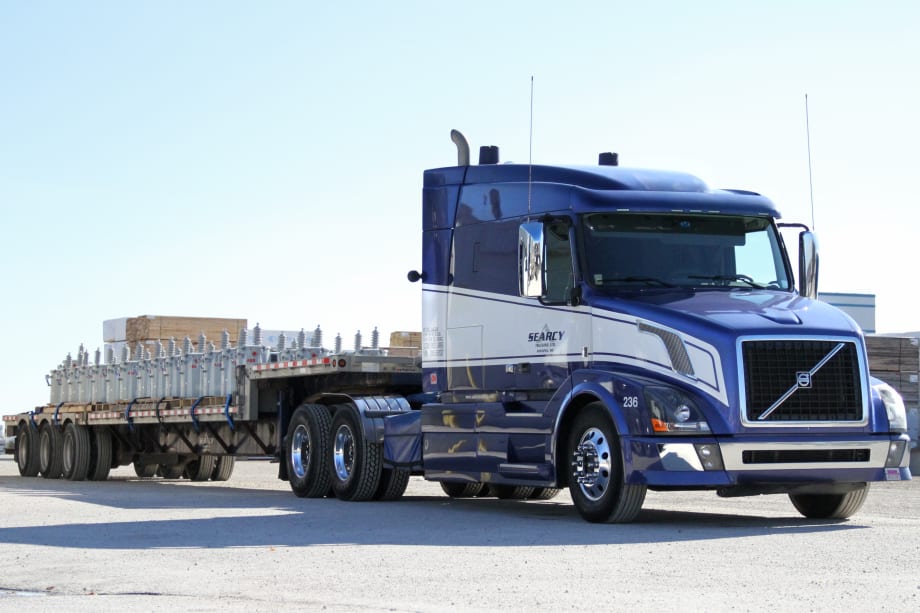
Searcy has a "right to decide" policy that allows drivers to interrupt a trip if conditions become unsafe.
PHILADELPHIA -- Ruan Transportation Management Systems and Searcy Trucking Limited were awarded 2015 Volvo Trucks Safety Awards on Oct. 19 at the ATA’s Management Conference & Exhibition here. The two companies were honored for their exemplary safety records and training programs, with each receiving $25,000 for future safety initiatives.
“By making safety a priority every day, Ruan Transportation and Searcy Trucking were able to deliver an outstanding safety performance during the past year,” said Göran Nyberg, president, Volvo Trucks North America. “Their investments in industry-leading safety programs and training show a dedication to driver safety, and we congratulate them on this achievement.”
Now entering its seventh year, Volvo’s Safety Award program recognizes the outstanding safety performance of North American fleets. Since 2009, Michelin Americas Truck Tires has been a co-sponsor of the program.
"Michelin has been focused on safety for over 125 years, and we are proud to again partner with Volvo Trucks to recognize the safest fleets in North America with the 2015 Volvo Trucks Safety Awards,” said Mike Cain, Michelin vice president of original equipment.
Nyberg said candidates were evaluated for their low accident rates and the quality of their safety programs. A candidate fleet must run some Volvos among its vehicles. Volvo and Michelin detailed the reasons for their choosing the two winning fleets:
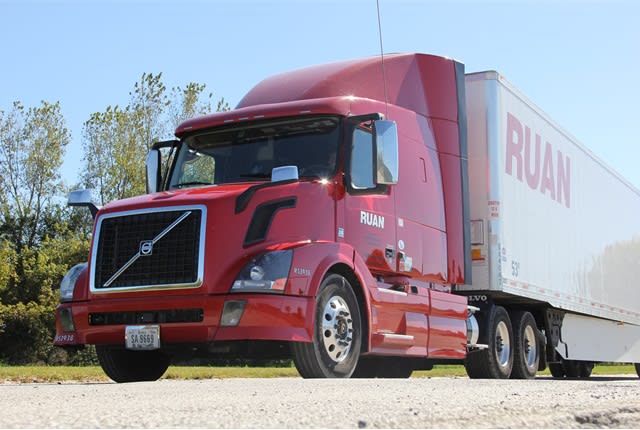
Ruan set up a formal safety program in the 1940s, and now has an active effort called Megasafe. Photos: Volvo Trucks
Ruan Transportation Management Systems, based in Des Moines, Iowa, is the 2015 winner in the over 20 million miles category. Ruan drivers logged more than 246 million miles in 2014 and had an accident frequency rate of only 0.61.
Founded in 1932, Ruan is one of the top 10 privately owned transportation companies in the U.S. with 270-plus locations. With more than 3,900 trucks in its fleet, Ruan hauls freight for a wide range of industries, including retail, manufacturing, food and dairy, chemicals, medical supplies and waste.
Its Megasafe program guides training, regular safety meetings and field operations. In the 1940s, Ruan became the first transportation company to introduce a formal safety program.
“We are honored and proud to be recognized with the Volvo safety award,” said Lisa Gonnerman, vice president of safety for Ruan. “Nothing is more important to us than the safety of our drivers and protecting the motoring public around us. We are driven to be safe, and our programs demonstrate our safety focus.”
Searcy has a "right to decide" policy that allows drivers to interrupt a trip if conditions become unsafe.
Searcy Trucking Ltd., a family-owned company located in Winnipeg, Manitoba, won the award in the under 20 million miles category. A division of Canada’s Bison Transport since 2013, Searcy was established in 1969 and specializes in flatbed transportation services. It runs 88 trucks.
Searcy’s strong safety culture calls for managing safety with the same attention to detail as financial management. Driver training includes simulations based on real-life fleet experience.The company has a “right to decide” policy that allows drivers to temporarily discontinue a trip when conditions are too hazardous to drive safely.
Searcy’s drivers logged more than 6.8 million miles in 2014 and had an accident frequency rate of just 0.58.
“Safety has been a core value at Searcy Trucking for as long as we’ve been in the trucking business, and was a key factor in Bison’s interest in acquiring Searcy back in 2013,” said Norm Blagden, the company’s president.
“Searcy drivers are some of the best in the business. That, combined with a leading safety program, ensures our drivers return home safely at the end of each and every trip.”
More Safety & Compliance

FMCSA Pauses Biennial-Update Enforcement Amid Motus Transition
Carriers whose updates were due on or after June 1 have more time, while FMCSA works to stabilize its new registration system and warns of phishing sites impersonating its new carrier registration system, Motus.
Read More →
ZF Expands Commercial Vehicle Push in North America
ZF is expanding its North American commercial-vehicle presence with new transmission applications, electrification, trailer technology and autonomous-driving systems.
Read More →
Truck Drivers Need More Than Another Alert
Fleets have more visibility into truck health, safety events, and driver activity than ever. The next challenge is turning all that information into useful guidance for the person who has to decide what to do next.
Read More →
Tesla Wants a Self-Driving Semi. Are Cameras Enough?
Could Tesla’s camera-only autonomous driving technology work on an 80,000-pound Semi? In this commentary, HDT's Deborah Lockridge takes a look at Tesla, Cybercab, and how autonomous trucks see the road.
Read More →
What DOT’s Automated Vehicle Strategy Means for Trucking
The U.S. Department of Transportation issued a new automated-vehicle strategy that outlines plans for driverless-truck regulations, cross-state freight corridors, and federal safety standards.
Read More →
NYC Expands Speed, Pedestrian Safety Tech Across Fleet
New York City is expanding intelligent speed assistance and pedestrian-alert systems across its municipal fleet, moving the technologies from pilot programs into vehicle procurement and retrofit requirements.
Read More →
FMCSA Removes 110 Truck Driver Training Schools from Certified ELDT List
Federal regulators also are targeting more than 160 additional training providers and launching a nationwide audit of third-party CDL skills testers as part of a broader crackdown on trucking fraud.
Read More →
Beyond DOT Compliance: What Makes a Trucking Fleet Truly Safe?
A trucking fleet can follow every rule and still make unsafe decisions. The real test comes when safety conflicts with freight, productivity, or cost.
Read More →
Hours of Service Pilot Programs: FMCSA Readies for 2027 Rollout
Two pilot programs could eventually reshape hours-of-service rules, giving truck drivers options to pause their 14-hour clock or use longer split sleeper rest periods.
Read More →
New Guide Offers Pet Safety Tips for Truck Drivers
Hundreds of thousands of pets travel in truck cabs. A new safety guide from Volvo Trucks and the Center for Pet Safety offers practical advice for truck drivers who bring dogs and cats along for the ride.
Read More →