




Volvo Debuts Global Truck Safety System
Volvo’s next-generation advanced safety system is designed to protect pedestrians and cyclists.

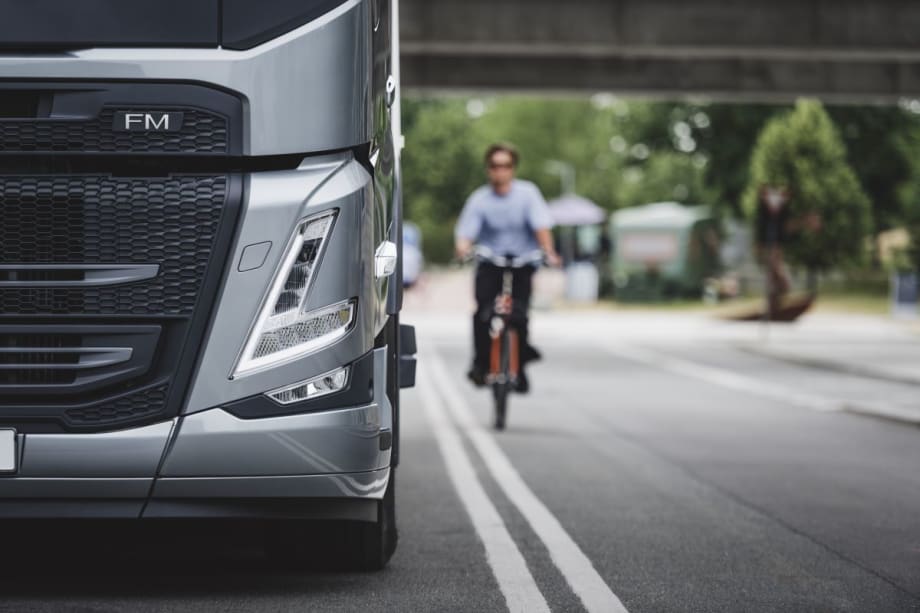
Volvo’s Active Side Collision Avoidance Support system uses radar sensors to detect approaching cyclists.
Photo: Volvo Trucks
Busy traffic situations pose daily safety risks to vulnerable road users. This is why Volvo Trucks is introducing two safety systems focusing on protecting pedestrians and cyclists, the company said.
Volvo Trucks said it continuously develops its active safety systems to protect vulnerable road users such as cyclists and pedestrians, all with the purpose of taking steps towards the company’s long-term vision of zero accident involving Volvo trucks.
Passenger-Side Safety
The latest example is Volvo’s Active Side Collision Avoidance Support. According to Volvo, the key word for this new system is “active”.
This is an evolution of an existing safety system, with the active brake function being added. Using radar sensors to detect approaching cyclists, the system can warn the driver and if necessary, it can now also actively brake the truck to avoid a collision with cyclists when turning the truck towards the passenger side.
Volvo is launching Active Side Collision Avoidance Support for its entire global truck portfolio.
Trucks are involved in 15% of fatal road accidents and city traffic can be challenging even for the most experienced truck driver, says Anna Wrige Berling, Traffic & Product Safety Director at Volvo Trucks. “At Volvo Trucks, we are constantly working to improve our trucks’ safety performance to protect both the driver and other road users. This safety system, aimed at protecting cyclists in the city environment, represents one of our latest innovations which will take us one step closer to our long-term vision of zero accidents involving Volvo trucks.”
The Active Side Collision Avoidance Support system will be available for customers to order as from November 2024 in the Volvo FH range, FM and FMX models in all markets globally.
Next-Generation Braking System
The second system is Volvo Trucks’ next-generation Collision Warning with Emergency Brake.
This system was first introduced in 2012 and has been continuously improved ever since. It uses both camera and radar sensors to monitor the traffic ahead of the truck and if a risk for a collision is detected, the system is designed to warn the driver, and if necessary, automatically brake to avoid or mitigate the collision.
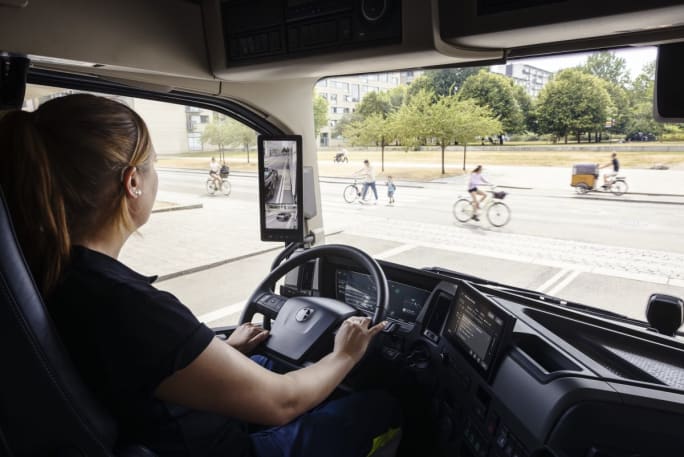
Volvo next-generation Collision Warning with Emergency Brake uses both camera and radar sensors to monitor the traffic ahead of the truck.
Photo: Volvo Trucks
With the latest improvements, this system can detect, warn and brake -- not only for other vehicles -- but also for pedestrians and cyclists.
It has been certified to meet the new tougher European legislation for Advanced Emergency Brake Systems that doesn’t come into force until 2028. In addition, Volvo Trucks’ system even exceeds the coming regulation in terms of the traffic situations it is designed to cover.
“We are happy to see that legal requirements are implemented in line with our own vision of zero accidents”, Wrige Berling said. “However, at Volvo we will not wait for legislation – we will continue to innovate and exceed legal requirements with new functions to support our own ambitious targets.”
This autobrake system is standard equipment in Europe on all FH series, FM and FMX trucks as from 2025 and available as option globally.
More Safety & Compliance

FMCSA Pauses Biennial-Update Enforcement Amid Motus Transition
Carriers whose updates were due on or after June 1 have more time, while FMCSA works to stabilize its new registration system and warns of phishing sites impersonating its new carrier registration system, Motus.
Read More →
ZF Expands Commercial Vehicle Push in North America
ZF is expanding its North American commercial-vehicle presence with new transmission applications, electrification, trailer technology and autonomous-driving systems.
Read More →
Truck Drivers Need More Than Another Alert
Fleets have more visibility into truck health, safety events, and driver activity than ever. The next challenge is turning all that information into useful guidance for the person who has to decide what to do next.
Read More →
Tesla Wants a Self-Driving Semi. Are Cameras Enough?
Could Tesla’s camera-only autonomous driving technology work on an 80,000-pound Semi? In this commentary, HDT's Deborah Lockridge takes a look at Tesla, Cybercab, and how autonomous trucks see the road.
Read More →
What DOT’s Automated Vehicle Strategy Means for Trucking
The U.S. Department of Transportation issued a new automated-vehicle strategy that outlines plans for driverless-truck regulations, cross-state freight corridors, and federal safety standards.
Read More →
NYC Expands Speed, Pedestrian Safety Tech Across Fleet
New York City is expanding intelligent speed assistance and pedestrian-alert systems across its municipal fleet, moving the technologies from pilot programs into vehicle procurement and retrofit requirements.
Read More →
FMCSA Removes 110 Truck Driver Training Schools from Certified ELDT List
Federal regulators also are targeting more than 160 additional training providers and launching a nationwide audit of third-party CDL skills testers as part of a broader crackdown on trucking fraud.
Read More →
Beyond DOT Compliance: What Makes a Trucking Fleet Truly Safe?
A trucking fleet can follow every rule and still make unsafe decisions. The real test comes when safety conflicts with freight, productivity, or cost.
Read More →
Hours of Service Pilot Programs: FMCSA Readies for 2027 Rollout
Two pilot programs could eventually reshape hours-of-service rules, giving truck drivers options to pause their 14-hour clock or use longer split sleeper rest periods.
Read More →
New Guide Offers Pet Safety Tips for Truck Drivers
Hundreds of thousands of pets travel in truck cabs. A new safety guide from Volvo Trucks and the Center for Pet Safety offers practical advice for truck drivers who bring dogs and cats along for the ride.
Read More →