




Related: Why U.S. Xpress is Getting Help With Fuel Economy Testing
U.S. Xpress Becomes a Pit Group Member
Following fuel consumption tests conducted at its facilities in Georgia, U.S. Xpress has become a member of the Pit Group, an organization specializing in truck related technology implementation through testing and fleet advisory services.
by Staff
January 26, 2017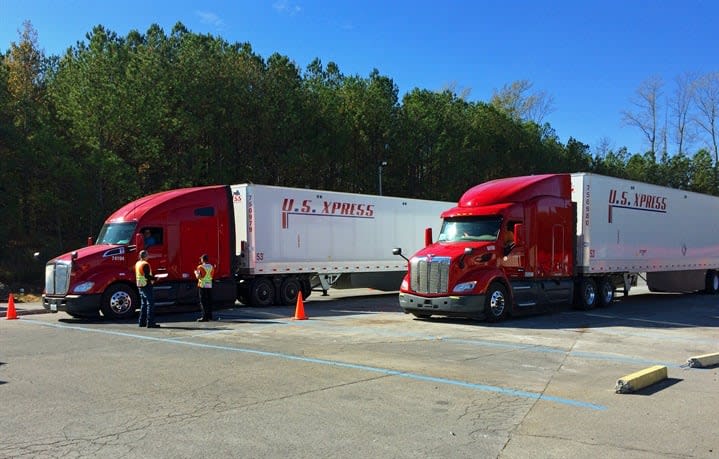
U.S. Xpress trucks preparing to begin a 52-mile fuel economy run out of its facility in Tunnel Hill, Georgia. The trucks are the latest model tractors available equipped with each OEM's most aggressive fuel economy package. Photo: Jack Roberts
2 min to read
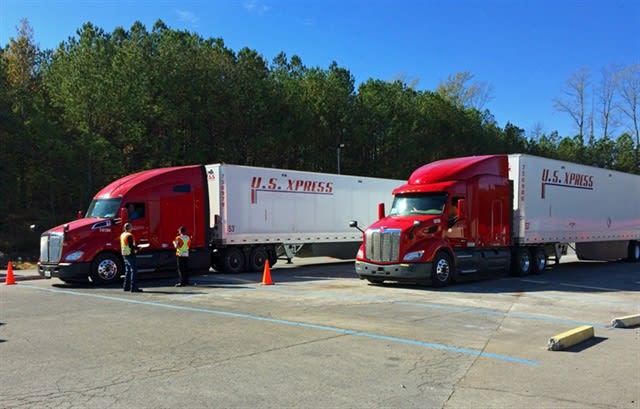
U.S. Xpress trucks preparing to begin a 52-mile fuel economy run out of its facility in Tunnel Hill, Georgia. The trucks are the latest model tractors available equipped with each OEM's most aggressive fuel economy package. Photo: Jack Roberts
Following fuel consumption tests conducted at its facilities in Georgia, U.S. Xpress has become a member of the Pit Group, an organization specializing in truck related technology implementation through testing and fleet advisory services.
U.S. Xpress signed up for the Pit Group’s membership program following the success of in-service fuel consumption tests that were carried out in Nov. 2016. The tests were carried out on U.S. Xpress trucks in a variety of different tractor and trailer combinations with equivalent loads.
Evaluations included 2016 and 2017 vehicles and testing covered a 52-mile test route on highways and local roads that represented the fleet’s day-to-day operations. Using this test, PIT group determined which tractor turned in the best fuel economy numbers for U.S. Xpress’s specific needs. Vehicles included in the U.S. Xpress tests included Peterbilt Model 579s, Kenworth T680s, Navistar LTs and Freightliner Cascadias.
"By collaborating with the Pit Group, we will be able to quickly obtain reliable results about fuel-saving technologies," said Gerry Mead, senior vice president of maintenance at U.S. Xpress. “We take fuel economy very seriously and we believe that Pit Group membership will help validate the decisions we make about our equipment.”
Pit Group consists of engineers, technicians, eco-driving trainers and fleet management specialists that promote efficient energy use in commercial transportation, municipal and transit industries in North America. Pit Group is a division of FPInnovations.
Other U.S.-based carriers that have joined the Pit Group include, Praxair, Experior Transport, Skyline Transportation, and Keller Logistics.
"The fact that such a major carrier as U.S. Xpress has joined our membership program and that it has done so immediately after the tests were carried out at its facilities emphasizes the valuable contribution that the PIT Group can make to all types of fleets in the North American transportation industry,” said Yves Provencher, PIT Group manager.
More Fuel Smarts

How Volvo Updated Its D13 for EPA 2027 [Watch]
Volvo’s updated D13 promises lower emissions without sacrificing performance or fuel economy. Take a closer look at what changed inside the engine in this HDT Spotlight video.
Read More →
Diesel Price Spike Shortens Payback for Natural Gas Trucks, Report Says
Energy Vision estimates fleets could recover the higher purchase price of an RNG-fueled Class 8 tractor in 1.3 to 2.8 years under current fuel-price scenarios.
Read More →
Calstart Becomes Catalyst Mobility, Reflecting Broader Focus
Calstart is now Catalyst Mobility, reflecting the nonprofit’s growing national role in clean transportation, including zero-emission trucks, infrastructure and incentive programs.
Read More →

Record Diesel Prices Squeeze Trucking Fleets
Average U.S. diesel prices have climbed to nearly $6 a gallon, surpassing the 2022 record as tight refinery capacity and Middle East disruptions keep fuel costs elevated.
Read More →
Sponsored•September 9, 2026
How Fuel Delivery Shapes Engine Performance
Fuel delivery depends on more than what happens at the injector. For fleet, maintenance and technical professionals, looking at the full path from pump to injector can provide useful context for understanding engine performance.
Read More →
East Coast Port Launches $45M Electric Truck Push
The Port Authority of New York and New Jersey announced millions in incentives for zero-emission drayage trucks, yard tractors, and new charging hubs near the port.
Read More →
California Bill Could Shed Light on Electric Truck Prices
Why do battery-electric Class 8 trucks remain so expensive? A California bill headed to Gov. Gavin Newsom would give fleets and state agencies more visibility into what manufacturers charge.
Read More →
Detroit Opens Orders for EPA 2027 Engines
Detroit isn’t starting from scratch to meet EPA 2027 diesel emissions standards. Its Gen 6 DD13 and DD15 engines keep much of today’s platform while updating the fuel and aftertreatment systems.
Read More →
Zero-Emission Truck Corridor Planned for West Coast
California, Oregon, Washington, British Columbia and Baja California are coordinating plans for truck charging and hydrogen fueling from Canada to Mexico.
Read More →
A Closer Look at Kenworth’s Electric T880E Vocational Truck [Video]
Learn more about Kenworth's T880E battery-electric vocational truck at the Paccar Technical Center, including its range, applications, upfitting considerations, and PTO options, in this HDT Spotlight video.
Read More →