




Study: Most Women Truck Drivers Experience Sexual Harassment
About 92% of women truck drivers reported that they had experienced at least one behavior associated with sexual harassment, according to a study by Kim Riddle.

While less than half of women truck drivers (42%) report they had been sexually harassed while on the job in a recent study, 92% indicated that they had experienced at least one behavior associated with sexual harassment.
As part of a dissertation, Kim Riddle — an assistant professor at Western Kentucky University, nurse, and a former over-the-road team driver — surveyed 236 women truck drivers over the age of 21 with a minimum of three months driving experience. The anonymous survey distribution online asked drivers if they had experienced several different behaviors that are classified as sexual harassment (see a sample of the questions below.)
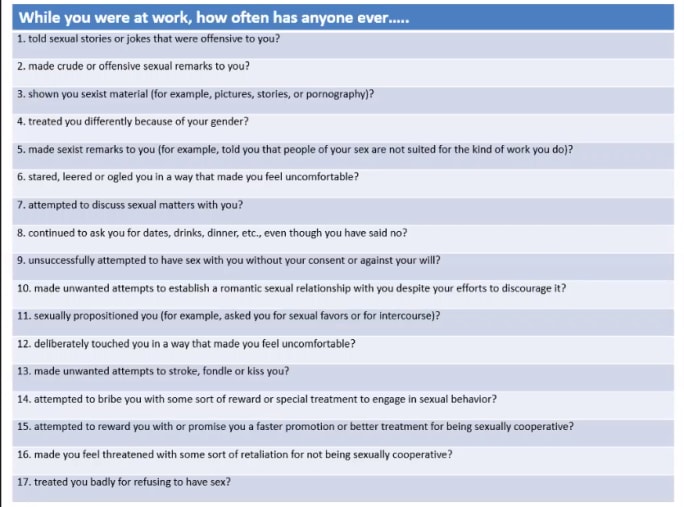
Kim Riddle's anonymous survey distribution online asked women drivers if they had experienced several different behaviors that are classified as sexual harassment.
Source: Kim Riddle
Riddle found that more than half of the drivers (55%) did not know for sure if their companies had sexual harassment reporting policies or not, and 75% of the drivers said they had no idea who to report those incidents to when they did occur, according to data shared during a Women In Trucking webinar.
The study found that older drivers were less likely to report incidents of sexual harassment, and Hispanic/Latina drivers reported more incidents than non-Hispanic drovers.
Furthermore, the study found that the greater the job control and the more positive the workplace culture, the lower the reported incidents of sexual harassment, Riddle said.
What is Sexual Harassment?
Sexual harassment includes unwelcome sexual advances, requests for sexual favors, and other verbal or physical harassment of a sexual nature, Riddle explained.
Sexual harassment can come in many forms, including sexual coercion or blackmail, as well as gender harassment, which can be non-sexual in nature and includes all acts of exclusion based on an individual’s gender.
Example of acts that are sexual harassment:
Verbal harassment includes sexual stories, jokes, crude or offensive remarks, unwanted requests for date, drinks or dinner.
Non-verbal harassment includes sexist or sexual material and staring.
Physical harassment includes deliberate touching.
Sexual harassment becomes illegal when it becomes so frequent or severe that it creates a hostile or offensive work environment, or when it results in an adverse employment decision, such as someone quitting, being fired or being demoted, Riddle explained.
The harasser can be the victim’s supervisor or a co-worker. In the case of truck driving, it could also be truck stop personnel or dock hands.
The consequences of sexual harassment include lower self-esteem, as well as physical and psychological issues for the victim. These can decrease productivity, lead to absenteeism, and perhaps also lead to early retirement from the industry, or choosing to be laid off.
“Understanding why sexual harassment occurs could provide a starting block to integrating effective policies and education within individual organizations, and help develop interventions to mitigate the negative responses related to sexual harassment,” Riddle said. “Individual organizations in the trucking industry need to take into consideration not only the female drivers, but everyone who they may come into contact with. Only then will we begin to see changes, and a decrease in sexual harassment of female truck drivers. And if we're lucky, an increase in the number of females joining the trucking ranks.”
More Drivers

Truck Drivers Need More Than Another Alert
Fleets have more visibility into truck health, safety events, and driver activity than ever. The next challenge is turning all that information into useful guidance for the person who has to decide what to do next.
Read More →
FMCSA Removes 110 Truck Driver Training Schools from Certified ELDT List
Federal regulators also are targeting more than 160 additional training providers and launching a nationwide audit of third-party CDL skills testers as part of a broader crackdown on trucking fraud.
Read More →
Hours of Service Pilot Programs: FMCSA Readies for 2027 Rollout
Two pilot programs could eventually reshape hours-of-service rules, giving truck drivers options to pause their 14-hour clock or use longer split sleeper rest periods.
Read More →
Medical Cards, English Proficiency Reshape Roadcheck Violations
Medical-card violations jumped to the top of the driver out-of-service list during CVSA’s 2026 International Roadcheck, while English-language proficiency violations appeared among the leading violations for the first time.
Read More →
Driver Trust Can Make or Break the Success of Fleet Safety Technology
New Teletrac Navman research suggests that onboarding, transparency about driver data, and positive feedback can play a significant role in how commercial drivers respond to safety and coaching technology.
Read More →
EEOC Sues KLLM Over Alleged Sex Discrimination in Driver Training
KLLM is facing a federal sex-discrimination lawsuit over policies the EEOC alleges put female truck driver trainees at a disadvantage.
Read More →
FMCSA Moves to Codify English Language Requirements for Commercial Drivers
By changing regulations on English-language proficiency requirements for commercial drivers, rather than relying on a guidance memo, the FMCSA said future administrations won't be able to walk back the Trump administration's stricter enforcement with just a memo.
Read More →
Drivers Put Western Star Trucks to the Test at Star Nation Experience
Watch to get an inside look at the Western Star trucks, technology, and community behind the Star Nation Experience 2026!
Read More →
Trump Administration Looks to Put More Veterans Behind the Wheel
The Freedom Haulers program pulls together existing and expanded programs at several federal agencies to recruit veterans to drive commercial heavy-duty trucks and cut the red tape for them to get a CDL, training, and employment.
Read More →
Putting Mack’s Command Steer to the Test
A test drive of Mack’s Command Steer active steering system evaluates how it can make truck driving easier and less tiring.
Read More →