




Spot Truck Freight Volume and Rates Drop
After a strong start to the month, freight activity and rates on the spot truckload market tapered off during the week ending Jan. 25 compared to the previous seven days.
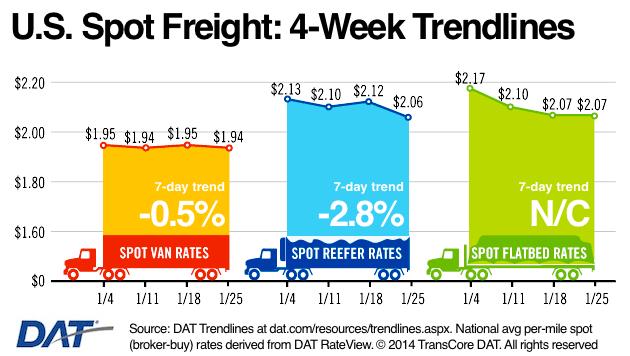
Click on graphic to enlarge.

After a strong start to the month, freight activity and rates on the spot truckload market tapered off during the week ending Jan. 25 compared to the previous seven days, according to the DAT network of load boards.
Overall load volume also fell, dropping 11.9%, while capacity barely moved higher, up 0.4%.
“Weather was a likely factor due to subzero temperatures to key areas of the country,” said DAT.
The average van rate fell 1 cent to $1.94 per mile including fuel surcharge, still 21 cents higher than the average in January 2013.
In the Northeast, the average outbound rate from Buffalo fell 6 cents to $1.87 per mile while Philadelphia was down 7 cents to $1.80 per mile. In the Midwest, the average rate from Chicago was unchanged at $2.17 per mile while the rate from Columbus, Ohio, fell 11 cents to $2.04 per mile. In the Southeast, the average rate out of Atlanta was down 2 cents to $1.91, while Memphis dropped 7 cents to $2.22 per mile. Average outbound van rates remained strong across much of the West, including Los Angeles at $2.05 per mile.
Nationally, van-load volume declined 15.6% while the number of available trucks increased 9.9%. As a result, the load-to-truck ratio was 3.7, down 23.2% from the prior week. Load-to-truck ratios represent the number of loads posted for every truck posted on the DAT network of load boards.
Demand for reefers slipped for the second straight week, dropping 17.1%. Reefer capacity increased 7.9% and the load-to-truck ratio dropped 23.2% to 11.5 compared to 15.0 the previous week. The national average reefer rate fell 6 cents to $2.06 per mile as demand slowed.
Flatbed demand decreased 4.4% compared to the prior week, while capacity dropped 18%. This pushed the flatbed load-to-truck ratio up 16.5% to 17.1 compared to 14.7 the prior week. The national average rate for flatbeds held steady at $2.07 per mile.
Fuel was another important storyline due to diesel prices jumping 3 cents a gallon nationally last week. Areas hard hit by winter are seeing steeper increases; the average for the Northeast was up 8 cents to $4.14 a gallon.
Looking ahead to next week’s numbers, DAT Analyst Mark Montague said port closures have introduced kinks into the supply chain, as well. This week, port activities are suspended in Houston, New Orleans, Mobile and Charleston.
“These ports handle container traffic to and from South America and Europe, and they serve some of the largest population centers on the continent. Airports have been closed intermittently as well. Most recently, Chicago's O'Hare was shut down and thousands of flights cancelled. Some of those flights carry freight, too,” he said.
More Drivers

Truck Drivers Need More Than Another Alert
Fleets have more visibility into truck health, safety events, and driver activity than ever. The next challenge is turning all that information into useful guidance for the person who has to decide what to do next.
Read More →
FMCSA Removes 110 Truck Driver Training Schools from Certified ELDT List
Federal regulators also are targeting more than 160 additional training providers and launching a nationwide audit of third-party CDL skills testers as part of a broader crackdown on trucking fraud.
Read More →
Hours of Service Pilot Programs: FMCSA Readies for 2027 Rollout
Two pilot programs could eventually reshape hours-of-service rules, giving truck drivers options to pause their 14-hour clock or use longer split sleeper rest periods.
Read More →
Medical Cards, English Proficiency Reshape Roadcheck Violations
Medical-card violations jumped to the top of the driver out-of-service list during CVSA’s 2026 International Roadcheck, while English-language proficiency violations appeared among the leading violations for the first time.
Read More →
Driver Trust Can Make or Break the Success of Fleet Safety Technology
New Teletrac Navman research suggests that onboarding, transparency about driver data, and positive feedback can play a significant role in how commercial drivers respond to safety and coaching technology.
Read More →
EEOC Sues KLLM Over Alleged Sex Discrimination in Driver Training
KLLM is facing a federal sex-discrimination lawsuit over policies the EEOC alleges put female truck driver trainees at a disadvantage.
Read More →
FMCSA Moves to Codify English Language Requirements for Commercial Drivers
By changing regulations on English-language proficiency requirements for commercial drivers, rather than relying on a guidance memo, the FMCSA said future administrations won't be able to walk back the Trump administration's stricter enforcement with just a memo.
Read More →
Drivers Put Western Star Trucks to the Test at Star Nation Experience
Watch to get an inside look at the Western Star trucks, technology, and community behind the Star Nation Experience 2026!
Read More →
Trump Administration Looks to Put More Veterans Behind the Wheel
The Freedom Haulers program pulls together existing and expanded programs at several federal agencies to recruit veterans to drive commercial heavy-duty trucks and cut the red tape for them to get a CDL, training, and employment.
Read More →
Putting Mack’s Command Steer to the Test
A test drive of Mack’s Command Steer active steering system evaluates how it can make truck driving easier and less tiring.
Read More →