




Shell Engine Teardown Compares Protection of Experimental Oil
What do you get when you put a group of trucking journalists in a room with three tables of engine teardown parts and ask them to choose which one is from the truck running the experimental low-viscosity oil? A lot of eeny-meeny-miney-mo.

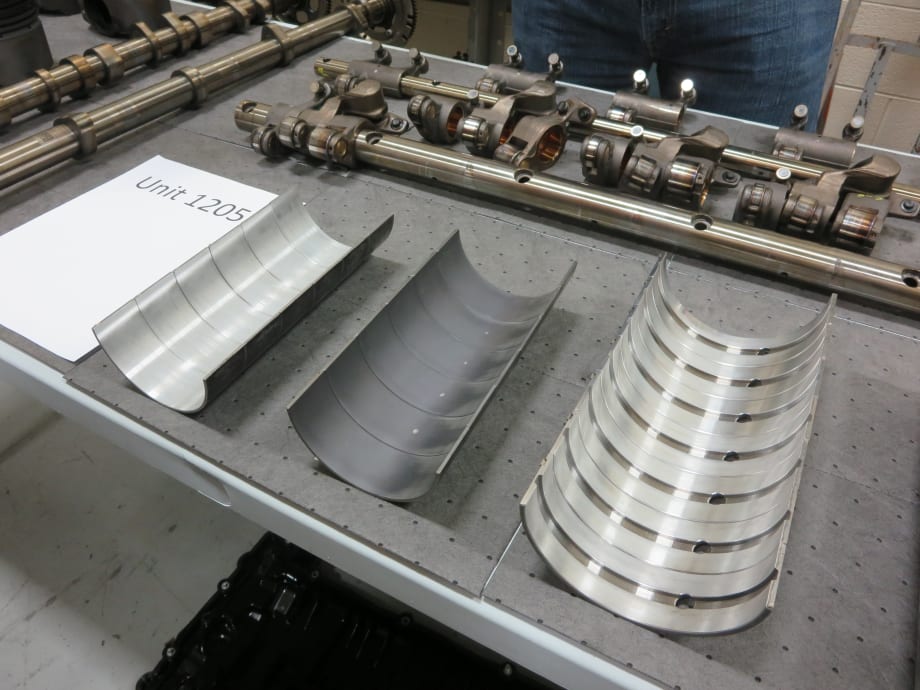
These engine parts are from a teardown of an engine using an experimental low-HTHS viscosity oil. A visual inspection shows no noticeable differences in wear between it and the higher-viscosity oil.
These engine parts are from a teardown of an engine using an experimental low-HTHS viscosity oil. A visual inspection shows no noticeable differences in wear between it and the higher-viscosity oil.
In anticipation of a new heavy-duty engine oil category due out in 2016, which will feature a lower-viscosity sub-category for improved fuel economy in newer engines, Shell has been running a fleet field test comparing Shell Rotella 15w-40, 10w-30, and an experimental 10w-30 with viscosity properties similar to what is expected in the new category.
This week, it laid out the parts for inspection in the Clarke Power shop in Greensboro, N.C., and dared trucking journalists to tell the difference.
They couldn't. Even those who picked the "right" table said it was simply a guess, or read it from the body language of one of the Shell representatives.
While the new oil category, currently termed PC-11, will offer improvements in areas such as oxidation stability, aeration performance, scuffing/adhesive wear and shear stability, one of the biggest changes is the viscosity change.
Traditional SAE viscosity ratings have been measured in a "non-shear" environment at 100 degrees C (212 F). The new oils will be measured at 150 degrees C (302 F) and in a "high-shear" environment. (Shear is mechanical stress that causes the oil to break down at a molecular level, "shearing" the polymers that give the oil its multi viscosity rating.)
"One of the key things is the oil has got to be able to protect with thinner films and hotter temperatures, and no compromises in the durability or life of the engine," said Dan Arcy, global OEM technical manager. "Our customers have become extremely accustomed to getting long lives out of their engines and they're not going to be willing to give that up in exchange for fuel economy."
While the category has not been finalized, Arcy, who is heading up one of the subcommittees developing the category standards, said it has been recommended to be 2.9 cP to 3.2 cP (a measure of high temp/high shear performance). In comparison, a 15w-40 oil is about 4.2 cP.
Arcy said Shell already has demonstrated that you can get 1.6% better fuel economy in on-highway trucks by going from that 4.2 to a 3.5, which is currently available in lower-viscosity engine oils. In fact 3.5 is the limit of CJ-4 oils. There is more fuel economy to be had by dropping lower, he said, although he couldn't give an estimate of just how much more.
Matt Urbanak, lead formulator, works closely with the field trial team and notes that Shell currently has more than 200 vehicles on test with an annual mileage of more than 25 million miles.
"It's normal to see wear" in an engine teardown, he explained. "What we're looking for is whether there's anything abnormal about that wear."
The engines torn down for this inspection were 2011 model year Detroit DD15 engines with about 550,000 miles on them. In Freightliner Cascadia trucks, they've been working in a North Carolina fleet driving in team operations coast to coast about 250,000 miles a year with average loads around 76,000 pounds. The recommended oil drain is 50,000 miles and this fleet average was a little higher, about 55,000 miles. Oil analysis performed at oil changes and at the mid-point of the change interval indicated the low-viscosity oil was performing as well as the traditional 15w-40 oil.
Howard Hill, engineer, lubricant technology, who's in charge of the field test program, said, "The comparison we're getting between the 15w-40s, the 10w-30s and new high-temp/high shear, you can go around and look at these parts, there is not a difference – there is absolutely not a difference. It bears out the chemical analysis. The iron wear rates, I think the highest was about 100 ppm, and Detroit Diesel's condemnation level is 250 ppm, so we're well under that condemnation level. We like how the oils are performing. We're very, very pleased with the new technology, and it's proven itself out with the engine inspections."
Below, watch Hill explain the findings:
More Fuel Smarts

How Volvo Updated Its D13 for EPA 2027 [Watch]
Volvo’s updated D13 promises lower emissions without sacrificing performance or fuel economy. Take a closer look at what changed inside the engine in this HDT Spotlight video.
Read More →
Diesel Price Spike Shortens Payback for Natural Gas Trucks, Report Says
Energy Vision estimates fleets could recover the higher purchase price of an RNG-fueled Class 8 tractor in 1.3 to 2.8 years under current fuel-price scenarios.
Read More →
Calstart Becomes Catalyst Mobility, Reflecting Broader Focus
Calstart is now Catalyst Mobility, reflecting the nonprofit’s growing national role in clean transportation, including zero-emission trucks, infrastructure and incentive programs.
Read More →

Record Diesel Prices Squeeze Trucking Fleets
Average U.S. diesel prices have climbed to nearly $6 a gallon, surpassing the 2022 record as tight refinery capacity and Middle East disruptions keep fuel costs elevated.
Read More →
How Fuel Delivery Shapes Engine Performance
Fuel delivery depends on more than what happens at the injector. For fleet, maintenance and technical professionals, looking at the full path from pump to injector can provide useful context for understanding engine performance.
Read More →
East Coast Port Launches $45M Electric Truck Push
The Port Authority of New York and New Jersey announced millions in incentives for zero-emission drayage trucks, yard tractors, and new charging hubs near the port.
Read More →
California Bill Could Shed Light on Electric Truck Prices
Why do battery-electric Class 8 trucks remain so expensive? A California bill headed to Gov. Gavin Newsom would give fleets and state agencies more visibility into what manufacturers charge.
Read More →
Detroit Opens Orders for EPA 2027 Engines
Detroit isn’t starting from scratch to meet EPA 2027 diesel emissions standards. Its Gen 6 DD13 and DD15 engines keep much of today’s platform while updating the fuel and aftertreatment systems.
Read More →
Zero-Emission Truck Corridor Planned for West Coast
California, Oregon, Washington, British Columbia and Baja California are coordinating plans for truck charging and hydrogen fueling from Canada to Mexico.
Read More →
A Closer Look at Kenworth’s Electric T880E Vocational Truck [Video]
Learn more about Kenworth's T880E battery-electric vocational truck at the Paccar Technical Center, including its range, applications, upfitting considerations, and PTO options, in this HDT Spotlight video.
Read More →