




Sapphire Energy's Commercial Demonstration Algae-to-Energy Facility Now Operational
Sapphire Energy announced that the first phase of its Green Crude Farm, which it says is the world's first commercial demonstration algae-to-energy facility, is now operational
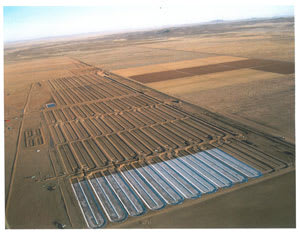
This is an arial view of the Green Crude Farm, also known as an Integrated Algal Bio-Refinery, in Columbus, New Mexico.
Sapphire Energy announced that the first phase of its Green Crude Farm, which it says is the world's first commercial demonstration algae-to-energy facility, is now operational.
Construction of this first phase, which began on June 1, 2011, was completed on time and on budget. When completed, the facility will produce 1.5 million gallons per year of crude oil and consist of approximately 300 acres of algae cultivation ponds and processing facilities.
By reaching this milestone, Sapphire Energy says it is on target to make algae-based Green Crude a viable alternative fuel solution, which will serve as the blueprint for scalable algae biofuel facilities globally.
Sapphire's products and processes for Green Crude differ significantly from other forms of biofuel because they are made solely from photosynthetic microorganisms (algae and cyanobacteria), using sunlight and CO2 as their feedstock; are not dependent on food crops or valuable farmland; do not use potable water; do not result in biodiesel or ethanol; enhance and replace petroleum-based products; are compatible with existing infrastructure; and are low carbon, renewable and scalable.
The Green Crude Farm, also known as an Integrated Algal Bio-Refinery, in Columbus, N.M., was funded with both private and public funds, including $85 million in private investment from Sapphire Energy backed by a U.S. Department of Agriculture loan guarantee and a $50 million grant from the U.S. Department of Energy.
The cultivation area consists of some of the largest algae ponds ever built with groupings of 1.1 acre and 2.2 acre ponds which are an 1/8 of a mile long. The initial phase also includes all the necessary mechanical and processing equipment needed to harvest and extract algae and recycle water for the 300-acre Green Crude Farm.
In March, the first seeding of ponds with algae, otherwise known as inoculation, took place and a series of "shakedown" tests began to ensure that all systems are working as planned. Currently, the farming operations are exceeding Sapphire Energy's internal productivity goals in terms of biomass yield, demonstrating that large-scale cultivation is possible and much larger cultivation systems can be implemented with the proper agronomic processes in place.
The company harvested its first crop in June without any system difficulties and has since harvested 21 million gallons of algae biomass totaling 81 tons. Next, the Green Crude Farm is preparing to transition its operations to a winter variety of algae while continuous cultivation, harvest and extraction activities continue.
"What was once a concept is now becoming a reality and model for growing algae to make a renewable crude oil for energy," says Cynthia 'CJ' Warner, CEO and chairman of Sapphire Energy.
Sapphire Energy will continue to conduct "shakedown" testing, as well as operate and expand farming operations over the winter, as the facility is commissioned into 2013. By the end of 2014, the Green Crude Farm will produce 100 barrels of Green Crude per day. The commercial demonstration project is expected to prove "commercial" techno-economics, and Sapphire's commercial scale Green Crude facility.
More Drivers
Medical Cards, English Proficiency Reshape Roadcheck Violations
Medical-card violations jumped to the top of the driver out-of-service list during CVSA’s 2026 International Roadcheck, while English-language proficiency violations appeared among the leading violations for the first time.
Read More →
Driver Trust Can Make or Break the Success of Fleet Safety Technology
New Teletrac Navman research suggests that onboarding, transparency about driver data, and positive feedback can play a significant role in how commercial drivers respond to safety and coaching technology.
Read More →
EEOC Sues KLLM Over Alleged Sex Discrimination in Driver Training
KLLM is facing a federal sex-discrimination lawsuit over policies the EEOC alleges put female truck driver trainees at a disadvantage.
Read More →
FMCSA Moves to Codify English Language Requirements for Commercial Drivers
By changing regulations on English-language proficiency requirements for commercial drivers, rather than relying on a guidance memo, the FMCSA said future administrations won't be able to walk back the Trump administration's stricter enforcement with just a memo.
Read More →
Drivers Put Western Star Trucks to the Test at Star Nation Experience
Watch to get an inside look at the Western Star trucks, technology, and community behind the Star Nation Experience 2026!
Read More →
Trump Administration Looks to Put More Veterans Behind the Wheel
The Freedom Haulers program pulls together existing and expanded programs at several federal agencies to recruit veterans to drive commercial heavy-duty trucks and cut the red tape for them to get a CDL, training, and employment.
Read More →
Putting Mack’s Command Steer to the Test
A test drive of Mack’s Command Steer active steering system evaluates how it can make truck driving easier and less tiring.
Read More →
Competition Heating Up for Truck Drivers
New report reveals rising driver hiring costs, the return of sign-on bonuses, growing AI advantages, and the operational factors shaping driver retention.
Read More →
How Fraley & Schilling Improved Logbook Compliance by Over 50%
Fraley & Schilling needed a way to close a compliance workflow gap in its ELD system without adding more work from driver training, reminders, and back-office follow-ups. It found the answer in a custom driver app.
Read More →
Volvo Goes Gaming
Volvo has roared into American Truck Simulator with two new flagship trucks.
Read More →