




Related: 7 Ways Aerodynamics Save Fuel
Ridge Partners with Aerospace Company to Improve Truck Aerodynamics
Ridge Corporation has partnered with the aerospace technology company FlexSys to help improve truck aerodynamics devices, reducing drag and improving fuel efficiency.
by Staff
June 26, 2017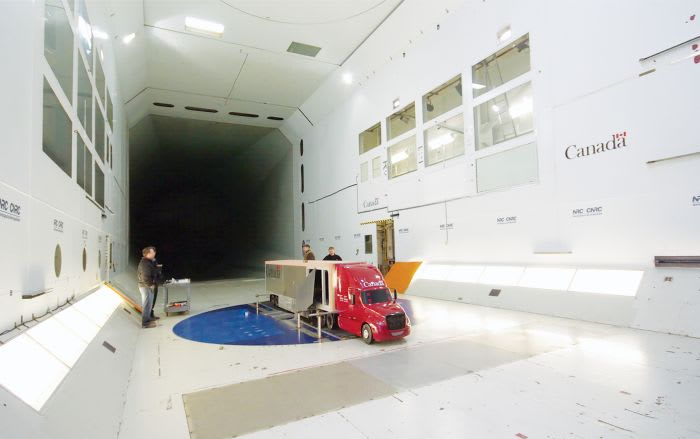
Photo: National Research Council of Canada
1 min to read
Photo: National Research Council of Canada
Ridge Corporation has partnered with the aerospace technology company FlexSys to help improve truck aerodynamics devices, reducing drag and improving fuel efficiency.
FlexSys is a Michigan-based company that has been developing advanced aircraft wing technologies with the Air Force Research Laboratories and has validated concepts through both NASA flight tests and on private jets.
The company’s technology involves variable geometry control surface mechanisms that use the inherent flexibility of aerospace materials to continuously reshape optimal aerodynamic profiles. Ridge wants to incorporate this dynamic technology into its devices to produce, resilient, low-complexity, cost-effective devices that improve fuel savings over currently available technologies.
“Ridge’s goal is to incorporate this new technology as a complement to our own engineering expertise and our ability to quickly move new technologies to market,” said Gary Grandominico, Ridge CEO.
The two companies have agreed to join forces to combine the latest aerospace technologies with the real-world requirements of the trucking industry.
“We have found a strong partner in Ridge Corporation and are looking forward to applying our technology to the field of truck aerodynamics,” said Dave Hornick, FlexSys COO.
More Fuel Smarts

Why Small Fuel Savings Matter in Trucking
Can better fuel economy help pay for driver raises? In this podcast, GP Transco explains how small efficiency gains create room to reinvest in its people.
Read More →
How GP Transco Cuts Trucking Fuel Costs, a Tenth of a Gallon at a Time
What’s another tenth of a mile per gallon worth? GP Transco shares how equipment upgrades and driver coaching turn small gains into meaningful fuel savings.
Read More →
Electric Yard Tractors Move Beyond Pilots
Operating-cost savings have overtaken sustainability goals as the leading reason surveyed fleets are adopting battery-electric terminal tractors, according to new NACFE research.
Read More →
Geotab Links Fleet Card to Vehicle Data
The new card combines fuel discounts with telematics-based purchase controls. Geotab’s analysis also points to potential savings from choosing lower-priced fuel stops.
Read More →
Fleet Economics Shape Electric Truck Outlook
ACT Research expects costs, charging infrastructure, and technology improvements to drive zero-emission commercial vehicle adoption as federal regulations and incentives retreat.
Read More →
Wex Adds Cardless Fuel Payments for Over-the-Road Customers
A new fuel card feature for Wex customers offers convenience and security.
Read More →
New California Law Could Shed Light on Electric Truck Prices
Why do battery-electric Class 8 trucks remain so expensive? A California bill signed by Gov. Gavin Newsom would give fleets and state agencies more visibility into what manufacturers charge.
Read More →
How Volvo Updated Its D13 for EPA 2027 [Watch]
Volvo’s updated D13 promises lower emissions without sacrificing performance or fuel economy. Take a closer look at what changed inside the engine in this HDT Spotlight video.
Read More →
Diesel Price Spike Shortens Payback for Natural Gas Trucks, Report Says
Energy Vision estimates fleets could recover the higher purchase price of an RNG-fueled Class 8 tractor in 1.3 to 2.8 years under current fuel-price scenarios.
Read More →
Calstart Becomes Catalyst Mobility, Reflecting Broader Focus
Calstart is now Catalyst Mobility, reflecting the nonprofit’s growing national role in clean transportation, including zero-emission trucks, infrastructure and incentive programs.
Read More →