




Report: Interstate Must Be Rebuilt to Meet Supply Chain Needs
As the U.S. Interstate Highway System reaches 65 years old, it is congested, carries significant levels of travel – particularly by large trucks – and lacks adequate funding to make needed repairs and improvements, TRIP officials said in a report.

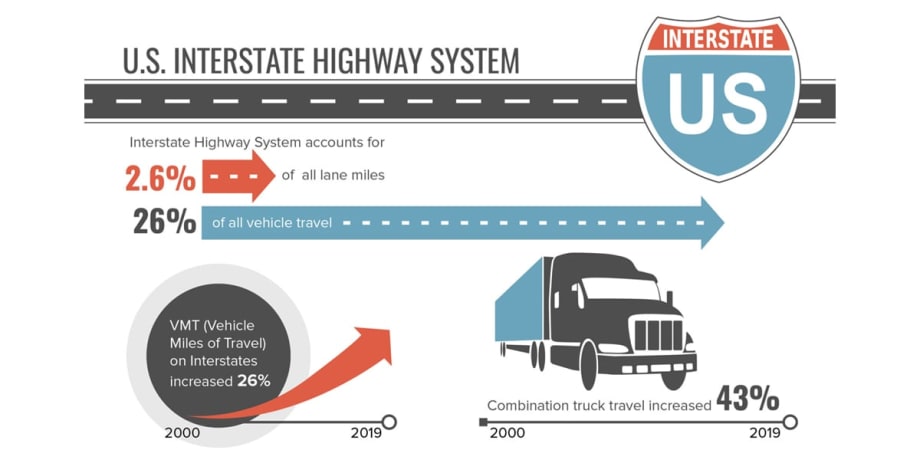
Combination truck travel on the Interstate system increased 43% from 2000 to 2019, while overall vehicle travel increased 19%.
Graphic: TRIP
As the U.S. Interstate Highway System reaches 65 years old, it is congested, carries significant levels of travel – particularly by large trucks – and lacks adequate funding to make needed repairs and improvements.
The system will need to be rebuilt and expanded to meet the nation’s growing transportation needs, according to a report released by TRIP, a national transportation research nonprofit.
The report, America’s Interstate Highway System at 65: Meeting America’s Transportation Needs with a Reliable, Safe & Well-Maintained National Highway Network, looks at the Interstate system’s use, condition and benefits, and the findings of a 2019 report prepared by the Transportation Research Board at the request of Congress as part of the Fixing America’s Surface Transportation Act.
According to the 2019 TRB report, the Interstate system has a persistent and growing backlog of physical and operational deficiencies as a result of age, heavy use and deferred reinvestment, and is in need of major reconstruction and modernization. The TRB report concludes that annual investment in the Interstate Highway System should be increased approximately two-and-a-half times, from $23 billion in 2018 to $57 billion annually over the next 20 years.
Interstate Congestion
The TRIP report found that from 2000 to 2019, travel on the Interstate system has increased by 26% — a rate nearly triple that at which new lane capacity was added.
As a result, 47% of urban Interstate highways are considered congested during peak hours. Due to the COVID-19 pandemic, vehicle travel on U.S. highways dropped by as much as 45% in April 2020 (compared to April 2019) but rebounded to 6% below April 2019 levels by April 2021.
The report also found that travel by combination trucks on the Interstate increased at a rate more than double that of overall vehicle travel between 2000 and 2019.
Combination truck travel on the Interstate system increased 43% from 2000 to 2019, while overall vehicle travel increased 19%.
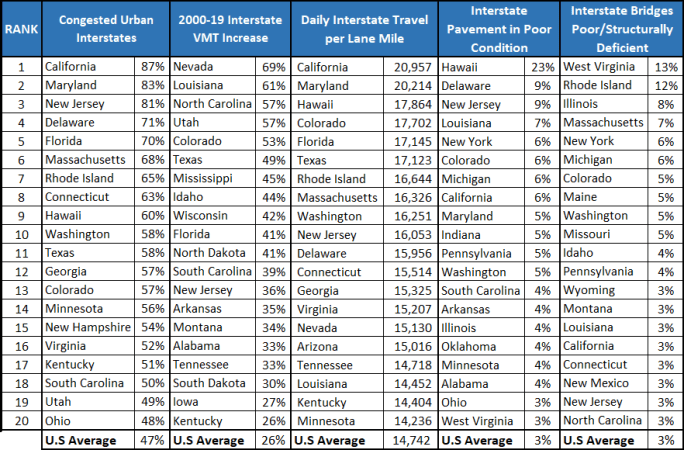
The chart ranks states whose Interstate systems are the most congested, have experienced the greatest increase in vehicle miles of travel (VMT) since 2000, are busiest (based on daily travel per lane mile), have the largest share of pavement in poor condition, and have the greatest share of bridges in poor/structurally deficient condition.
Chart: TRIP
“Our rapidly deteriorating infrastructure is a clear and present danger to our nation’s supply chain. Breakdowns in the Interstate Highway System add an annual $75 billion to the cost of freight transportation, and 67 million tons of excess carbon dioxide emissions are released into the atmosphere every year from trucks stuck in traffic congestion,” said Chris Spear, president and CEO of the American Trucking Associations, in a TRIP press release. “This report quantifies how severe this crisis has become, and it underscores the urgent need for Congress to make real infrastructure investments that are backed by a fair and equitable user-based revenue source.”
Repairs and Improvements
TRIP’s report finds that while pavement smoothness on most segments of the Interstate system is acceptable, the crumbling foundations of most highway segments need to be reconstructed, and that continued resurfacing — rather than addressing underlying foundational issues — is resulting in diminishing returns and results in shorter periods of pavement smoothness.
As the aging system’s foundations continue to deteriorate, most Interstate highways, bridges and interchanges will need to be rebuilt or replaced, the TRB report finds. According to the TRIP report, pavements on 11% of Interstate highways are in poor or mediocre condition. Three percent of Interstate bridges are rated in poor/structurally deficient condition and 57% are rated in fair condition.
The current federal surface transportation program, the FAST Act, the primary source of Interstate highway funding, expired on September 30, 2020 and was extended by one year by Congress to September 30, 2021. Reauthorization of a new long-term, adequately and reliably funded long-term federal program will be needed to ensure that a strong federal program supports the restoration of the Interstate system, TRIP officials said.
Based on the findings of the TRB Interstate report, TRIP has provided a set of recommendations for the restoration of the Interstate Highway System, which includes: the foundational reconstruction of Interstate highways, bridges and interchanges; improvement to roadway safety features; system right-sizing, including upgrading of some roadway corridors to Interstate standards; adding needed additional highway capacity on existing routes; adding additional corridors; and, modifying some urban segments to maintain connectivity while remediating economic and social disruption.
More Drivers

Truck Drivers Need More Than Another Alert
Fleets have more visibility into truck health, safety events, and driver activity than ever. The next challenge is turning all that information into useful guidance for the person who has to decide what to do next.
Read More →
FMCSA Removes 110 Truck Driver Training Schools from Certified ELDT List
Federal regulators also are targeting more than 160 additional training providers and launching a nationwide audit of third-party CDL skills testers as part of a broader crackdown on trucking fraud.
Read More →
Hours of Service Pilot Programs: FMCSA Readies for 2027 Rollout
Two pilot programs could eventually reshape hours-of-service rules, giving truck drivers options to pause their 14-hour clock or use longer split sleeper rest periods.
Read More →
Medical Cards, English Proficiency Reshape Roadcheck Violations
Medical-card violations jumped to the top of the driver out-of-service list during CVSA’s 2026 International Roadcheck, while English-language proficiency violations appeared among the leading violations for the first time.
Read More →
Driver Trust Can Make or Break the Success of Fleet Safety Technology
New Teletrac Navman research suggests that onboarding, transparency about driver data, and positive feedback can play a significant role in how commercial drivers respond to safety and coaching technology.
Read More →
EEOC Sues KLLM Over Alleged Sex Discrimination in Driver Training
KLLM is facing a federal sex-discrimination lawsuit over policies the EEOC alleges put female truck driver trainees at a disadvantage.
Read More →
FMCSA Moves to Codify English Language Requirements for Commercial Drivers
By changing regulations on English-language proficiency requirements for commercial drivers, rather than relying on a guidance memo, the FMCSA said future administrations won't be able to walk back the Trump administration's stricter enforcement with just a memo.
Read More →
Drivers Put Western Star Trucks to the Test at Star Nation Experience
Watch to get an inside look at the Western Star trucks, technology, and community behind the Star Nation Experience 2026!
Read More →
Trump Administration Looks to Put More Veterans Behind the Wheel
The Freedom Haulers program pulls together existing and expanded programs at several federal agencies to recruit veterans to drive commercial heavy-duty trucks and cut the red tape for them to get a CDL, training, and employment.
Read More →
Putting Mack’s Command Steer to the Test
A test drive of Mack’s Command Steer active steering system evaluates how it can make truck driving easier and less tiring.
Read More →