





Related: The Dark Side of Autonomous Tech Nobody Wants to Talk About
Report: Self-Driving Trucks Could Put Best-Paying Jobs at Risk
Autonomous trucks could have a significant impact on the less-than-truckload sector of trucking and drivers could be left behind unless industry and public policymakers work together to guide the transition.
September 5, 2018
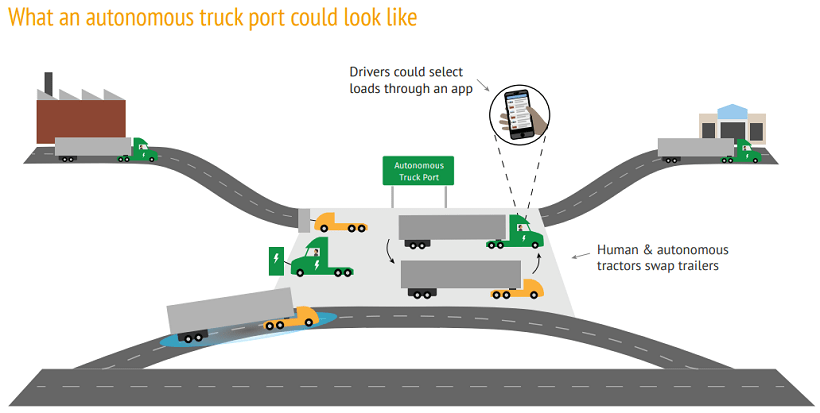
With self-driving trucks, the future of trucking could feature autonomous truck ports where human drivers would bring loads to autonomous trucks that would take them across the country. This could have a serious impact on drivers in the less-than-truckload sector.
Image via Driverless Report
3 min to read
A new report on driverless trucks projects that self-driving trucks could replace as many as 294,000 jobs in the trucking industry and emphasizes the role that industry leaders and policymakers could have on smoothing that transition for drivers.
The report, "Driverless? Autonomous Trucks and the Future of the American Trucker," stresses the point that without proper guidance, automation could end up removing high and moderate paying truck driving jobs and leave the industry with mostly lower paying local and independent contractor type jobs.
While autonomous systems are currently being developed for all modes of transportation, the trucking industry is likely to be an early adopter of it because certain types of driving are primed for it, according to the report. This primarily affects long distance non-specialized less-than-truckload jobs that account for many of the industry’s best earning jobs.
Currently, the autonomous trucking model that makes the most sense is to have autonomous truck ports at either end of long routes. Since current levels of automation would have a harder time driving in congested urban environments or backing freight into a dock, human drivers would take over for automated trucks in these environments, leaving the more simple long-haul portions for driverless trucks. While this has the potential to add more trucking jobs, these jobs would likely not pay as much.
This model could also lead to increased “digitization” of trucking with app-based marketplaces similar to Uber freight and other freight matching platforms. The report suggests that this could drive down pay even further, as the costs associated with the currently more complex system of matching loads to carriers would be smoothed out.
To curb this trend, the Driverless Report proposes public policy designed to drive collaboration between workers and industry leaders and policymakers. This collaboration would be based on three main pillars: The development of an industry-wide approach to worker advancement and stability, stronger labor standards and worker protections, and investment in innovation that would achieve social, economic and environmental goals.
These goals would aim to create a future where the trucking industry would change in ways that benefit both the market and the workers. The report puts forward an adoption scenario for automated trucking that would have human drivers leading a platoon of autonomous trucks on the highway instead of a simple hub and spoke model where autonomous trucks require little to no human assistance until they reach an autonomous port. In order to protect labor, the report also suggests that local drivers be classified as employees with incentives for trucking firms to use labor efficiently. The idea behind this is to support and train drivers through the transition to autonomous trucking.
The Driverless Report was compiled by Steve Viscelli, a sociologist at the University of Pennsylvania and author of a book on long-haul truck drivers called The Big Rig: Trucking and the Decline of the American Dream. He worked with the UC Berkeley Labor Center and Working Partnerships USA to examine the impact that truck automation could have on the trucking industry.
The full report is available online.
More Drivers

EEOC Sues KLLM Over Alleged Sex Discrimination in Driver Training
KLLM is facing a federal sex-discrimination lawsuit over policies the EEOC alleges put female truck driver trainees at a disadvantage.
Read More →
FMCSA Moves to Codify English Language Requirements for Commercial Drivers
By changing regulations on English-language proficiency requirements for commercial drivers, rather than relying on a guidance memo, the FMCSA said future administrations won't be able to walk back the Trump administration's stricter enforcement with just a memo.
Read More →
Drivers Put Western Star Trucks to the Test at Star Nation Experience
Watch to get an inside look at the Western Star trucks, technology, and community behind the Star Nation Experience 2026!
Read More →
Trump Administration Looks to Put More Veterans Behind the Wheel
The Freedom Haulers program pulls together existing and expanded programs at several federal agencies to recruit veterans to drive commercial heavy-duty trucks and cut the red tape for them to get a CDL, training, and employment.
Read More →
Putting Mack’s Command Steer to the Test
A test drive of Mack’s Command Steer active steering system evaluates how it can make truck driving easier and less tiring.
Read More →
Competition Heating Up for Truck Drivers
New report reveals rising driver hiring costs, the return of sign-on bonuses, growing AI advantages, and the operational factors shaping driver retention.
Read More →
How Fraley & Schilling Improved Logbook Compliance by Over 50%
Fraley & Schilling needed a way to close a compliance workflow gap in its ELD system without adding more work from driver training, reminders, and back-office follow-ups. It found the answer in a custom driver app.
Read More →
Volvo Goes Gaming
Volvo has roared into American Truck Simulator with two new flagship trucks.
Read More →
What the Best Fleets to Drive For Teach About Driver Retention
Survey fatigue, AI-powered routing, owner-operator expectations, and the decline of social media all emerged as themes from this year's Best Fleets to Drive For program.
Read More →
Driver Retention Lessons From the Best Fleets to Drive For
What separates trucking's best workplaces from the rest? Jane Jazrawy shares the biggest lessons from this year's Best Fleets to Drive For program on driver retention, communication, AI, and workforce trends on the HDT Talks Trucking podcast.
Read More →