




Report: Driver Retention Issues Differ For Women, Men
Understanding what drivers are satisfied with along with their pain points can help fleets create a better recruiting and retention strategy.


Understanding what drivers are satisfied with along with their pain points can help fleets create a better recruiting and retention strategy.
Illustration: Stay Metric
Understanding what drivers are satisfied with along with their pain points can help fleets create a better recruiting and retention strategy. If fleets can segment that strategy in an intentional way, they can make an even greater impact on your turnover numbers.
Through analysis of its driver surveys, Stay Metrics, produces a analytic referred to as the Stay Index. This analytic identifies issues that both show high levels of driver dissatisfaction and also are more influential in a driver’s level of commitment to a carrier. In other words, these issues, if addressed, will have the biggest impact on driver retention. The Stay Index data (picture below) is computed across a set of survey items from Stay Metrics Ongoing Experience Surveys relating to a host of driver-related issues and was produced using a dataset from the second half of 2020. The rating for each of the items below is based on at least 8,300 responses from men and 500 responses from women.
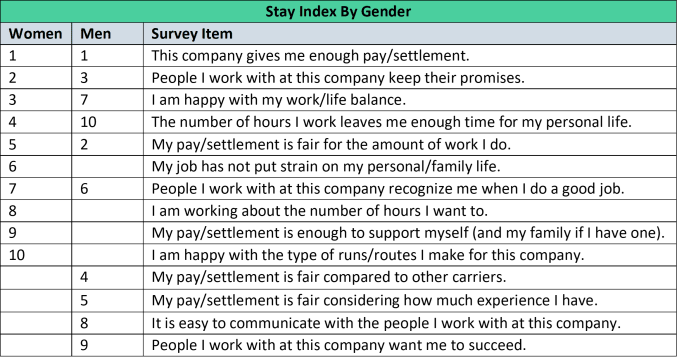
The table displays the 10 items with the highest Stay Index ratings for both men and women.
Table: Stay Metric
The trucking industry is dominated by men. As such, the opinions and voices of women may be harder to hear and recognize. By analyzing our Stay Index separately for men and women, we are able to identify issues that may be more important to either gender as it relates to their experiences driving for a carrier, Stay Metrics officials said.
Findings
Pay matters, regardless of gender. The top item for both men and women is ‘The company gives me enough pay/settlement’.
Women are more likely to value work/life balance. Three out of the top six items on the Stay Index for women are related to work/life balance, while there are no work/life balance items in the top six for men, and just two in the top ten.
Pay/Settlement comparison items are more likely to affect men’s commitment to carriers. Pay/settlement issues were responsible for four out of the top five items for men, compared to two out of the top five for women (and three out of the top ten). The two unique pay/settlement issues appearing for men relate to their opinions of pay fairness based on experience and comparisons to other carriers.
Takeaways
Implement and promote practices that address work/life balance. There are a number of areas to consider. Holiday pay should reflect an actual average day’s pay. Special home time requests should be honored and tracked. Rewards programs should provide more than money but also items that families would appreciate and enjoy.
Customize recruiting messages. If fleets are focused on increasing the number of women driving for their organization, consider emphasizing the company’s efforts to promote work/life balance as well as addressing key items like pay as part of recruitment marketing.
Keep an eye on average time in the industry. On average, women have less experience in the trucking industry. As they spend more time in the industry, items like ’my pay/settlement is fair compared to other carriers’ and ’my pay/settlement is fair considering how much experience I have’ could have a greater influence on their commitment.
More Drivers

Hours of Service Pilot Programs: FMCSA Readies for 2027 Rollout
Two pilot programs could eventually reshape hours-of-service rules, giving truck drivers options to pause their 14-hour clock or use longer split sleeper rest periods.
Read More →
Medical Cards, English Proficiency Reshape Roadcheck Violations
Medical-card violations jumped to the top of the driver out-of-service list during CVSA’s 2026 International Roadcheck, while English-language proficiency violations appeared among the leading violations for the first time.
Read More →
Driver Trust Can Make or Break the Success of Fleet Safety Technology
New Teletrac Navman research suggests that onboarding, transparency about driver data, and positive feedback can play a significant role in how commercial drivers respond to safety and coaching technology.
Read More →
EEOC Sues KLLM Over Alleged Sex Discrimination in Driver Training
KLLM is facing a federal sex-discrimination lawsuit over policies the EEOC alleges put female truck driver trainees at a disadvantage.
Read More →
FMCSA Moves to Codify English Language Requirements for Commercial Drivers
By changing regulations on English-language proficiency requirements for commercial drivers, rather than relying on a guidance memo, the FMCSA said future administrations won't be able to walk back the Trump administration's stricter enforcement with just a memo.
Read More →
Drivers Put Western Star Trucks to the Test at Star Nation Experience
Watch to get an inside look at the Western Star trucks, technology, and community behind the Star Nation Experience 2026!
Read More →
Trump Administration Looks to Put More Veterans Behind the Wheel
The Freedom Haulers program pulls together existing and expanded programs at several federal agencies to recruit veterans to drive commercial heavy-duty trucks and cut the red tape for them to get a CDL, training, and employment.
Read More →
Putting Mack’s Command Steer to the Test
A test drive of Mack’s Command Steer active steering system evaluates how it can make truck driving easier and less tiring.
Read More →
Competition Heating Up for Truck Drivers
New report reveals rising driver hiring costs, the return of sign-on bonuses, growing AI advantages, and the operational factors shaping driver retention.
Read More →
How Fraley & Schilling Improved Logbook Compliance by Over 50%
Fraley & Schilling needed a way to close a compliance workflow gap in its ELD system without adding more work from driver training, reminders, and back-office follow-ups. It found the answer in a custom driver app.
Read More →