




Related: San Fransico's Renewable Diesel Detailed
Renewable Diesel Reduces Ore. Utility's Maintenance Costs
Since switching from biodiesel to renewable diesel, the Eugene Water & Electric Board (EWEB) in Oregon has reduced its fleet greenhouse gas emissions as well as maintenance on its diesel vehicles.
by Staff
January 15, 2016
EWEB's renewable diesel fueling station. Photo courtesy of Oregon Department of Energy
3 min to read
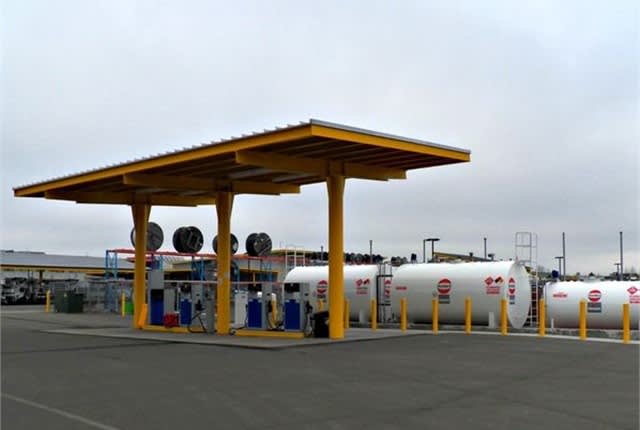
EWEB's renewable diesel fueling station. Photo courtesy of Oregon Department of Energy
Since switching from biodiesel to renewable diesel, the Eugene Water & Electric Board (EWEB) in Oregon has reduced its fleet greenhouse gas emissions as well as maintenance on its diesel vehicles, according to the Oregon Department of Energy (ODOE).
The agency began testing renewable diesel use in September, and now uses it on 85 of its diesel vehicles.
Renewable diesel, like petroleum-based diesel, is made through a hydrogenation process instead of the chemical process used to create biodiesel, according to the agency. But unlike petroleum fuel, renewable diesel is a product of natural fats or vegetable oils, making it a cleaner, lower carbon content fuel option for diesel vehicles.
In 2014, the the Eugene Water & Electric Board obtained a tax credit for installing an alternative fuel fueling station to run its fleet of vehicles. The station was designed to pump biodiesel, but ODOE thought EWEB could go even greener by using renewable diesel rather than biodiesel.
EWEB was enthusiastic about giving the product a try. “Moving our fleet to biodiesel helped us achieve our carbon reduction goals,” said Gary Lentsch, CAFM, and the board's fleet manager. “Switching to renewable diesel has taken us to another level.”
Using a regular gallon of diesel fuel emits more than 30 lbs. of greenhouse gases into the air. Using a gallon of renewable diesel emits fewer than 10. EWEB is currently using about 6,100 gallons of renewable diesel each month.
EWEB also discovered that renewable diesel is much easier on vehicle engines and diesel particulate filter systems. After making the switch, Lentsch noticed a significant decrease in maintenance issues.
“We have telematics on all of our vehicles and equipment so we know what’s going on with our fleet,” he said. “It wasn’t uncommon to get alert codes on our vehicles, and our shop would have to manually empty the filters (known as regeneration). After we switched to renewable diesel, our trucks don’t require regeneration as often as when they were using regular diesel. As a matter of fact, the shop hasn’t done a manual re-gen since the switch. Now, our trucks are staying in service longer with less down time.”
Renewable diesel is an emerging market, so ODOE and EWEB worked together to identify a local supplier. ODOE provides guidance to make sure production of the imported fuel doesn’t have other negative environmental effects, such as deforestation.
Cities and municipalities across the northwest are already making the switch, including the City of Portland; Lane County Public Works; Clark County PUD in Washington; and more. Oregon’s new Clean Fuels Program went into effect on Jan. 1, with the goal to reduce the carbon intensity of transportation fuels used in Oregon by 10% over the next ten years. Alternative fuels like renewable diesel will play a role in helping the state reach that goal.
More Fuel Smarts

How Volvo Updated Its D13 for EPA 2027 [Watch]
Volvo’s updated D13 promises lower emissions without sacrificing performance or fuel economy. Take a closer look at what changed inside the engine in this HDT Spotlight video.
Read More →
Diesel Price Spike Shortens Payback for Natural Gas Trucks, Report Says
Energy Vision estimates fleets could recover the higher purchase price of an RNG-fueled Class 8 tractor in 1.3 to 2.8 years under current fuel-price scenarios.
Read More →
Calstart Becomes Catalyst Mobility, Reflecting Broader Focus
Calstart is now Catalyst Mobility, reflecting the nonprofit’s growing national role in clean transportation, including zero-emission trucks, infrastructure and incentive programs.
Read More →

Record Diesel Prices Squeeze Trucking Fleets
Average U.S. diesel prices have climbed to nearly $6 a gallon, surpassing the 2022 record as tight refinery capacity and Middle East disruptions keep fuel costs elevated.
Read More →
Sponsored•September 9, 2026
How Fuel Delivery Shapes Engine Performance
Fuel delivery depends on more than what happens at the injector. For fleet, maintenance and technical professionals, looking at the full path from pump to injector can provide useful context for understanding engine performance.
Read More →
East Coast Port Launches $45M Electric Truck Push
The Port Authority of New York and New Jersey announced millions in incentives for zero-emission drayage trucks, yard tractors, and new charging hubs near the port.
Read More →
California Bill Could Shed Light on Electric Truck Prices
Why do battery-electric Class 8 trucks remain so expensive? A California bill headed to Gov. Gavin Newsom would give fleets and state agencies more visibility into what manufacturers charge.
Read More →
Detroit Opens Orders for EPA 2027 Engines
Detroit isn’t starting from scratch to meet EPA 2027 diesel emissions standards. Its Gen 6 DD13 and DD15 engines keep much of today’s platform while updating the fuel and aftertreatment systems.
Read More →
Zero-Emission Truck Corridor Planned for West Coast
California, Oregon, Washington, British Columbia and Baja California are coordinating plans for truck charging and hydrogen fueling from Canada to Mexico.
Read More →
A Closer Look at Kenworth’s Electric T880E Vocational Truck [Video]
Learn more about Kenworth's T880E battery-electric vocational truck at the Paccar Technical Center, including its range, applications, upfitting considerations, and PTO options, in this HDT Spotlight video.
Read More →