




President Signs Highway Bill
President Obama signed the long-awaited highway bill into law at the White House this afternoon. The bill, Moving Ahead for Progress in the 21st Century, or MAP-21, funds transportation programs through September 2014
President Obama signed the long-awaited highway bill into law at the White House this afternoon. The bill, Moving Ahead for Progress in the 21st Century, or MAP-21, funds transportation programs through September 2014.
The bill holds transportation spending at current levels, authorizing $101.3 billion for highways and transit over the next 27 months.
"This measure includes historic reforms - cutting red tape and consolidating or eliminating nearly 70 federal programs," said Transportation and Infrastructure Committee Chairman John Mica, R-Fla., in a statement.
"This bill will provide a major boost to our economy by putting Americans back to work building our nation's bridges and highways," he said.
"It has been a very long and winding road to get to this place," said Sen. Barbara Boxer, D-Calif., chairman of the Environment and Public Works Committee. "This sends a message to the people of America, and that is that we can work together."
The agreement lays the groundwork for the first national freight policy. It includes a number of trucking provisions, including mandator electronic onboard recorders to track driver logs, a study of the 34-hour restart provision, a study of size and weight limits. It gives FMCSA legal authority for a range of initiatives, many of which already are under way.
Although an agreement was reached and the legislation passed last week, Obama had to sign a one-week measure last Friday to extend the two programs until the new legislation reached his desk. The previous transportation funding extension expired on June 30.
Reactions
American Trucking Associations President and CEO Bill Graves noted in a statement that "it has been 30 months since we have had a true, long-term highway funding bill, so today's bill signing is a good thing for trucking and for our national economy."
"It is not perfect, but this law advances the cause of highway safety and, I believe, will ultimately be seen as a springboard to even more robust transportation funding in the future," Graves said. He did say he was disappointed that it fails to deliver adequate funding to improve our nation's infrastructure network.
"If America is to maintain its place as the world's preeminent economy, then we must do more to maintain and improve our nation's system of roads and bridges to ensure that goods can move freely and efficiently from factories to ports and from farms to markets," Graves said. "While this bill takes steps in that direction, much more must be done in the future."
The Commercial Vehicle Safety Alliance emphasized that it provides a steady level of funding for state safety and enforcement programs and advanced key safety initiatives supported by the group, such as stronger requirements to help address the chameleon carrier threat, an industry-wide requirement that CMVs be equipped with electronic logging devices for HOS compliance, and tighter CDL and driver training requirements.
For more details on the bill, see 6/29/2012 Agreement Sets New Course for Highway Program
More Drivers

Hours of Service Pilot Programs: FMCSA Readies for 2027 Rollout
Two pilot programs could eventually reshape hours-of-service rules, giving truck drivers options to pause their 14-hour clock or use longer split sleeper rest periods.
Read More →
Medical Cards, English Proficiency Reshape Roadcheck Violations
Medical-card violations jumped to the top of the driver out-of-service list during CVSA’s 2026 International Roadcheck, while English-language proficiency violations appeared among the leading violations for the first time.
Read More →
Driver Trust Can Make or Break the Success of Fleet Safety Technology
New Teletrac Navman research suggests that onboarding, transparency about driver data, and positive feedback can play a significant role in how commercial drivers respond to safety and coaching technology.
Read More →
EEOC Sues KLLM Over Alleged Sex Discrimination in Driver Training
KLLM is facing a federal sex-discrimination lawsuit over policies the EEOC alleges put female truck driver trainees at a disadvantage.
Read More →
FMCSA Moves to Codify English Language Requirements for Commercial Drivers
By changing regulations on English-language proficiency requirements for commercial drivers, rather than relying on a guidance memo, the FMCSA said future administrations won't be able to walk back the Trump administration's stricter enforcement with just a memo.
Read More →
Drivers Put Western Star Trucks to the Test at Star Nation Experience
Watch to get an inside look at the Western Star trucks, technology, and community behind the Star Nation Experience 2026!
Read More →
Trump Administration Looks to Put More Veterans Behind the Wheel
The Freedom Haulers program pulls together existing and expanded programs at several federal agencies to recruit veterans to drive commercial heavy-duty trucks and cut the red tape for them to get a CDL, training, and employment.
Read More →
Putting Mack’s Command Steer to the Test
A test drive of Mack’s Command Steer active steering system evaluates how it can make truck driving easier and less tiring.
Read More →
Competition Heating Up for Truck Drivers
New report reveals rising driver hiring costs, the return of sign-on bonuses, growing AI advantages, and the operational factors shaping driver retention.
Read More →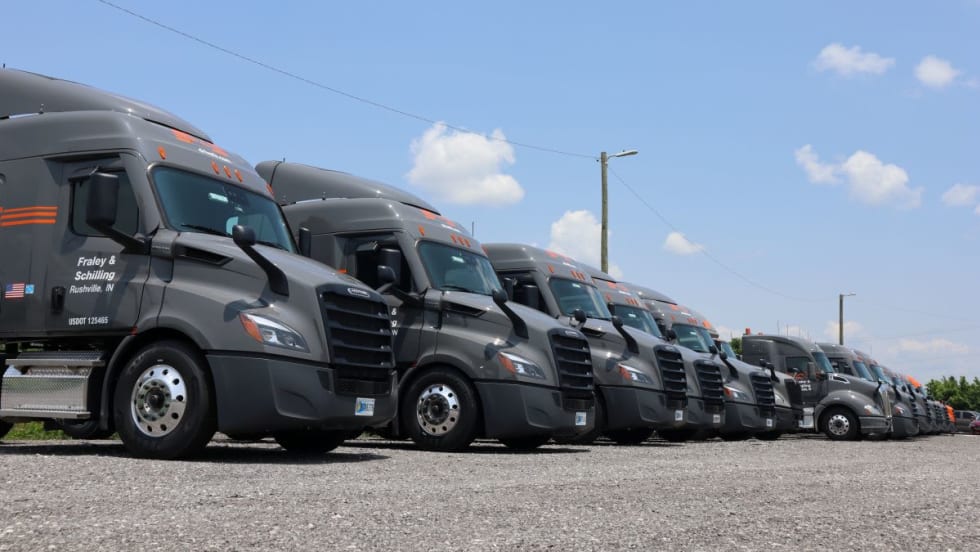
How Fraley & Schilling Improved Logbook Compliance by Over 50%
Fraley & Schilling needed a way to close a compliance workflow gap in its ELD system without adding more work from driver training, reminders, and back-office follow-ups. It found the answer in a custom driver app.
Read More →