




Peace Bridge War Threatens to Ruin Border Improvements
The New York State Legislature has moved to dissolve the bi-national Peace Bridge Authority, a move that the Ontario Trucking Association is saying will stall progress on key infrastructure improvements at the border crossing.
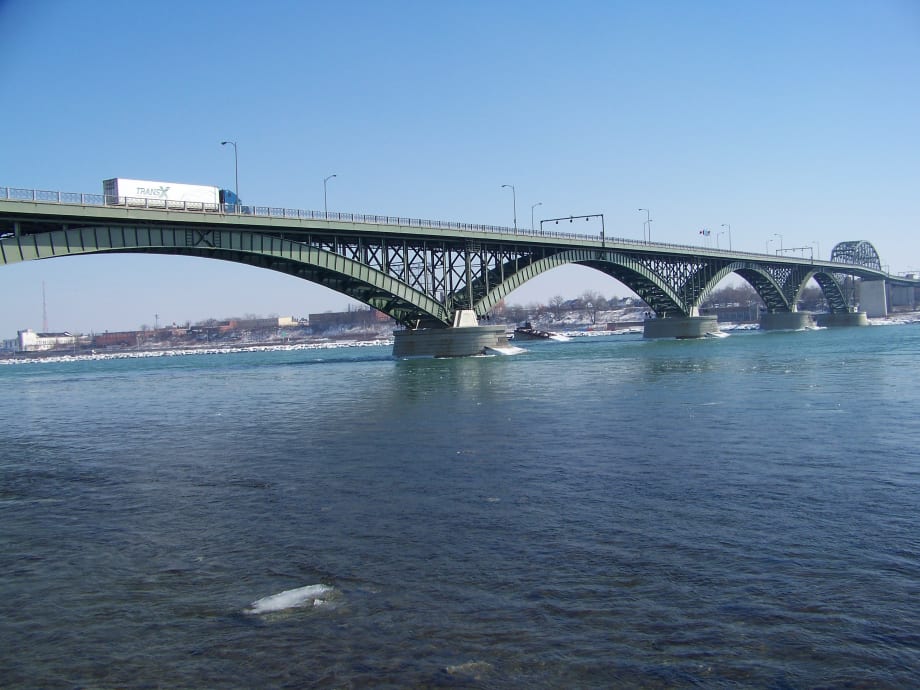
A New York proposal to dissolve the Peace Bridge Authority leaves any planned infrastructure improvements at Canada's second largest border is up in the air. (Photo by Óðinn via Wikimedia Commons)
A New York proposal to dissolve the Peace Bridge Authority leaves any planned infrastructure improvements at Canada's second largest border is up in the air. (Photo by Óðinn via Wikimedia Commons)
The New York State Legislature has moved to dissolve the bi-national Peace Bridge Authority, a move that the Ontario Trucking Association is saying will stall progress on key infrastructure improvements at the border crossing.
”Did anyone tell these people the War of 1812 is over?," OTA President David Bradley asks.
As Today's Trucking reports, the Peace Bridge Authority, which consists of five Canadian and five American members, has had its share of internal conflicts that have recently spilled over into the public sphere.
Blame Game
According to various media reports, the last few months have seen New York politicians accusing Canadian PBA members of stalling progress towards the building of a new plaza on the U.S. side.
"That progress is in jeopardy due to lack of co-operation from the Canadian members of the PBA board," wrote New York's Director of State Operations Howard Glaser to Minister of Transport, Infrastructure and Communities Denis Lebel.
Transport Canada's assistant deputy minister Scott Streiner responded to Glasner in a letter, saying that it wasn't Canadian PBA members obstructing progress but rather "a lengthy environmental assessment process that was managed by the Federal Highway Administration and terminated by the State of New York after approximately 10 years. " Streiner added that it was Canada's understanding that the PBA had no authority to purchase lands or undertake other related projects until that assessment was completed. These are issues that had "nothing to do with Canadian law or Canadian representation on the PBA."
Steiner goes on to write that the introduction of the bill to dissolve the PBA has created a "climate of doubt" that will only serve "as a distraction and compromise the ability to move ahead on the approved capital projects."
The bill passed the legislature 92-49, and a whooping 61-0 in the Senate. All that remains is for New York Governor Andrew Cuomo to sign the bill into law.
Payback's a Congested Border
According to the Niagara Falls Review, paraphrasing the board's chairman Anthony Annunziata, "the authority would remain until 2020, but effective July 2014 wouldn't have the ability to manage the long-term affairs of the Peace Bridge as it would have to sell off around $38 million worth of bonds."
The OTA noted that "in 2012 the Peace Bridge Authority’s board approved a $50 million capital plan to improve the U.S. plaza that includes a new customs commercial building, the widening of approach lanes and improved access to I-190. Dissolution of the Peace Bridge Authority would force the pay-back of any outstanding bonds and would eliminate the funding needed to move forward with projects important to alleviating congestion and improving customs clearance processes."
However, there's speculation that New York cannot unilaterally and legally dissolve the 90-year old Canada-U.S. partnership. "Canada's view is that significant amendments to the governance of the PBA cannot be made without the consent of both federal governments," wrote Steiner in his response to Glaser.
But as it stands now, any planned infrastructure improvements at Canada's second largest border is up in the air.
“Dissolving the Peace Bridge Authority seems to be an extreme way of resolving differences,” summed up Bradley.
More Drivers

Platform Science Adds Dispatch and Safety Tools
Four additions to PS Fleet help fleets monitor loads, manage driver coaching, share truck locations and adjust video system settings.
Read More →
When Language Stops the Truck: The Return of ELP Out-of-Service Orders
English language proficiency rules for commercial drivers aren’t new, but renewed out-of-service enforcement has raised the stakes. Here’s what carriers need to know before a driver reaches a roadside inspection.
Read More →
Samsara Launches Custom AI Agent Builder
Agent Studio lets fleets create AI tools for hours-of-service monitoring, reporting and driver support, including agents that communicate by phone.
Read More →
Trucker Path Expands Reserved Parking Network
Trucker Path has added close to 6,000 more truck parking spaces to its Trucker Path Reserved Parking Network with the addition of Safe Truck Parking.
Read More →
EEOC Sues Texas Trucking Company Over Driver Age Limits
The agency says Trancasa USA rejected applicants over 65 and applied tougher driving-record standards to those over 60.
Read More →
Nussbaum, Roehl Announce Second Driver Pay Increase This Year
This year has seen a swath of major truck driver pay increases as freight capacity has tightened.
Read More →
From One Generation to the Next: How Mentorship Builds Safer Truck Drivers
After three decades in trucking, Harold Perry shares what he's learned about driver safety, mentorship, and helping the next generation build confidence behind the wheel.
Read More →
Truck Drivers Need More Than Another Alert
Fleets have more visibility into truck health, safety events, and driver activity than ever. The next challenge is turning all that information into useful guidance for the person who has to decide what to do next.
Read More →
FMCSA Removes 110 Truck Driver Training Schools from Certified ELDT List
Federal regulators also are targeting more than 160 additional training providers and launching a nationwide audit of third-party CDL skills testers as part of a broader crackdown on trucking fraud.
Read More →
Hours of Service Pilot Programs: FMCSA Readies for 2027 Rollout
Two pilot programs could eventually reshape hours-of-service rules, giving truck drivers options to pause their 14-hour clock or use longer split sleeper rest periods.
Read More →