




New Jersey Requiring Face Masks
Effective April 10, New Jersey is requiring workers and customers to wear cloth face covering while on the premises of the essential retail businesses, warehouses, and construction sites that are still allowed to be open during the COVID-19 pandemic.
April 10, 2020


The CDC offers online instructions for sewing cloth masks, as well as no-sew options.
Image: CDC
3 min to read
Effective April 10, New Jersey is requiring workers and customers to wear cloth face covering while on the premises of the essential retail businesses, warehouses, and construction sites that are still allowed to be open during the COVID-19 pandemic.
Gov. Philip Murphy's Executive Order #122, issued April 8, implemented a number of measures to limit the spread of the virus at essential businesses, including occupancy and social distancing measures, among others. The order also requires non-essential construction projects to cease and put in place restrictions for essential projects.
The order states that “businesses must provide, at their expense, such face coverings and gloves for their employees. If a customer refuses to wear a cloth face covering for non-medical reasons and if such covering cannot be provided to the individual by the business at the point of entry, then the business must decline entry to the individual.”

Cloth face coverings should fit snugly but comfortably against the side of the face.
Image: CDC
A New Jersey Motor Truck Association notice says most facilities will provide the driver with a face mask, if they don't have one.
“We had heard that a few drivers were turned away from making a delivery due to the lack of a face mask. We have not been able to confirm an actual incident. We have confirmed that several major grocery companies will provide the driver with a mask, if needed.”
The association said it has advised the DOT commissioner that the industry has had a difficult time securing the proper equipment and hopes that it doesn't cause a problem for the supply chain.
“If you have not been able to secure face masks for your drivers, a cloth mask, scarf or other material covering their nose and mouth will be acceptable,” says the association.
Guidance on Cloth Face Coverings
The governor’s order calls for cloth face coverings, but it also says workers or customers may wear surgical-grade masks or other more protective face covering “if the individual is already in possession of such equipment, or if the business is otherwise required to provide such worker with more protective equipment due to the nature of the work involved.”
The Centers for Disease Control and Prevention, in its latest guidance regarding face masks, advises the use of cloth face coverings – not the surgical masks or N95 masks needed by medical workers. It notes that these can be fashioned from household items or made at home from common materials at low cost.
CDC recommends wearing cloth face coverings in public settings where other social distancing measures are difficult to maintain, such as grocery stores and pharmacies, especially in areas of “significant community-based transmission.”
Recent studies, the CDC explains, show that a significant portion of individuals with the novel coronavirus have no symptoms, and that those who eventually develop symptoms can transmit the virus to others before showing symptoms, the guidance explains. This means that the virus can spread between people interacting in close proximity—for example, speaking, coughing, or sneezing—even if those people are not exhibiting symptoms.
The CDC also emphasizes that even with masks, maintaining 6-feet social distancing remains important to slowing the spread of the virus.
More Safety & Compliance

FMCSA Pauses Biennial-Update Enforcement Amid Motus Transition
Carriers whose updates were due on or after June 1 have more time, while FMCSA works to stabilize its new registration system and warns of phishing sites impersonating its new carrier registration system, Motus.
Read More →
ZF Expands Commercial Vehicle Push in North America
ZF is expanding its North American commercial-vehicle presence with new transmission applications, electrification, trailer technology and autonomous-driving systems.
Read More →
Truck Drivers Need More Than Another Alert
Fleets have more visibility into truck health, safety events, and driver activity than ever. The next challenge is turning all that information into useful guidance for the person who has to decide what to do next.
Read More →
Tesla Wants a Self-Driving Semi. Are Cameras Enough?
Could Tesla’s camera-only autonomous driving technology work on an 80,000-pound Semi? In this commentary, HDT's Deborah Lockridge takes a look at Tesla, Cybercab, and how autonomous trucks see the road.
Read More →
What DOT’s Automated Vehicle Strategy Means for Trucking
The U.S. Department of Transportation issued a new automated-vehicle strategy that outlines plans for driverless-truck regulations, cross-state freight corridors, and federal safety standards.
Read More →
NYC Expands Speed, Pedestrian Safety Tech Across Fleet
New York City is expanding intelligent speed assistance and pedestrian-alert systems across its municipal fleet, moving the technologies from pilot programs into vehicle procurement and retrofit requirements.
Read More →
FMCSA Removes 110 Truck Driver Training Schools from Certified ELDT List
Federal regulators also are targeting more than 160 additional training providers and launching a nationwide audit of third-party CDL skills testers as part of a broader crackdown on trucking fraud.
Read More →
Beyond DOT Compliance: What Makes a Trucking Fleet Truly Safe?
A trucking fleet can follow every rule and still make unsafe decisions. The real test comes when safety conflicts with freight, productivity, or cost.
Read More →
Hours of Service Pilot Programs: FMCSA Readies for 2027 Rollout
Two pilot programs could eventually reshape hours-of-service rules, giving truck drivers options to pause their 14-hour clock or use longer split sleeper rest periods.
Read More →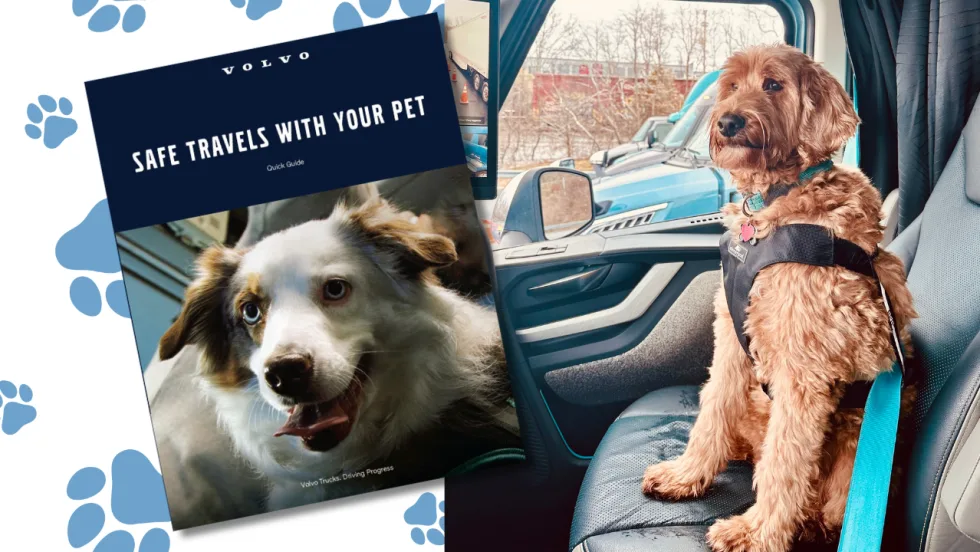
New Guide Offers Pet Safety Tips for Truck Drivers
Hundreds of thousands of pets travel in truck cabs. A new safety guide from Volvo Trucks and the Center for Pet Safety offers practical advice for truck drivers who bring dogs and cats along for the ride.
Read More →