




Natural Gas for Trucking Building Momentum
Sales of trucks powered by natural gas will grow faster than the rest of the North American Market over the next several years, according to Frost & Sullivan, an industry analysis firm. A new report predicts that North American sales of Class 6-8 LNG and CNG vehicles will rise to nearly 30,000 by 2017. That's up from just 1,950 last year, slightly less than 1% of North American sales
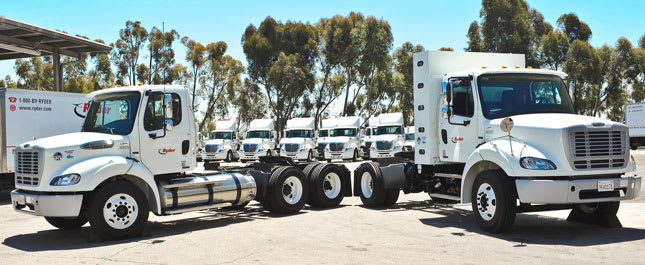
Ryder is making 202 natural gas vehicles available for lease or rent in Southern California with the help of a public/private partnership.
Sales of trucks powered by natural gas will grow faster than the rest of the North American Market over the next several years, according to Frost & Sullivan, an industry analysis firm.
A new report predicts that North American sales of Class 6-8 LNG and CNG vehicles will rise to nearly 30,000 by 2017. That's up from just 1,950 last year, slightly less than 1% of North American sales.
The researchers estimated that the total truck market will grow from 226,400 vehicles last year to 371,700 in 2017, and by that point nearly 8% of sales will be powered by some form of natural gas.
One of the stumbling blocks to fleets using natural gas is the higher up-front cost. The Frost & Sullivan report said while a basic Class 8 diesel tractor costs $100,000 to $150,000, but natural gas engines add $28,000 to $72,500, depending on the type of natural gas ignition technology used.
In some areas, government programs are helping out. For instance, the Ryder/San Bernardino Associated Governments (SANBAG) Natural Gas Vehicle project has allowed the company to secure lease agreements for 90 natural-gas trucks in its Southern California fleet.
The Ryder/SANBAG project is part of a joint public/private partnership between the U.S. Department of Energy, the California Energy Commission, San Bernardino Associated Governments, Southern California Association of Governments, and Ryder.
The $38.7 million project includes:
* 202 natural gas vehicles available for lease or rent
* three strategically located natural gas compliance maintenance shops in Rancho Dominguez, Orange and Fontana
* two fueling stations.
Even without government subsidies, analysts at Frost & Sullivan said fleets can get their money's worth as long as natural gas prices are $1.50 less per gallon-equivalent than diesel fuel. The researchers said most fleets they have studied pay $1.65 to $1.80 per natural gas gallon equivalent, significantly lower than the $4 a gallon diesel is running at the pump these days.
The other main limitation to broader natural gas adoption is the absence of a broad-based fueling infrastructure, which makes the vehicles more suited to certain types of trucking, such as refuse fleets, drayage operations at ports, regional fleets, private fleets and dedicated contract carriage. Right now, the area of California to Texas is most densely developed as far as natural gas fueling infrastructure is concerned, and is still growing.
In recent months, major energy companies have announced big investments to push further natural gas infrastructure.
Chesapeake Energy, the country's second-largest producer of natural gas, is creating a $1 billion venture capital fund, Chesapeake NG Ventures Corp. The fund will identify and invest in companies and technologies that make it easier to move from imported oil to domestic natural gas resources. The company's redirecting about 1-2% of its annual drilling budget to the effort.
Over the next 10 years, the company anticipates committing at least $1 billion to natural gas vehicle initiatives. One of its first investments is $150 million in Clean Energy Fuel to accelerate its build-out of LNG fueling infrastructure along U.S. interstates.
Last week, Shell and Westport Innovations announced they've teamed up to encourage transportation companies to switch over to natural gas and develop standards for its use.
The two will launch a co-marketing program in North America aimed at giving customers a better economic case when buying and operating liquefied natural gas-powered vehicles.
As soon as next year, Shell will make LNG available to some heavy-duty fleet customers at truckstops in Alberta, Canada's energy hub. Shell wants to produce LNG by 2013 at its Jumping Pound gas-processing facility in the foothills of Alberta.
"We really see this as the starting gun for the whole industry," Westport CEO David Demers said on CNBC's "Mad Money."
Read more about fleets using natural gas in the October issue of HDT.
More Drivers

Platform Science Adds Dispatch and Safety Tools
Four additions to PS Fleet help fleets monitor loads, manage driver coaching, share truck locations and adjust video system settings.
Read More →
When Language Stops the Truck: The Return of ELP Out-of-Service Orders
English language proficiency rules for commercial drivers aren’t new, but renewed out-of-service enforcement has raised the stakes. Here’s what carriers need to know before a driver reaches a roadside inspection.
Read More →
Samsara Launches Custom AI Agent Builder
Agent Studio lets fleets create AI tools for hours-of-service monitoring, reporting and driver support, including agents that communicate by phone.
Read More →
Trucker Path Expands Reserved Parking Network
Trucker Path has added close to 6,000 more truck parking spaces to its Trucker Path Reserved Parking Network with the addition of Safe Truck Parking.
Read More →
EEOC Sues Texas Trucking Company Over Driver Age Limits
The agency says Trancasa USA rejected applicants over 65 and applied tougher driving-record standards to those over 60.
Read More →
Nussbaum, Roehl Announce Second Driver Pay Increase This Year
This year has seen a swath of major truck driver pay increases as freight capacity has tightened.
Read More →
From One Generation to the Next: How Mentorship Builds Safer Truck Drivers
After three decades in trucking, Harold Perry shares what he's learned about driver safety, mentorship, and helping the next generation build confidence behind the wheel.
Read More →
Truck Drivers Need More Than Another Alert
Fleets have more visibility into truck health, safety events, and driver activity than ever. The next challenge is turning all that information into useful guidance for the person who has to decide what to do next.
Read More →
FMCSA Removes 110 Truck Driver Training Schools from Certified ELDT List
Federal regulators also are targeting more than 160 additional training providers and launching a nationwide audit of third-party CDL skills testers as part of a broader crackdown on trucking fraud.
Read More →
Hours of Service Pilot Programs: FMCSA Readies for 2027 Rollout
Two pilot programs could eventually reshape hours-of-service rules, giving truck drivers options to pause their 14-hour clock or use longer split sleeper rest periods.
Read More →